
We are excited to launch Income+ Max, a multi-asset income strategy thoughtfully curated by Syfe using Active ETFs issued by some of the largest asset managers, designed to deliver consistently high income with growth potential through changing and volatile market environments.
Income+ Max, offering a target payout range between 8%-10% p.a.,has been created to address the biggest challenges to income investing today: falling interest rates and dividend yields, compounded by intense volatility.
Compared with conventional income strategies, Income+ Max has a larger proportion of equities, while enabling income generation through option strategies. This enriches our existing Income range (Income+ Pure and Income+ Enhance), which are more conservative and focus primarily on fixed income opportunities.
Why Income+ Max? Confronting the Challenge of Our Times
Income+ Max addresses three key challenges facing investors in 2026:
Interest rates: Income is hard-earned in today’s market. As inflation eases, central banks around the world are cutting interest rates to shore up economic growth. Whereas investors could easily earn 4% to 5% “risk-free” rate for cash parked at the bank a few years back, getting the same passive income would require taking on a lot more risk.
Equity concentration: Gains in equities are becoming harder to keep, too. The thumping rally has caused extreme concentration in the stock market. According to estimates by JPMorgan Asset Management in January 2026, 42 stocks related to generative AI have been responsible for 65% to 75% of the S&P 500’s total return, profits, and capital spending since ChatGPT’s launch in 2022. The pace of US tech earnings growth, while still positive, slowed meaningfully in 2025 as investors stepped up scrutiny on the sustainability of AI spending. Concentration risk was exposed in 2025, while globally diversified portfolios proved more resilient. Few investors will manage the sort of eye-popping annualised returns, often at over 20%, we saw in the last few years.
Volatility: When the margins of error are this thin, the risk of volatility is elevated. Overlay this with geopolitical shocks, which have become commonplace in the 2020s, and we are looking at an uncertain environment that is conducive to large swings and extreme outcomes, and adverse to the stability in income and growth that investors have come to rely on.
About Income+ Max: A New Formula for Income and Growth
Underpinning Income+ Max is our conviction that diversification, in the current market environment, is a driver of returns.
Diversification: Income+ Max presents a break from the traditional “60/40” (60% equities, 40% bonds) model portfolio, the “safety” appeal of which has been challenged by the extreme concentration in the equity market. A “60/40” portfolio launched in late 2022 would have drifted to something more akin to a 70/30 portfolio by early 2026.
Instead, our strategy will maintain 55% exposure to equity securities, 35% fixed income, and 10% gold. As we argued in our 2026 outlook, diversification is no longer a nice-to-have, but a key driver of performance as market leadership broadens and investors spread their risk across global markets and various asset classes.
Equities: The equity component focuses on high-quality companies with strong fundamentals and lower volatility than the broader market. Our strategy and deep research identify ETFs covering a broad universe of equities listed globally, identifying and capturing assets with solid fundamentals as well as those with strong income attributes.
Fixed Income: The 35% bond allocation is a more conventional fixed income play, comprising a range of interest-bearing instruments. Unlike the equity portion, this part of the portfolio thrives on low volatility, managed with a short to medium duration profile, meaning it is relatively less sensitive to interest rate fluctuations that can weigh on the performance of long-dated bond funds. The key is credit as well as emerging market selection, which, again, is underwritten by JPMorgan’s research prowess.
Gold: A structural 10% allocation to gold serves as the portfolio’s key diversification and growth driver. Last year, precious metals produced standout returns, and we expect further gains from gold in 2026. As more investors seek safety from volatility and concentration risks in US assets, and central banks and retail buying continue, gold’s safe haven appeal is undented.
Investment Process: Turning Volatility Into a Source of Consistent Income
Unlike traditional “growth and income” active funds, this strategy is designed to capture yield from four distinct sources: (i) equity dividends, (ii) equity option premiums, (iii) bond coupons, and (iv) gold option premiums.
What makes the strategy distinct is the use of options by the underlying ETFs. Selling out-of-money covered call options on stocks or indices is expected to generate more income from the equity portion of the strategy than dividends.
Simply explained, options are agreements that let you choose whether to buy or sell a stock at a fixed price within a set period of time. “Call” options give you the right to buy at a certain price. A covered call is a strategy where you sell a call option on shares you currently hold. You can learn more about options here.
The ETFs within Income+ Max are essentially paid an upfront cash fee (“premium”) by another investor who is betting on a sizable, near-term rally in the shares.The strategy gets to keep 100% of that cash premium if the stocks appreciate mildly, stay flat, or even fall. Some of the ETFs set the options’ strike price higher than the current prices to allow for higher potential capital growth, while still capturing the premium income.
This strategy is designed to thrive on volatility. Because options are essentially bets on uncertainty – protection against outsized swings in the underlying asset – options premiums paid to Income+ Max (and ultimately to its investors) become more valuable in volatile markets. Market shocks, which typically adversely affect actively managed long-only equity income funds, should be a source of strength for Income+ Max and its investors.
The gold block is built in partnership with First Trust Advisors L.P.. Gold’s greatest drawback for income investors has always been its lack of cash flow. To solve this problem, Income+ Max is using a “covered call” strategy on gold, similar to the enhancement in the equity portion. This allows the strategy to create income where there was none, transforming a non-interest-bearing asset into a steady stream of capital. Volatile geopolitics could also help bulk up the premium income for the strategy.
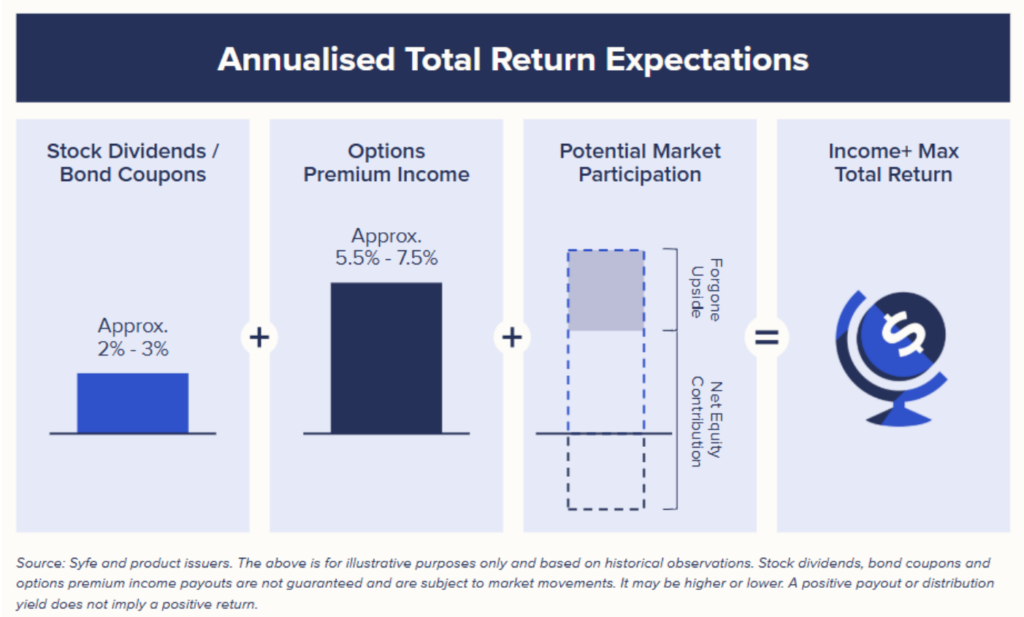
Income+ Max is managed by Syfe’s experienced investment team, and constructed with “active ETF” building blocks from J.P. Morgan Asset Management (JPMAM), the world’s largest active ETF provider, and ETF solutions experts REX Advisors LLC and First Trust Advisors L.P..
Traditional actively managed equity funds often charge annual fees of 1% to 1.5%, which can significantly erode long-term returns. Using actively managed ETFs as building blocks allows investors to access institutional-grade security selection at a much lower cost, in addition to better liquidity and transparency. This has fueled rapid growth in active ETFs, making them a compelling modern choice over traditional active mutual funds for many portfolios.
In Numbers: Performance, Volatility, and Composition
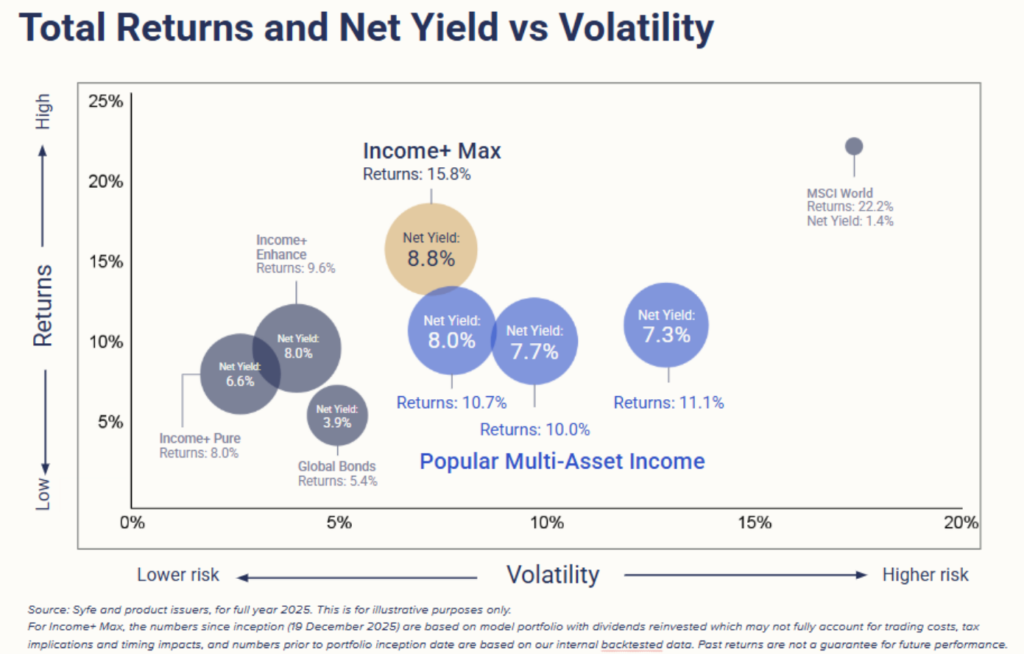
While past performance is not an indicator of future performance, the backtested performance of Income+ Max historically demonstrated resilience during periods of market volatility.
The chart below shows the strategy’s superior returns (15.8%) compared to Income+ Pure (8.0%), Income+ Enhance (9.6%), and global bonds (5.4%) in 2025, with about only two percentage points more in volatility. MSCI World, which represents developed markets equities, delivered a higher return at 22.2%, but that came with more than double the annualised volatility.
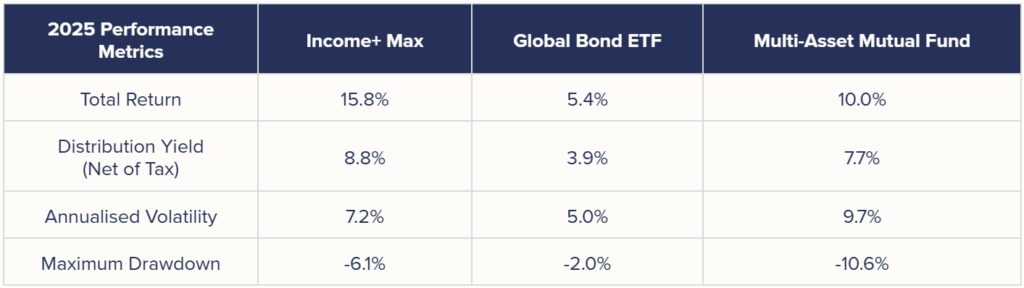
Likewise, we believe Income+ Max is also more optimal in risk and reward than the comparables available in the Hong Kong market. Income+ Max would have produced superior returns (15.8%) in 2025 with reduced volatility, compared to one of the largest HK multi-asset mutual funds (10%), with similar distribution yield.
This would have also been delivered with lower volatility, measured by the deviation in returns from historical averages, and a smaller maximum drawdown than the multi-asset mutual fund.
Sector-level exposure of this strategy is more diverse than major indices, in line with Syfe’s conviction that market leadership is broadening. For example, tech exposure in this strategy is contained at just above 20%, compared to 36% in the S&P 500, mitigating concentration risks.
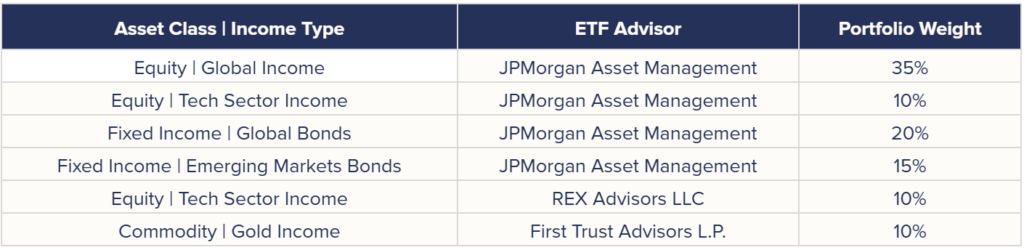
80% of the strategy is built with JPM’s highly-regarded active ETFs, with the remainder – the gold diversifier layer and technology sector layer – coming from the other providers. All of these building blocks are liquid instruments. This makes speedy rebalancing, when needed, possible.
Composition Snapshot
Summary: Reliable Income, Reasonably Priced
Income+ Max represents an innovative approach to income investing. By embracing market volatility as a source of yield and utilising gold as a returns driver, the strategy balances the need for defence in uncertain times while capturing the opportunities in a broadening market.
By relying on systems and innovations, instead of human judgment, the ETFs within the portfolio carry an average competitive management fee of just 0.44% p.a.. This is a fraction of the cost of traditional “growth and income” active funds. Managed solely at the discretion of portfolio managers, those funds typically charge between 1% to 1.5%.
By providing active returns at the cost of passive index-tracking strategies, we ensure that a much larger portion of the generated income stays in your account, compounding your wealth more effectively over time. This is the smart solution, built for investors who seek stability in these uncertain times – and we are delighted to present it to our valued clients at Syfe.
Target Monthly Payout
Income+ portfolio is built with an objective to achieve a Target monthly payout range, in current market environment. Target monthly payout is not guaranteed, and is subject to market movements. Past distributions are not necessarily indicative of future trends, which may be lower. A positive monthly payout or distribution yield does not imply a positive return. Investment involves risks.
In some cases, monthly payouts may be made from the income or capital of the funds in your portfolio, which is decided by the constituent fund managers. The funds may also charge some of their management fees to the capital, which can increase the available income for dividends. This could lead to paying dividends out of capital and may result in an immediate reduction of the fund’s net asset value.
For more detailed information about income statistics, please visit fund manager websites:
JP Morgan Asset Management: https://am.jpmorgan.com/us/en/asset-management/adv/, https://am.jpmorgan.com/gb/en/asset-management/adv/
REX Advisors LLC: https://hanetf.com/rex-etfs/
First Trust Advisors L.P.: https://www.ftportfolios.com/index.aspx
Risk Disclosures
Investment involves risks including possible loss of the principal amount invested. The portfolio and/or the constituent funds in the portfolio may not achieve their investment objectives. Any past performance, projection, forecast or simulation of results is not necessarily indicative of the future or likely performance of any investment. Investors should consider the investment objectives, risks, charges and expenses carefully before investing.
Some of the risks within the constituent funds include market risk (potential losses from market-wide changes), liquidity risk (difficulty selling an asset), interest rate risk (changes in interest rates affecting the market value), credit risk (risk of default on a debt or default of an exchange), and fund management risk (the chance that the constituent fund managers’ investment strategies do not work as planned).
Some of the constituent funds may also use derivatives. Transactions in options (and derivatives generally) also carry a high degree of risk. Selling (“writing” or “granting”) an option generally entails considerably greater risk than purchasing options. Although the premium received by the seller is fixed, the seller may sustain a loss well in excess of that amount. The seller will also be exposed to the risk of the purchaser exercising the option and the seller will be obliged either to settle the option in cash or to acquire or deliver the underlying investment. If the option is “covered” by the seller holding a corresponding position in the underlying investment or a future on another option, the risk may be reduced. You should understand the risks associated and be willing to assume the risks before making any investment decision.
The information in this website is for information only. The information and opinions contained in this publication has been obtained from sources believed to be reliable at the time of writing, but Syfe makes no representation or warranty as to its adequacy, completeness, accuracy or timeliness for any particular purpose. Opinions and estimates are subject to change without notice. Syfe does not provide legal, tax or accounting advice.
There is no assurance that the credit ratings of any securities mentioned in this publication will remain in effect for any given period of time or that such ratings will not be revised, suspended or withdrawn in the future if, in the relevant credit rating agency’s judgment, the circumstances so warrant. The value of any product and any income accruing to such a product may rise as well as fall.
Information on this website is not and should not be construed as an offer to sell, or a solicitation of an offer to buy any security, investment product or service, nor a distribution of information for any such purpose.