New to options? This beginner-friendly guide explains what options are, how they work, why investors use them, and how Singaporeans can place their first options trade with confidence.
If you’ve been investing in Singapore over the past few years, you’ve probably noticed more conversations about options trading. What used to feel niche or “too advanced” for everyday investors has now become increasingly mainstream, thanks to simpler trading platforms, rising market volatility, and investors seeking more flexible tools to protect or grow their portfolios.
Yet the concept of options can still feel intimidating, especially when you’re just starting out. What exactly are options? How are they different from stocks? Are they risky? And how does a beginner in Singapore even place an options trade?
This guide demystifies options trading in a clear, practical, and beginner-friendly way. Whether you’re exploring options to amplify potential returns, protect your portfolio, or generate additional income, this article gives you the foundation needed to get started.
What Are Options?
Options are agreements that let you choose whether to buy or sell a stock at a fixed price within a set period of time. You are not required to go through with the trade if you don’t want to.
This is different from buying stocks, where you actually own part of a company. With options, you don’t own the stock—you only own the right to decide whether to buy or sell it under certain conditions.
There are two basic types of options:
- Call options, which give you the right to buy at a certain price
- Put options, which give you the right to sell at a certain price
These simple building blocks form the foundation of all options strategies.
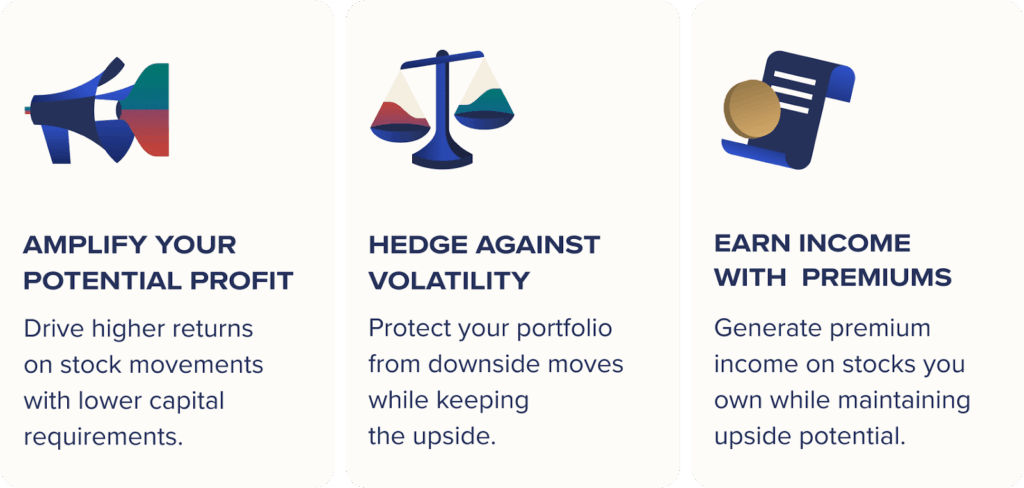
Where things get often misunderstood is how these rights can be used. Options can help investors amplify potential returns, hedge against volatility and earn income with premiums. In other words, they’re versatile tools that can fit very different risk profiles depending on how you use them.
Why Singapore Investors Are Paying More Attention to Options
The demand for options in Singapore has risen for several reasons.
- Global stock markets have become increasingly volatile.
Events like inflation shocks, interest-rate changes, geopolitical tensions, and surprise earnings announcements have pushed investors to look for tools that offer protection or better risk-adjusted returns.
- Commissions and platform fees have become more transparent.
What used to be expensive and complicated can now be executed at lower cost and with better tools, from visualised profit/loss charts to real-time data.
- Singapore investors often have concentrated portfolios
Singaporean portfolios are typically heavy on blue-chip Singapore stocks, REITs, or a few US tech names. Options offer a way to hedge these positions or generate additional income without selling the stocks themselves.
- Options provide access to strategic exposure
Options traders don’t need large amounts of capital to get started. Buying Apple or Tesla stock outright can be costly, but buying an option that gives you exposure to price movements requires significantly less upfront capital.
Key Terminology Every Beginner Should Know
Before placing your first trade, you need to understand a few essential terms that define how options work.
Strike Price
The fixed price at which you can buy (call) or sell (put) the underlying asset.
Premium
The cost of buying the option. It’s paid upfront, and it represents your maximum possible loss when you buy options.
Expiration Date
Every option has a lifespan. Once the expiry date passes, the option becomes invalid.
In the Money / At the Money / Out of the Money
When people talk about an option being “in the money”, “at the money”, or “out of the money”, they’re answering one simple question: If this option expired right now, would it be worth anything?
These terms refer to whether an option has intrinsic value (the favourable difference between the stock price and the strike price).
Consider this example:
The stock price is $110 and the strike price is $100.
If you bought a call option
- You have the right to buy the stock at $100, while the market price is $110.
- Which means your contract is valuable
- Therefore, you are in the money
If you bought a put option
- You have the right to sell the stock at $100,
- But because the stock is valued at $110 now, you wouldn’t want to sell it.
- Which means you wouldn’t exercise it if it expired right now
- Therefore, you are out of the money
When the stock price is very close to the strike price, the option is called at the money.
Contract Size
Most options contracts represent 100 shares. This means a premium of US$1.00 is actually US$100 in cost.
Implied Volatility (IV)
A measure of how much the market expects the stock to move. Higher IV generally means more expensive options premiums.
Understanding strike, premium, expiry, and basic pricing behaviour is enough to begin trading.
How Options Differ from Stocks
Options have characteristics that make them fundamentally different from traditional equity investing.
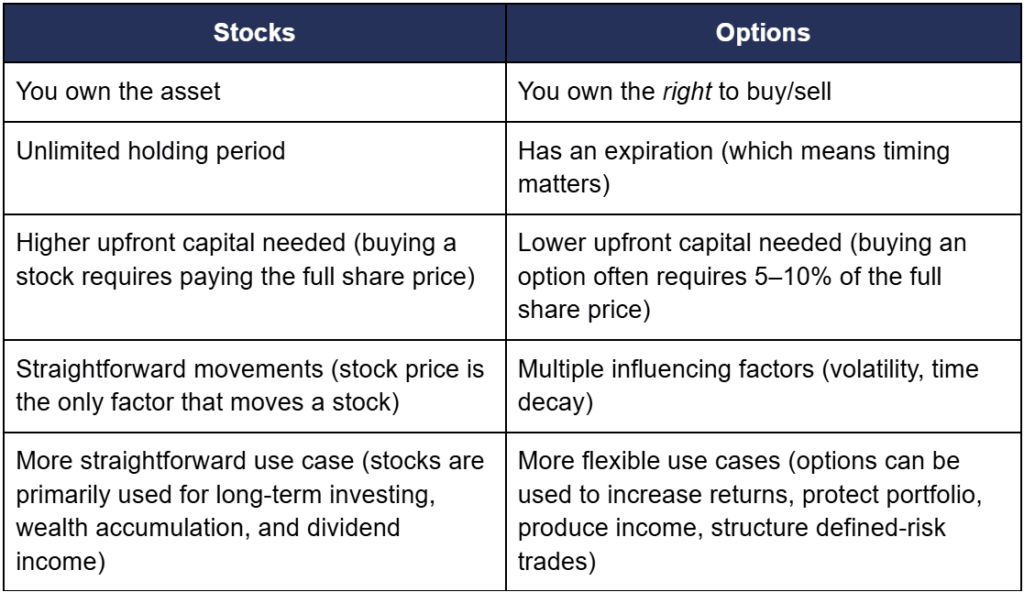
Because options require less upfront capital, they offer greater exposure with less capital.
Step-by-Step Guide to Placing Your First Options Trade in Singapore
Now let’s walk through a beginner-friendly roadmap.
1. Define Your Objective
Are you aiming to:
- profit from a price movement?
- protect existing holdings?
- generate income?
Your goal determines your strategy.
2. Choose Your Strategy
For total beginners, the safest strategies are:
- buying calls (bullish)
- buying puts (bearish or protective)
These have limited risk (the premium) and clear outcomes.
3. Choose Your Stock or ETF
Pick something familiar, an index ETF or a large-cap company. Avoid volatile “hype stocks” until you gain experience.
4. Pick Strike & Expiry
A good rule of thumb:
- expiry: 30–60 days
- strike: near the current price if you want higher probability that the option finishes profitably
5. Place a Limit Order
Limit orders allow you to control the maximum premium paid.
6. Actively Manage the Trade
Options require more active management than stocks. You can take profits early, cut losses, manually roll to a new expiry, and let it expire. Over time, you’ll gain comfort in recognising price patterns and volatility changes.
Common Mistakes Beginners Should Avoid
Even smart investors make these errors early on:
- Trading options that are too far out of the money
Cheap doesn’t mean good value. - Choosing expiries that are too short
Time decay accelerates close to expiry. - Overtrading because options seem “cheap”
Always size your trades based on risk, not premium. - Ignoring fees and bid-ask spreads
Small gaps can erode profitability. - Not having an exit plan
Options reward clarity, especially on risk limits.
Avoiding these mistakes can dramatically improve your experience.
Should Beginners Trade Options?
Options aren’t inherently risky. They’re powerful tools, but like any tool, they must be used with knowledge and discipline. Once you understand how they work, you’ll find they provide strategic flexibility beyond traditional stock investing.
For Singapore investors navigating global markets, options offer an accessible way to:
- gain exposure with smaller capital outlay
- hedge and protect long-term positions
- generate additional income on existing holdings
And with modern platforms reducing complexity, there’s never been a better time to learn.
Options are becoming more accessible. More platforms now provide educational explainers and transparent fees. Syfe’s unified platform focuses specifically on clarity, transparency, and accessibility, reducing much of the friction beginners face.
Discover how Syfe’s options experience can help you trade confidently, whether you’re seeking exposure, protection, or income.