


With markets on sky-high valuations and returns extremely concentrated in a few megacap companies, 2026 is set to be challenging for stock pickers and index trackers alike. New, smarter solutions are needed for those who want to stay invested.
The Choices Facing Today’s Investors
Historically, there are two major avenues for investing. Pure passive aims to “buy the market”, replicating the index performance at low cost. Traditional active managers strive to do better and “beat the market” by taking outsized, high-conviction bets, although many fall short while the cost of that ambitious goal is always passed on to end-investors.
Both have their drawbacks in the current market environment of “dispersion”, where the gap between winners and losers is getting wider, once extreme scenarios become the reality, and returns are harder-earned. Today’s investors need more than these traditional choices, created in a different era, to build a portfolio that can withstand the challenges in the coming years.
Enter “smart” strategies: time-tested solutions, engineered to outperform, that are based on disicpline and diversification. Once the preserve of large institutions, Syfe has made them accessible, affordable, and available to retail investors in Asia. This article explains what they are – and why they are particularly ideal for the times we live in.
Pure Passive: The false comfort of index hugging
For the better part of the last two decades, passive investing has worked well for everyday investors. Global markets trended up, led by the US, and retail investors got a piece of that growth via low-cost exchange-traded funds. This strategy, however, has become more challenging to execute as a new reality grips markets in 2026.
Standard index construction is backward-looking by design. Capital flows towards whatever has already succeeded. The bigger a company becomes, the larger its share of the index; the larger its share, the more passive money buys it. This self-reinforcing dynamic was benign when it distributed gains broadly.
Buying a world index tracker today is not a bet on the global economy. It is a wager on whether a few tech companies can keep defying gravity. The top 10 US stocks last year accounted for 40% of the market capitalisation, with 42 AI-related stocks driving 75% of the gains. Five hyperscalers are expected to spend close to US$650 billion this year – greater than the GDP of Singapore. Valuations are hot at 22 times, a level not seen since the dot-com bubble.
Traditional Active: The stock-picker’s challenge
If passive indexing is too rigid, traditional active management has proven too fragile. Wall Street likes to celebrate star stock pickers, from Peter Lynch to John Templeton. But almost 90% of active managers perform worse than the index. That underperformance has persisted through recent episodes of volatility and high dispersion, which theoretically should favour the skilled active managers.
Concentration risks are inherent in active strategies. The classic star manager runs a concentrated portfolio of dozens of stocks, each position a high-conviction call. This has been little help in the face of tail risks.
On the upside, a number of value-conscious managers stood aside from AI-related stocks ike Nvidia as its valuation stretched compared to historical averages, only to watch the stock break out as AI development accelerated beyond expectations. On the downside, trade and geopolitical shocks have sparked episodes of indiscriminate sell-offs in markets over the past 12 months. Traditional active portfolios, built around careful bottom-up analysis, had little structural protection against these unlikely outcomes.
Core Equity100 and Equity Alpha: Smart Strategies for a New Era
We are living in an era of surprises. A foundational growth portfolio should be broad enough to capture growth wherever it takes place. But it also needs the ability to be agile as the market experiences more frequent shocks, from geopolitics to technological disruptions.
These ostensibly contradictory demands are ideal for “smart” strategies, such as Equity Alpha and Core Equity100 on Syfe’s platform. They represent two distinct drivers of returns, both instrumental to building a long-term portfolio.
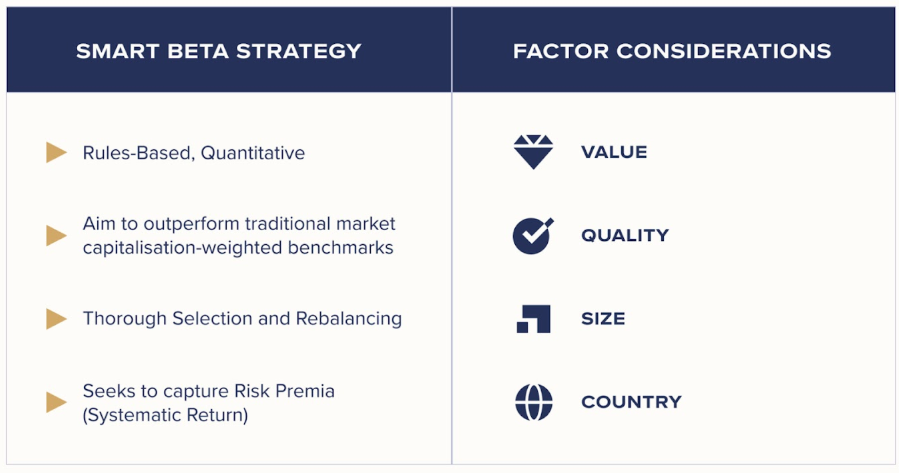
Core Equity100 is part of our Core suite and runs on transparent, rules-based “smart beta” strategies. It selects and weights groups of stocks based on proven performance “factors”, or categories that reflect the characteristics of companies. These include “value” (undervalued), “size” (nimble), and “quality” (resilient balance sheets, profitability).
Backed by academic research, factors have outperformed the benchmark in the long run. That advantage makes it ideal as a foundation building block for a long-term growth portfolio.
Equity Alpha, powered by J.P.Morgan Asset Management (JPMAM), provides another path to outperformance. The strategy leverages JPMAM’s 360 analysts covering 2,500 stocks worldwide. Their findings about companies, conveyed through a structured ratings system, then inform Equity Alpha’s overweights and underweights decisions on a large number of small, active positions. This is thoughtful stock selection, executed at scale, enabled by research – the opposite of “all or nothing” stock picking typical in traditional active.
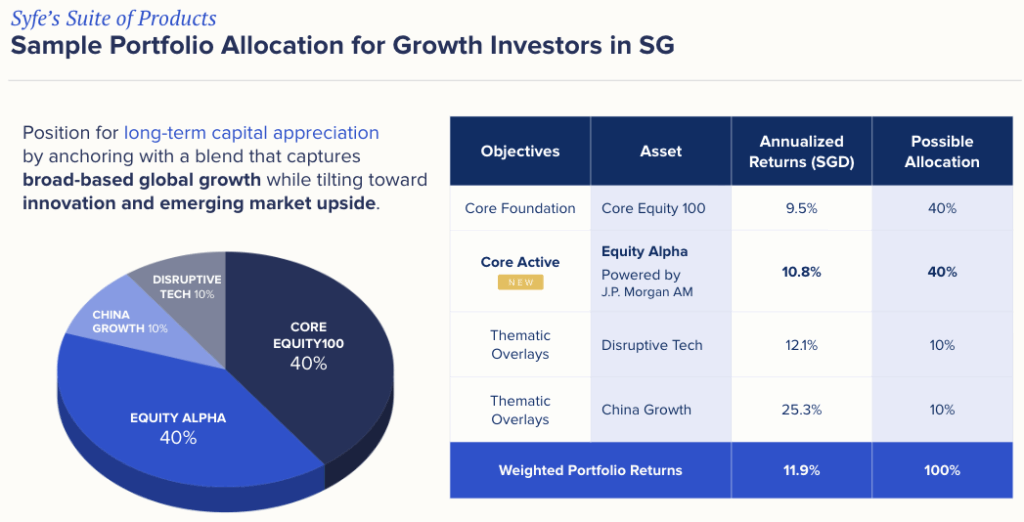
Together, these small tilts create a meaningful edge. The Equity Alpha portfolio is built with J.P. Morgan’s Research Enhanced Index (REI) active ETFs. The J.P. Morgan REI strategy has generated 10.8% annualised returns over the last eight years and outperformed over 20 years – an exceptional level of consistency that is all the more valuable in uncertain times.
The table below and the corresponding pie chart provide an example of how “smart” strategies can serve the “core” of your portfolio, while you input more “satellite” exposures to enhance performance on the periphery. Find out more about the differences between the two here – and how you can construct a portfolio that works for you with these strategies.
Institutional Investing, Made Available and Accessible
Until recently, strategies of this calibre were not available to most investors. Institutional research, execution at scale, and portfolios that adapt were the preserve of pension funds, endowments, and other large asset managers.
Through Equity Alpha and Equity100, Singapore investors can access institutional-quality portfolio management without that complexity, with all the necessary rebalancing managed by Syfe’s investment team. This ensures your allocations stay on course and aligned with your objectives as market cycles shift. In an evolving market that demands more of every portfolio decision, where alpha is increasingly hard to earn, that capability matters more than ever.
Read More:
Active, Passive, and Beyond: How to Build a Portfolio That Works for You


