


When it comes to managing your finances, it’s easy to focus on the money you’re investing and overlook the money you’re simply holding.
Perhaps you have savings sitting in a bank account, funds set aside for a big purchase, or US dollars left over from an overseas investment. Whatever the reason, cash is still part of your financial portfolio – and where you keep it can make a difference.
More than just finding the highest rates of returns for a cash management solution, it’s more crucial to understand when you’ll need your money, how much flexibility you want, and what you’re comfortable trading off for potentially better returns.
Before deciding where to put your cash, here are five questions worth asking.
1. What is this cash for, and when will I need it?
Not all cash serves the same purpose, and not all of it needs to be accessible at the same time. Before deciding where to put your money, it helps to think about what you’re keeping it for and when you might need it.
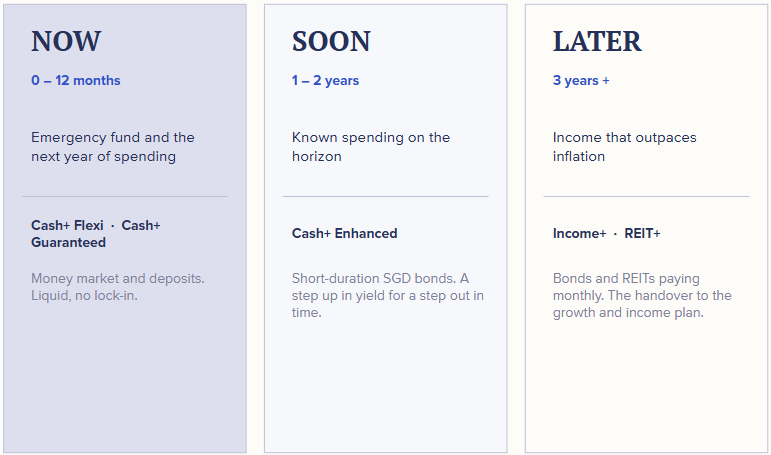
“Now” cash is for the here and now: everyday expenses, bills and emergencies. Since you may need it at short notice, keeping it readily accessible in a regular savings account or a cash management solution without a lock-in period may make more sense.
“Soon” cash is for the near future. You might be saving for a holiday, home renovation or upcoming wedding. If you have a reasonably clear timeline for when you’ll need the money, you could consider a solution with a fixed tenure, provided the maturity date aligns with your plans.
Then there’s “later” cash that you don’t expect to need for a while. Perhaps you’re building up funds for a future goal or holding money while waiting for the right investment opportunity. Depending on your timeline, you may have more flexibility to consider solutions that offer a predetermined return over an agreed period in exchange for committing your funds until maturity.
For instance, Syfe Cash+ Guaranteed offers different tenures, allowing you to select a period that better matches your financial timeline.
The key is to match your cash to its intended purpose and timeframe. Don’t lock away money you might need at short notice, or leave funds that could earn a return sitting idle. And remember, a longer tenure isn’t necessarily better just because it offers a more attractive rate. Make sure you can comfortably do without the money until maturity.
2. Should I prioritise a higher rate or greater flexibility?
It’s tempting to compare cash management solutions by looking at one number: the advertised rate.
But a higher rate doesn’t automatically mean a better fit.
Some solutions offer projected returns with greater flexibility to withdraw your money. Others offer guaranteed returns over a fixed period but require you to leave your funds invested until maturity.
These are two different propositions.
For example, a solution with no lock-in period may be more suitable if your plans could change. You retain greater flexibility, although the returns may fluctuate and are not guaranteed.
A fixed-tenure solution, meanwhile, lets you lock in a specified rate for the duration of your investment. You have greater certainty over the return, but won’t be able to access your money along the way.
Neither approach is inherently better. It comes down to how much certainty you want, how soon you might need your money, and whether you’re comfortable committing to a particular period.
3. Does the currency I’m holding matter?
This is particularly relevant if you earn, save or invest in more than one currency.
For Singapore-based investors, Singapore dollars might be the natural choice for everyday expenses and local financial commitments. But you may also hold US dollars from overseas investments, international transactions or other financial goals.
In that case, keeping some of your cash in USD could make sense if you have future USD-denominated expenses or want to maintain exposure to the currency.
However, there’s an important consideration: foreign exchange risk.
A higher USD rate may look attractive compared with an SGD rate, but the difference in returns isn’t the whole story. If the US dollar weakens against the Singapore dollar, converting your money back into SGD could reduce or even outweigh the additional returns.
For example, imagine you invest US$10,000 in a USD-denominated cash management solution. Even if you receive the expected USD returns, the final SGD value of your investment will depend on the exchange rate when you convert it.
This means USD cash management is best considered in the context of your overall currency needs, rather than simply as a way to access higher rates.
4. What does “guaranteed” actually mean?
When comparing cash management solutions, it’s important to understand not just how much you could earn, but also what is being guaranteed.
A projected return is an estimate based on prevailing market conditions and the underlying investments. It is not a promise of what you will receive.
A guaranteed return, on the other hand, gives you greater certainty over the amount you can expect to receive, subject to the product’s terms and conditions.
Take Syfe Cash+ Guaranteed USD as an example. It offers investors the opportunity to lock in a guaranteed return for a selected tenure, with rates of up to 4.6% p.a. for a 12-month tenure (rate as of 23 Nov 2026).
The portfolio invests in fixed deposits placed with MAS-regulated partner banks. Once invested, the rate is fixed for the selected tenure, with capital and returns guaranteed in USD, subject to underlying bank risk.
However, there are a few important distinctions to understand. Cash+ Guaranteed (available in SGD and USD) is a managed investment portfolio, not a bank deposit, and is not covered by SDIC deposit insurance. Funds are also locked in until the selected tenure ends. In addition, while the capital and returns are guaranteed in USD, fluctuations in the USD/SGD exchange rate may affect the value you ultimately receive in Singapore dollars.
In other words, guaranteed returns don’t mean there are no considerations or risks. Always understand what is guaranteed, in which currency, and under what conditions.
So, where should your cash go?
A useful way to approach it is to stop thinking of cash as one big pool of money. Different portions can serve different purposes, and there’s no reason they all need to be managed in the same way.
Consider what you’re saving for, when you’ll need the money, which currency you need it in and how much flexibility you’re willing to give up for potentially better returns. Then, decide what solutions you need for each pool of money.
If you have money you can comfortably set aside for a fixed period, Syfe Cash+ Guaranteed could be worth considering. With USD rates of up to 4.6% p.a. for a 12-month tenure (as of 23 Nov 2026), it offers a way to lock in a known USD return rather than leave suitable funds idle.
Ultimately, good cash management isn’t just about squeezing the highest possible return out of every dollar, but making sure your money is in the right place, doing the right job, at the right time.
Ready to put your cash to work?
Explore Syfe Cash+ and find a cash management solution that fits your financial needs.


