


Following US markets from Singapore can feel counterintuitive at first. Earnings may be released while you are finishing dinner, the official open can land close to midnight, and some of the largest price moves may happen before the opening bell. This guide to US extended trading hours is designed to make the schedule clear and usable—so you can plan trades (or long-term buys) without living on US time.
Table of Content
- US Pre-Market and Trading Hours Singapore: The Full Schedule (SGT)
- What Actually Happens During Pre-Market and After-Hours Trading
- Price Discovery vs Execution Quality: The One Distinction That Matters
- Order Types and Execution Controls in Extended Hours
- A Singapore Investor’s Playbook for US Market Open in Singapore Time
- Syfe Brokerage Callout: Trading Regular and Extended Hours with Clear Controls
- Risks and Common Misconceptions About Extended Hours
- Quick Takeaways
- Conclusion
- Frequently Asked Questions (FAQs)
- Resources & Further Reading
US Pre-Market and Trading Hours Singapore: The Full Schedule (SGT)
Most US equity trading activity is organised into a regular session, with additional access available via pre-market and after-hours sessions (also known as extended hours trading). The regular session for the NYSE and Nasdaq is 9:30 a.m. to 4:00 p.m. Eastern Time (ET) on trading days.
Extended hours schedule is commonly:
- Pre-market: 4:00 a.m. to 9:30 a.m. ET
- After-hours: 4:00 p.m. to 8:00 p.m. ET
US Daylight Saving Time (DST)
Singapore does not observe DST, but the US does in most states. Under current US rules, DST generally starts on the second Sunday in March and ends on the first Sunday in November.
That one-hour shift is the main reason US market open time for investors based in Singapore changes across the year.
The US trading hours in Singapore Time (SGT)
Below is a practical reference table that you can use
| Session | ET (US Eastern) | Singapore Time (SGT) when US is on DST | Singapore Time (SGT) when US is not on DST |
|---|---|---|---|
| Pre-market | 4:00 a.m. – 9:30 a.m. | 4:00 p.m. – 9:30 p.m. | 5:00 p.m. – 10:30 p.m. |
| Regular session | 9:30 a.m. – 4:00 p.m. | 9:30 p.m. – 4:00 a.m. | 10:30 p.m. – 5:00 a.m. |
| After-hours | 4:00 p.m. – 8:00 p.m. | 4:00 a.m. – 8:00 a.m. | 5:00 a.m. – 9:00 a.m. |
Singapore-specific perspective: For many investors, the US pre-market trading window is the most lifestyle-compatible window because it falls in the late afternoon/evening SGT. That said, it is often best used for planning and price discovery (understanding the market’s reaction) rather than large, time-insensitive execution—because trading conditions differ outside regular hours.
What Actually Happens During Pre-Market and After-Hours Trading
Extended sessions exist because price-sensitive information does not arrive neatly within the regular session. Earnings, guidance updates, corporate actions, and macroeconomic releases often land outside 9:30 a.m.–4:00 p.m. ET, and markets need a mechanism to respond.
However, extended trading hours access is not simply “more time.” It is a different trading environment with different participation levels and execution characteristics.
The structural differences that shape outcomes
1) Lower liquidity.
Extended hours trading tends to have lower liquidity compared to regular trading hours. That’s because there are usually fewer orders in the market outside regular trading hours. As such, your order may only be partially executed, or not at all.
2) Higher volatility.
There may be greater price swings in extended hours trading than in regular trading hours. There’s no guarantee that the limit order you placed will be fully executed.
3) Change in prices.
When the market opens for the next day’s trading, stock prices may not necessarily open at the same price at which it traded during after-hours. For instance, a stock could have risen after positive earnings were released during after-hours. But if investors realise the company’s performance is not really that impressive, sell orders may outnumber buy orders at market open. This results in the stock price opening below its after-hours price.
Price Discovery vs Execution Quality: The One Distinction That Matters
A practical way to think about extended hours trading singapore is to separate two objectives:
- Price discovery: understanding how new information is being interpreted (direction, magnitude, sentiment).
- Execution quality: getting filled efficiently at a fair price with minimal hidden costs (especially spread and slippage).
Extended hours can be excellent for price discovery, especially during earnings season. But execution quality may be less reliable when liquidity is thin and spreads widen.
Example: Earnings-driven moves outside regular hours
A common pattern looks like this:
- Results are released after the close (or before the open).
- The stock moves sharply in the extended session as the first wave of orders hits.
- Liquidity deepens around the next regular-session open as more participants enter and pricing becomes more competitive.
In this context, pre-market quotes can help you assess the initial reaction range—but it may not be the best environment for large, time-insensitive execution.
Unique insight: Use a “two-window” routine
Many investors blend the best of both worlds by using:
- an evening review window (often pre-market SGT) for news, levels, and plan-setting, and
- a smaller execution window during regular hours (or a pre-set limit order), where liquidity tends to be deeper.
This approach reduces reactive decisions while still keeping you informed.
Order Types and Execution Controls in Extended Hours
If there is one principle that separates disciplined participation from avoidable mistakes in extended hours, it is this: Use limit orders by default. This is standard practice across brokerages.
Market orders can still be placed in extended hours, but they will be queued for execution during regular trading hours. Similarly, if you wish to trade fractional shares with other order types, you may still place your trades but they will only be executed during regular trading hours.
Why limit orders matter more outside regular hours
During extended hours:
- Fewer orders sit at each price level,
- spreads can widen noticeably, and
- the “next trade” can occur far from the last traded price when liquidity is thin.
A market order is therefore more likely to produce an execution price you did not intend. By contrast, a limit order allows you to define:
- the maximum price you will pay for a buy, or
- the minimum price you will accept for a sell.
If the market does not meet your terms, your order does not execute. For example,
- A buy limit order for Stock A at $30 can only be executed when the price reaches $30 (the limit price) or lower.
- A sell limit order for Stock B at $40 can only be executed when the price goes to $40 or higher.
What else to expect: partial fills and non-execution
Extended hours can involve:
- Partial fills (only a portion executes),
- no execution (your limit is not reached), and
- sharp gaps when new headlines arrive.[6][8]
This is normal behaviour in thinner liquidity conditions. It is also why smaller position sizing is often prudent outside regular hours.
A concise checklist for pre-market and after-hours orders
Before placing a trade during us pre-market trading singapore hours or after-hours:
- Define the purpose. Is this truly time-sensitive, or can it wait for regular hours?
- Check liquidity proxies. Are spreads materially wider than usual? Is the order book thin?
- Set a limit with a reason. One sentence is enough: “I will buy up to X because…”
- Reduce size when uncertain. Thin markets can exaggerate moves.
- Plan your next step if not filled. Will you reassess at the open, or keep the order?
A Singapore Investor’s Playbook for US Market Open in Singapore Time
Knowing the timetable is helpful, but the real goal is a routine you can sustain. For many investors, better outcomes come from reducing reactive decisions, not increasing screen time.
Scenario A: Long-term investors (ETFs and steady contributions)
If your primary goal is long-term compounding:
- Your advantage is consistency and cost control, not speed.
- Regular-session liquidity is often more favourable for execution than thin extended-session conditions.
- A practical approach is:
- Use the late afternoon/evening window (SGT) for review and planning.
- Prefer execution during regular hours, unless there is a clear reason to transact in extended hours.
Practical tip: If you dollar-cost average, you may not need to “catch” every headline. Your process matters more than a perfect entry.
Scenario B: Investors trading around earnings and major news
If you trade catalysts, extended sessions can be useful for:
- observing the initial reaction,
- defining a post-news range, and
- identifying where liquidity is developing.
A disciplined approach often looks like:
- Extended hours: observe, map levels, define invalidation.
- Regular session: execute when liquidity deepens, unless urgency is exceptional.
This balances responsiveness with execution quality.
Scenario C: Working professionals who want a practical routine
If your schedule is anchored to Singapore business hours, consider one of these structures:
Option 1: Use pre-market as your main decision window
During DST, pre-market runs 4:00 p.m.–9:30 p.m. SGT, which many investors find workable after work.
Option 2: A “first 15–30 minutes” rule at the open
If the US market opens at 9:30 p.m. SGT (DST) or 10:30 p.m. SGT (standard time), you can evaluate early, execute, and disengage.
Option 3: Place orders in advance with clear limits
If your thesis does not require immediate reaction, pre-set limit orders can help you participate without continuous monitoring.
A practical observation: If following the open consistently reduces sleep quality, it is often a signal to tighten your rules (limit orders, smaller sizing, fewer discretionary trades) rather than to increase monitoring.
Do not skip this: Check US market holidays and early closes
US exchanges close on specific holidays, and some sessions have early closes. If you trade around events (or place orders expecting liquidity), always confirm the official market calendar first.
Syfe Brokerage: How You Can Trade Regular and Extended Hours with Clear Controls
If you prefer a single workflow for monitoring and execution across sessions, Syfe Brokerage is designed to support investors through both regular and extended US trading hours.
How Syfe supports pre-market and after-hours access
Placing a trade during pre-market or after-hours is similar to trading during regular hours. First, log into Syfe Brokerage on your app. Then, choose the stock you want to buy or sell.
The only difference is that you should use a limit order instead of a market or stop order. As shown in the example below, simply enter your limit price and the quantity of whole shares you want to buy. Next, set how long you want your limit order to remain active for.
- GTD (Good till day): Your order will stay active unless executed or till the trading day ends
- GTC (Good till cancelled): Your order will remain active unless executed or you cancel it
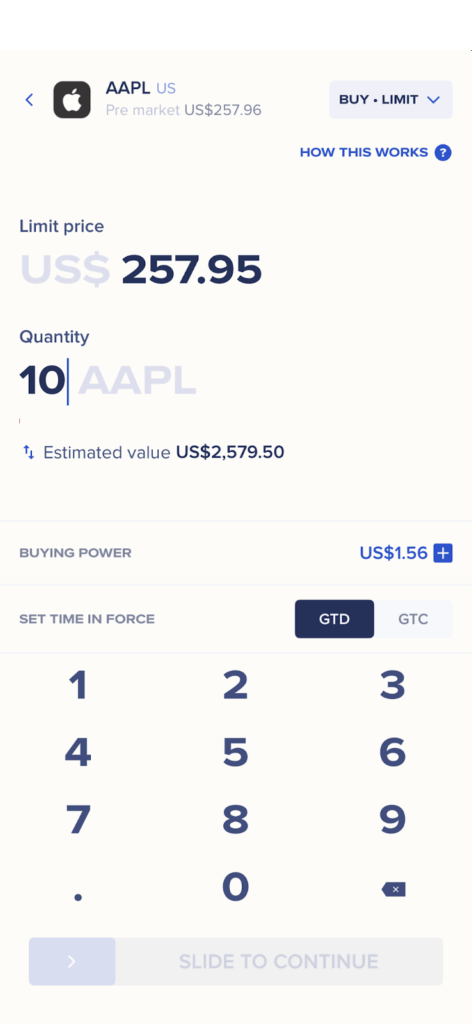
Finally, slide the button to place your trade. If the trade is executed, you can view it under Trade > Holdings. You will also receive a notification upon trade execution.
Practical ways Syfe can support disciplined execution
Depending on your investing style, these product-aligned considerations may be helpful:
- Free unlimited US trades for the first three months. After the introductory offer period, you’ll get up to 10 free trades each month (based on your tier).
- Fractional Trading for US-listed names, useful for building positions with smaller amounts.
- Auto FX Conversion converts your SGD funding to USD at order time to complete the trade, no extra manual conversion step required.
- Auto-invest with eGIRO feature draws funds directly from your selected bank account so you won’t miss an investment, helping you stick to your DCA strategy with recurring buys.
Risks and Common Misconceptions About Extended Hours
Extended sessions can be useful, but investors should be clear-eyed about the trade-offs.
Risk 1: Wider bid–ask spreads (a hidden cost)
Lower participation often leads to wider spreads, which can make it harder to obtain favourable pricing. Spreads act like friction: you effectively pay more to enter and receive less to exit, all else equal.
Risk 2: Higher volatility and less reliable price signals
Limited activity can produce larger price swings. Extended-hours prints may be exaggerated relative to what follows at the open, because the pool of active buyers and sellers is smaller.
Risk 3: Different order handling
Certain rules that apply during regular trading hours may not apply in the same way during after-hours trading, and investors should understand how their brokerage routes and handles such orders.
Misconception: “If I do not trade extended hours, I will miss the move.”
Extended hours often show the market’s first reaction, but regular-session liquidity can bring more robust price competition. For many Singapore-based investors, the objective is not to capture every tick—it is to execute at sensible prices with controllable risk.
Quick Takeaways
- US extended and regular trading hours shift by one hour depending on US DST (second Sunday in March to first Sunday in November).
- The US regular session is 9:30 a.m.–4:00 p.m. ET.
- Common extended windows are 4:00 a.m.–9:30 a.m. ET (pre-market) and 4:00 p.m.–8:00 p.m. ET (after-hours).
- Extended sessions often have lower liquidity, wider spreads, and higher volatility, which can reduce execution quality.
- Limit orders are the default tool for extended hours,to protect investors from unexpectedly poor prices.
- Use extended hours deliberately (time-sensitive catalysts, price discovery), not casually.
- Always check US market holidays and early closes before timing-sensitive trades.
Conclusion
Understanding the US extended and regular trading hours is ultimately about removing friction from your investing process. Once the schedule is clear, you can plan with intention rather than reacting to the clock.
Just as important, it helps to treat extended sessions as a distinct trading environment. Extended hours can involve lower liquidity, wider bid–ask spreads, and higher volatility, and prices may be less reliable than during regular trading hours. That said, extended hours can still be highly informative for price discovery, especially around earnings and major headlines, but execution quality may be weaker when participation is thin.
For many Singapore-based investors, a practical approach is to use extended hours primarily for planning and selective, time-sensitive action, while relying on regular-session liquidity for routine investing and portfolio building. If you want a simple next step, adopt one rule you will follow consistently—such as “limit orders only outside regular hours”—and pair it with a sustainable schedule that fits your lifestyle. Over time, those process decisions often matter more than chasing every overnight move.
Frequently Asked Questions (FAQs)
1) What time does the US stock market open in Singapore?
The US regular session opens at 9:30 a.m. ET, which is typically 9:30 p.m. SGT when the US is on DST and 10:30 p.m. SGT when the US is not on DST.
2) What are the US pre-market hours Singapore time?
A commonly used pre-market window is 4:00 a.m.–9:30 a.m. ET. In Singapore, that is typically 4:00 p.m.–9:30 p.m. SGT during US DST, or 5:00 p.m.–10:30 p.m. SGT outside DST.
3) Is after-hours trading riskier than trading during regular hours?
It can be. Extended hours may involve lower liquidity, wider bid–ask spreads, and higher volatility, and prices may be less reliable than during regular trading hours.
4) Which order type is generally best for extended hours trading Singapore investors?
Limit orders are generally preferred in extended hours because they help control execution price when spreads are wider and liquidity is lower. Many firms accept only limit orders during extended-hours trading to protect investors from unexpectedly poor prices.
5) Do US market holidays affect US trading hours in Singapore?
Yes. On US market holidays, exchanges are closed, and some dates have early closes. Check the official exchange calendar before placing time-sensitive trades.


