Global markets have been turbulent this year, with plenty of ups and downs. These swings have brought challenges, but they have also created new opportunities worth exploring. This article summarises the key points from the webinar and shares our latest views on the macro environment, the main asset classes and portfolio allocation.
Here’s a summary:
- The end of the “global rally”: divergence is the new normal
- A change in conditions: monetary policy moves from easing to tightening
- Equities: fundamentals still strong, but valuations less attractive
- US economy: more resilient than expected, with overheating a bigger risk than stalling
- Asset allocation
1. The end of the “global rally”: divergence is the new normal
Last year, almost everything went up: equities performed strongly, and bonds and gold also rose. This year, simply holding on and riding the gains has become much less rewarding.
Performance has diverged sharply across markets. Sectors that grew fastest or rallied hardest over the past year or two on the back of the artificial intelligence (AI) boom have started to show signs of slowing in major markets around the world this year.
Diverging asset performance returns in HKD
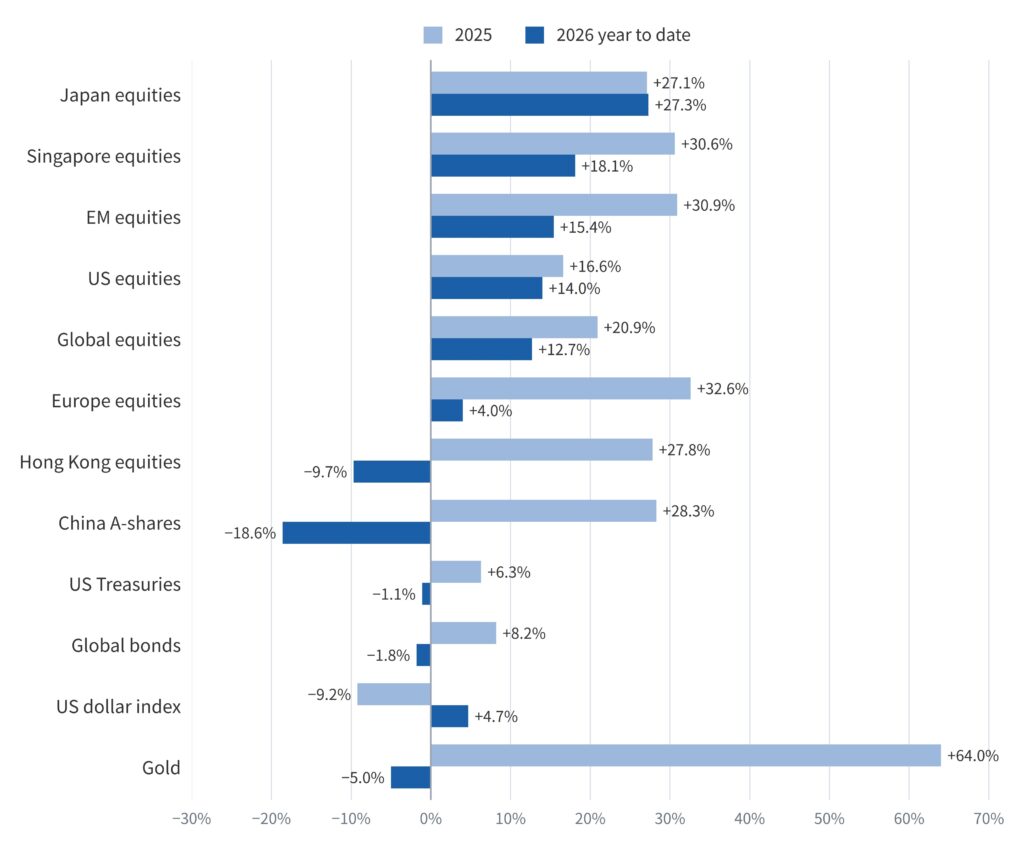
Source: Bloomberg, as of 29 October 2026. Returns in HKD; equity indices are price returns (excluding dividends), bonds are total return indices and gold is GLD total return. China A-shares are represented by the MSCI China Index; the US dollar index is DXY. 2025 = full year; year to date = 1 January to 29 October 2026. Past performance is not indicative of future returns.
2. A change in conditions: monetary policy moves from easing to tightening
To understand how markets have changed this year, it helps to go back to the start of the year. At that time, the macro and market environment was very supportive of risk assets, for two main reasons:
- Monetary policy was leaning towards easing, with markets broadly expecting the Fed to keep cutting rates and liquidity staying abundant;
- The outlook for AI earnings was bright, and many positives were not yet reflected in valuations.
This was visible across several markets, including Japan’s tech-heavy Nikkei, emerging markets (where Taiwan and South Korea now make up about half the weight) and the familiar US stock market. As a result, sentiment at the start of the year generally favoured staying on the “offensive”. In football terms, it was a time to play a proactive 4-3-3 formation with three strikers up front.
Today, from a macro perspective, the interest-rate environment looks very different.
At the start of the year, markets expected two rate cuts during the year; now the Fed has already raised rates once in September, and markets expect up to two more hikes at the remaining meetings before year-end. In short, monetary policy has moved from relatively easy to relatively tight.
At the same time, much of the expected corporate earnings growth is already reflected in prices. Overall, compared with the start of the year, markets have moved from conditions that suited an offensive, more aggressive strategy to conditions that, given the many challenges, call for a stance that balances attack and defence. To stick with the football analogy, a more balanced 4-4-2 formation may now be the better fit.
3. Equities: fundamentals still strong, but valuations less attractive
We remain confident in equity market fundamentals. AI-related earnings are still very strong, and capital expenditure (capex) at the major tech companies remains high. Over the first three quarters of this year, analysts kept raising their earnings forecasts for these companies.
However, equity valuations are less attractive than they were at the start of the year. On top of this, the market is extremely narrow: it is relying on the same few tech stocks to drive the rally, which creates concentration risk. That means it takes very little (a new AI model, say, or disappointment over AI spending) for equities to stumble, and we have seen what that looks like in recent weeks. We have therefore moved our valuation assessment of equities to “neutral”.
4. US economy: more resilient than expected, with overheating a bigger risk than stalling
One of this year’s surprises has been how resilient the US economy has been. This also explains why the Fed has been willing to tighten policy: in its view, the biggest risk facing the economy now is overheating, not stalling.
That said, market expectations may be getting ahead of themselves. Investors generally assume that rate hikes hit every industry in much the same way, and pay less attention to whether hikes can sway AI investment at all. Large tech firms are so highly favoured by the market that a small rise in rates barely moves their financing costs. If that is the case, the tightening falls disproportionately on homebuyers, small firms and consumers. The risk would then tilt towards the Fed overdoing it, cooling the economy sharply and pushing rates in the opposite direction.
5. Asset allocation
Based on the macro analysis above, here is our view on each asset class in a multi-asset portfolio:
Global equities: downgraded from “overweight” to “neutral”
At the start of the year and at our last webinar, we believed equities still merited an overweight and a more aggressive allocation. We have now moved to neutral, holding equities close to their benchmark weight rather than adding an overweight.
Government bonds: fairly valued and reasonably attractive
Government bond yields have climbed back to more reasonable levels. If the economic cycle turns over the next 12 to 18 months, current government bond yields look quite attractive. We therefore rate their valuation as fair.
10-year US Treasuries: 12-month return by change in yield
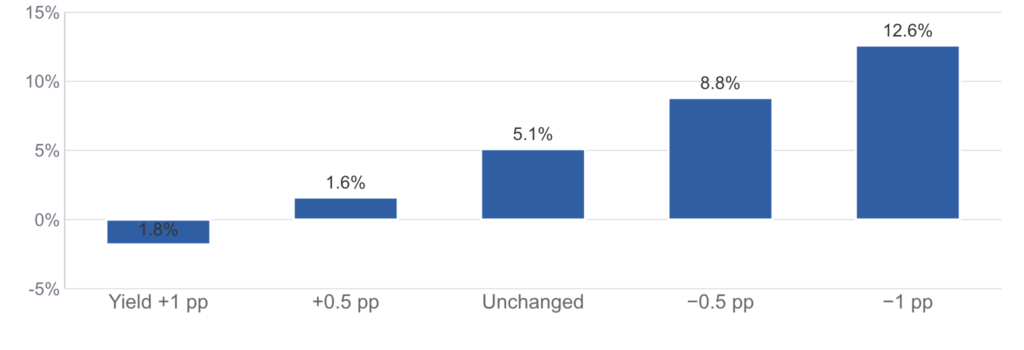
For illustration only, not a forecast. Based on a 10-year Treasury yield of 5.10% (FRED DGS10, 15 October 2026), held for 12 months, assuming a parallel shift in the yield curve, no reinvestment of coupons and no roll-down return. Past performance is not indicative of future returns.
Corporate bonds: valuations elevated, allocate in moderation
Corporate bonds generally offer investors a higher yield than government bonds. However, we think corporate bond valuations are currently elevated. Despite a very difficult global macro environment this year, the spread between corporate and government bonds has not widened noticeably.
On the one hand, this shows that, at least from the start of the year to September, markets were not seriously worried about companies’ ability to repay their debt, which is a positive sign for the overall macro picture. On the other hand, for investors buying corporate bonds on their own or adjusting their allocation to them within a portfolio, narrow spreads mean valuations are relatively high. Especially as we near the late stage of the economic cycle, a measured allocation deserves careful consideration.
Key takeaways
- Markets have gone from last year’s broad rally to this year’s divergence; simply holding passively is unlikely to repeat last year’s returns.
- Monetary policy has shifted from the rate cuts expected at the start of the year to rate hikes and relatively tight conditions.
- AI earnings fundamentals remain strong, but many positives are already priced in and the market is highly concentrated, so valuations are less attractive.
- The US economy has been more resilient than expected and the Fed sees overheating as the main risk; but hikes barely dent AI spending, so the squeeze may fall on households and small firms, and the risk of the Fed overdoing it is worth watching.
- Allocation has shifted from “offence” to “balance”: global equities downgraded to neutral; government bonds valued.
Disclaimer: This article is for general information only and does not constitute investment advice, an offer or a solicitation. Investing involves risk; asset prices can go down as well as up, and past performance is not indicative of future performance. Before making any investment decision, investors should consider their own financial situation and risk tolerance and seek professional advice where necessary.