

Leaning in on index tracking worked well for many investors for much of the past decade. But in today’s volatile and concentrated markets, that strategy may not be enough.

“Why don’t you just buy the index?” might be one of the most-asked questions in investing. It’s an approach that’s simultaneously simple, low-cost, and seemingly diversified.
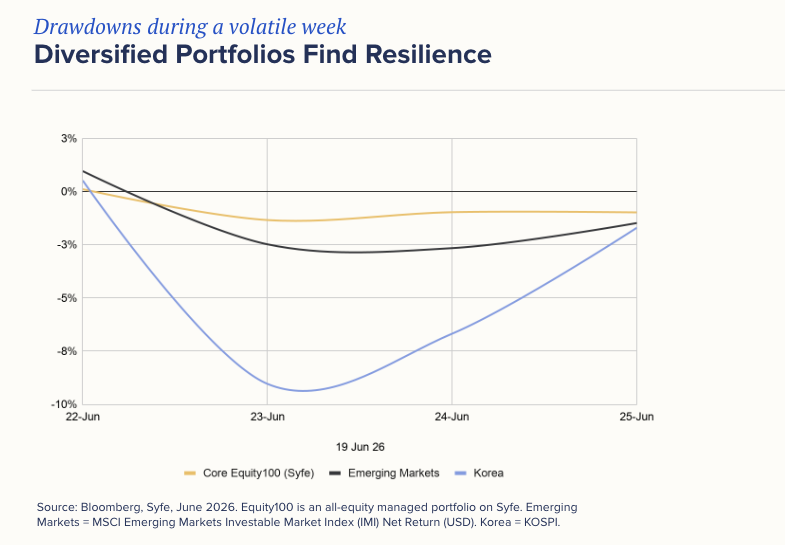
What’s less talked about is the opportunity cost of relying on this strategy alone to build long-term wealth, and its vulnerability in the volatile markets we’re living through.
The answer isn’t to abandon passive investing altogether — but to seek true diversification by combining passive ETFs with “smart” managed portfolios. Here’s why, and how.
Over-Indexing on the Short Term
By design, a market-cap index buys more of whatever has already gone up. The more a stock rises, the larger its weight, regardless of valuation.
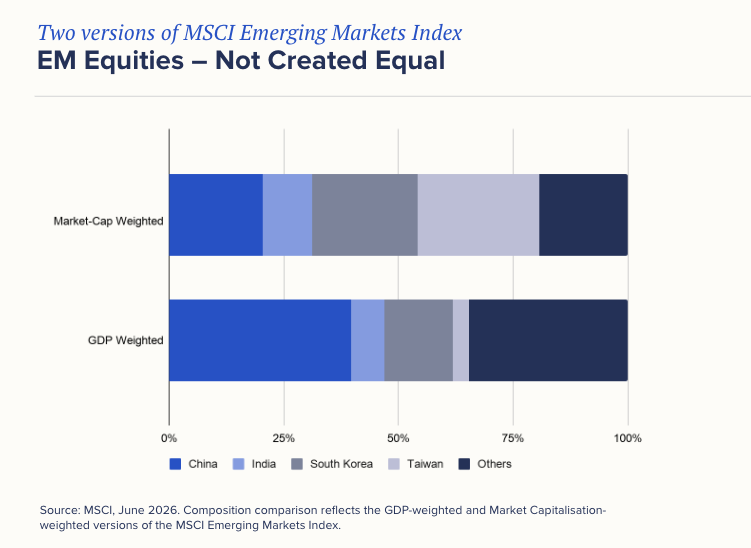
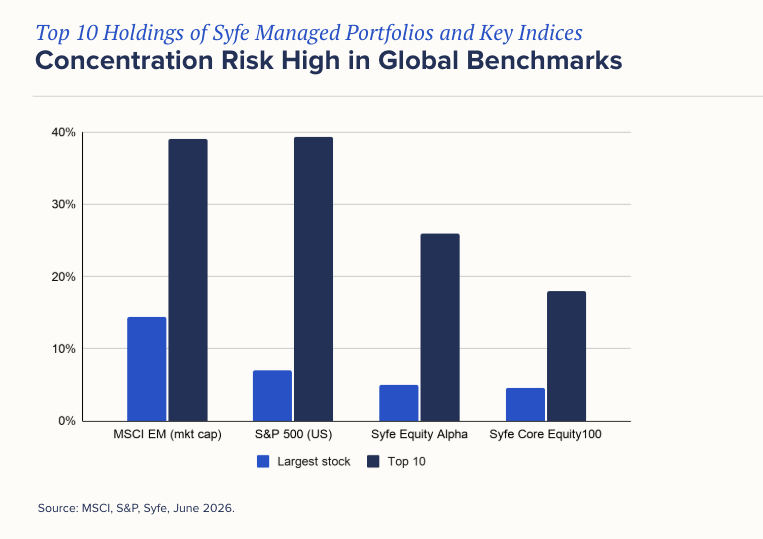
Thanks to the AI rally, chip-heavy Taiwan and Korea together now make up close to half of emerging-market indices — more than China and India combined — with TSMC alone more than half of Taiwan’s index weight, and Samsung and SK Hynix together about half of Korea’s. It isn’t only emerging markets: in a developed-world tracker like CSPX (the S&P 500), the ten largest holdings now make up close to 40% of the fund.
Index tracking is therefore increasingly a bet on the “hot stocks” of the moment. Managed portfolios, like Syfe’s Core suite, are built to look further out. Rather than weighting by what has just rallied, our Core portfolios tilt toward “factors” such as size, value and quality — traits of stocks that have rewarded patient investors across many decades.
Under-Representing the Biggest Economies
The flip side of chasing winners is underweighting the economies that matter most. On a GDP-weighted basis, China and India together would be close to half of emerging markets. These two markets also happen to have unmatched breadth in the number of stocks and sectors.
China is a striking example. In a global tracker like VWRA, the world’s second-largest economy carries only a ~3% weight; on a GDP-weighted basis, it would be closer to 15%. China is also central to the AI story — Goldman Sachs estimates it accounts for around 16% of global AI-related revenue — yet its equities remain consistently under-owned by global investors.
This is why we don’t just follow the index. Core Equity100, for instance, deliberately holds more China than a standard global benchmark would give you. The objective isn’t to bet on one country, but to give you a portfolio that truly captures growth in the global economy.
Putting Your Fate in the Hands of Index Providers
You don’t actually decide what enters your portfolio — the index providers do. In May, several quietly rewrote their inclusion rules to fast-track mega-IPOs, paving the way for SpaceX to enter major benchmarks like the Nasdaq-100 within weeks of listing. AI giants OpenAI and Anthropic could be next in line.
The deeper issue isn’t about any single stock — or whether you like these names or not. It’s that you can end up owning things you never knowingly chose. A broad, “diversified” fund may quietly leave you with a heavy tech component. Index providers are incentivised to capture the biggest, most tradeable names in the market — compounding the concentration challenge.
Long Story Short: Diversify, For Real
So, what’s the answer?
The problem was never owning index funds per se (don’t ditch your VWRA or CSPX just yet!), but pinning all your hopes on them for long-term wealth — believing you’re getting diversification and capturing growth as best you can.
Managed portfolios do the work the index won’t: purposefully curated to offer true diversification, rebalancing to prevent drift and concentration, and reinvesting your dividends to compound your growth.
Achieving long-term wealth requires a bit of both (that’s why we offer both managed portfolios and DIY investing on Syfe). Managed portfolios can serve as your “core” to keep your money growing over time, and passive ETFs (from broad growth to thematics) can serve as “sleeves” that express your higher-conviction ideas.
Investing for the long term was never about effort. It’s about the strategic choices you make — and choosing what’s built to last.


