

From powering an AI-driven future to building financial resilience in retirement, Budget 2026 unveiled a slew of plans that investors should consider when planning their investments.
Prime Minister Lawrence Wong’s Budget 2026 sets the stage for Singapore’s next phase of growth, centred around becoming an AI-powered economy, strengthening retirement adequacy, and accelerating the clean energy transition.
Here are the key themes of this year’s Budget and what they mean for your investments, career, and long-term wealth strategy.
Table of Contents
- Cost-of-Living Measures
- Retirement & CPF
- AI-Powered Economy
- Clean Energy & Sustainability
- Businesses, Markets & Equities
Budget 2026 at a Glance: The Main Themes
Budget 2026 strikes a careful balance between short-term stability and long-term ambition.
Singapore is expected to end FY2025 with a S$15.1 billion surplus (1.9% of GDP), before narrowing to a projected S$8.5 billion surplus (1% of GDP) in FY2026. Revenues are rising — particularly from corporate income tax collections — but so are spending needs across healthcare, defence, infrastructure, and economic transformation.
Three themes stand out:
- AI as a national priority – A coordinated push to become a trusted AI hub, backed by new national AI missions across manufacturing, connectivity, finance, and healthcare.
- Retirement adequacy and CPF enhancements – Targeted CPF top-ups for seniors and future life-cycle investment products.
- Clean energy and sustainability – Expanded solar targets, EV incentives, and energy diversification, including nuclear feasibility studies.
Why this matters to investors:
Government priorities often signal where capital, policy support, and long-term demand may flow. Budget 2026 provides a clear roadmap of where Singapore is placing its bets, and that has implications for portfolios.
Budget 2026 Key Announcements — How They Impact Your Money
1. Cost-of-Living Measures: Short-term relief, long-term discipline
Growth for 2026 is projected at 2–4%, with inflation moderating to 1–2%. While broad-based stimulus is limited, targeted support continues:
- Additional U-Save rebates for HDB households to cushion carbon tax impact
- Corporate income tax rebate of 40% (capped at S$30,000) for active companies
- Enhanced grants and financing support for businesses expanding overseas
- S$500 CDC vouchers, Cost-of-Living special payments of up to S$400
What this means for your money
If your household receives vouchers, rebates, or benefits from business tax relief (for SME owners), the key question isn’t “What can I spend it on?”, but “How can I strengthen my finances with this?”
A practical approach would be to:
- Rebuild emergency funds if they’ve been drawn down.
- Keep short-term cash in higher-yielding instruments rather than idle savings accounts.
- Avoid increasing lifestyle inflation just because inflation has eased.
For funds you may need within 6–12 months — such as renovation, insurance premiums, travel, tax payments — a cash management solution like Syfe Cash+ can help your idle funds beat inflation while keeping liquidity.
Meanwhile, longer-term investments remain invested for growth. With a globally diversified mix of equities, bonds, and commodities, Syfe’s Core portfolios are built for long-term wealth-building. The key is to separate short-term liquid funds and long-term wealth-building funds.
2. Retirement & CPF: Income planning matters more than ever
Retirement adequacy is a major focus this year.
Key CPF updates include:
- CPF top-ups of up to S$1,500 for Singaporeans aged 50 and above with balances below the Basic Retirement Sum (larger top-ups for lower balances)
- The next phase of CPF contribution rate increases for senior workers in 2027 (a total of 2.5% for workers aged 55–60, and a total of 2% for those aged 60–65)
- Development of life-cycle investment products, where younger members take on more risk and portfolios automatically rebalance toward safer assets as retirement approaches
This signals a clear shift: Singapore is doubling down on structured, long-term retirement income planning.
Investor takeaway: CPF is a foundation, not the full solution
CPF enhancements improve retirement resilience, but they do not eliminate longevity risk, inflation risk, and healthcare cost uncertainty. As lifespans extend, retirement planning becomes less about accumulating a lump sum and more about sustaining income over several decades.
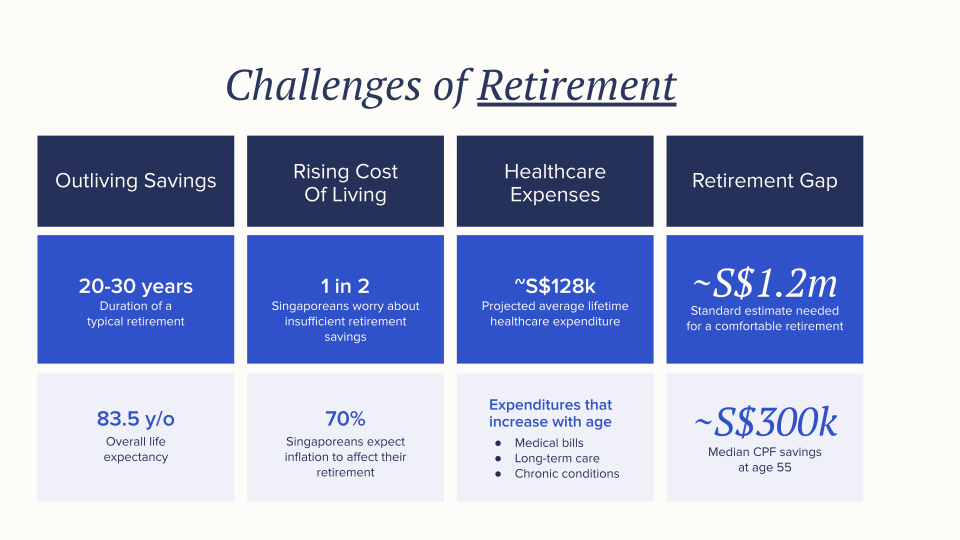
This is where diversification beyond CPF becomes important:
- Income-focused portfolios, such as Income+, can complement CPF payouts by providing regular income streams.
- REIT-focused strategies like REIT+ offer diversified property exposure without requiring direct real estate ownership — potentially useful for investors seeking income and inflation-linked assets.
The broader shift is a psychological one. Retirement is no longer just “stop working at 63” (to be increased to 64 as of 1 July 2026). It is now a phased transition, and your portfolio should reflect that by blending growth assets in earlier years with income-producing assets later on.
3. AI-Powered Economy: Positioning for Structural Growth
Perhaps the most consequential theme of Budget 2026 is Singapore’s ambition to become an AI-powered economy.
The government announced:
- A new National AI Council, to be chaired by PM Wong himself
- Four national AI missions (advanced manufacturing, connectivity, finance, healthcare)
- Six months of free access to premium AI tools for selected training participants
- Expanded support for firms adopting AI and energy-efficient solutions
- A S$37 billion Research, Innovation and Enterprise plan
- S$1.5 billion top-up to the Financial Sector Development Fund
- S$1 billion enhancement to Startup SG Equity (including growth-stage funding)
AI adoption will reshape jobs, but Singapore’s strategy is to redeploy and reskill rather than displace.
For individuals:
- Upskilling in AI-adjacent tools improves job and income resilience.
- Higher productivity can translate into wage growth in competitive sectors.
- Finance, healthcare, manufacturing, and logistics professionals are particularly exposed to transformation.
Your human capital (i.e. your earning power) is your biggest asset. Budget 2026 reinforces the need to treat career investment as seriously as financial investment.
What this means for your portfolio
PM Wong says that Singapore’s advantage is not in building the biggest AI frontier models, but in deploying AI effectively and responsibly. This suggests opportunities in:
- Digital infrastructure
- Automation and robotics
- Semiconductor supply chains
- Healthcare innovation
- Financial technology
For investors who want exposure without stock-picking, Syfe’s thematic allocations — such as Disruptive Tech or Healthcare Innovation — allow you to participate in structural growth trends.
4. Clean Energy & Sustainability: The Long Game
As of 2026, Singapore has:
- Reached its 2030 solar deployment target of 2 GWp ahead of schedule (and intends to raise the target to 3 GWp by 2030)
- Continued expanding EV incentives (with cap adjustments)
- Advanced plans to import low-carbon electricity
- Begun capability-building for potential civilian nuclear energy
The clean energy transition is now a strategic necessity for energy security and climate commitments.
What this means for investors
Energy diversification requires:
- Infrastructure investment
- Grid upgrades
- Regional energy cooperation
- Corporate decarbonisation spending
The Energy Efficiency Grant and green financing support encourage companies to adopt sustainable equipment and practices. For businesses, sustainability is moving from ESG branding to economic competitiveness. Companies that fail to adapt may face higher costs or regulatory risk.
For investors, exposure to global clean energy, infrastructure, and sustainability leaders — either through diversified Core allocations or thematic solutions like ESG and Clean Energy — can position your portfolio for long-term policy-aligned growth.
5. Businesses, Markets & Equities: A Boost for Capital Markets
Budget 2026 also strengthens Singapore’s equities ecosystem:
- S$1.5 billion top-up to the Financial Sector Development Fund
- Second S$1.5 billion tranche of the Anchor Fund (co-investment with Temasek)
- Streamlined listing rules
- Enhanced internationalisation grants
- 200% double tax deduction (cap raised to S$400,000)
- Higher enterprise financing loan limits
This signals strong intent to deepen capital markets and support high-growth companies.
For retail investors, deeper markets and stronger listings improve the long-term attractiveness of equities as an asset class.
Rather than trying to predict which individual company benefits most, diversified global equity exposure — such as through Core portfolios or selective Brokerage investing — helps capture broad economic growth.
How To Position Your Portfolio After Budget 2026: A Quick Checklist
1. Separate liquidity from growth.
Keep short-term funds accessible and long-term funds invested.
2. Reassess asset allocation but don’t overreact.
Budget announcements shape long-term direction, not short-term market swings.
3. Balance growth and income.
AI and innovation for growth; REITs and income assets for stability.
4. Think in life stages.
Younger investors: lean into growth and AI-driven sectors.
Mid-career: balance growth with increasing income stability.
Pre-retirement: focus on sustainable income and capital preservation.
5. Invest in your career alongside your portfolio.
Upskilling in AI may produce higher returns than any single stock.
Putting Budget 2026 into Action: A Simple Framework
Budget 2026 reinforces a time-tested strategy: structuring your money by purpose.
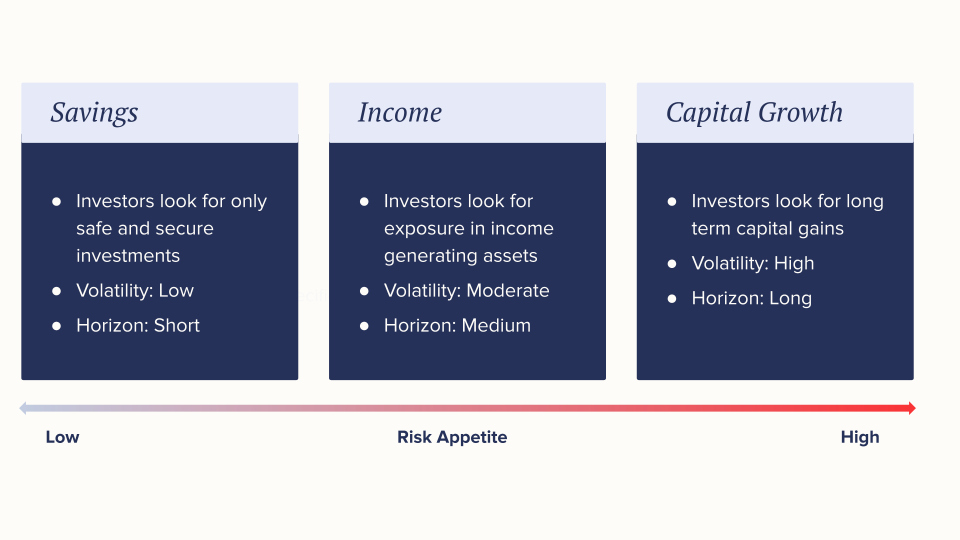
Short-term needs → Cash management solutions
Medium-term goals → Diversified Core portfolios
Long-term growth → Thematic allocations (AI, healthcare, sustainability)
Income needs → Income+ or REIT-focused portfolios
The broader message from Budget 2026 is clear: Singapore is preparing for a more digital, lasting, and energy-efficient future.
As an investor, aligning your financial plan with structural trends beats chasing headlines. With strategic allocation, intentional planning, and financial discipline, you can confidently position yourself and your portfolio for the next decade of Singapore’s growth.
Explore how Syfe’s solutions can help you invest in alignment with Singapore’s next chapter.
Read More:
Syfe 2026 Outlook: Growth, Disinflation, and Monetary Transition
Top Market Trends and Investment Themes for 2026
CPF vs SRS Top-Ups: Which to Choose and What’s the Difference?
ESG Investing: Investing For Change


You must be logged in to post a comment.