

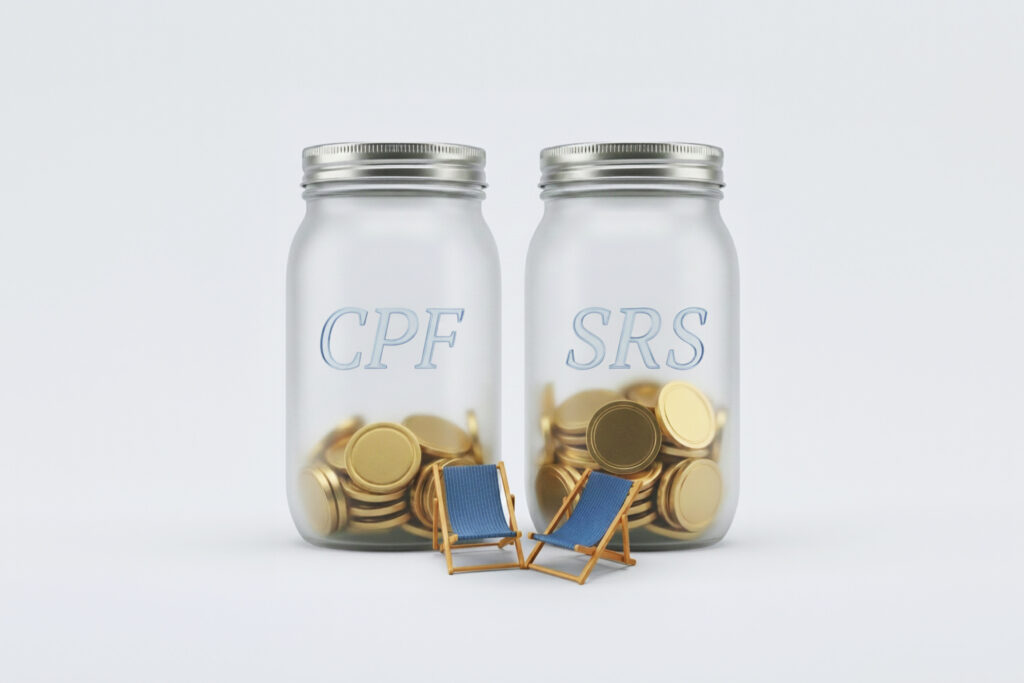
Both the Central Provident Fund Special Account (CPF SA) and Supplementary Retirement Scheme (SRS) are designed to help you save for retirement, but they have different structures, rules, and benefits.
Let’s break down the key differences:
Table of contents
- What is a CPF SA Account
- What is a SRS Account
- Difference Between CPF SA and SRS
- Which Account Should You Top Up: CPF or SRS SA
What is a CPF SA Account
Before we go into what a CPF SA account is, let us give you a quick overview of the CPF system.
The CPF system is a mandatory savings plan designed to help Singaporeans save for retirement, healthcare, and housing.
Your CPF savings are divided into several accounts (Ordinary, Special, Medisave, and Retirement), each with different purposes:
- Ordinary Account (OA): used for housing, education, insurance, and investment
- Special Account (SA): used for retirement planning
- Medisave Account (MA): used for healthcare expenses
- Retirement Account (RA): used for your retirement
Because the SA is designed to help Singaporeans better prepare for retirement, it offers an attractive interest rate of 4%, much higher than the 2% that the OA gives.
(Note: for members aged 55 and above, the CPF SA has been closed since the second half of January 2025. all funds will be transferred to your RA.)
What is a SRS Account
The SRS is a voluntary retirement savings scheme aimed at preparing you for your golden years. It’s primarily for people who want to save more for retirement while enjoying the tax savings brought about from funding their SRS accounts.
Difference Between CPF SA and SRS
Eligibility
- CPF SA
If you are a Singapore Citizen (SC) or Permanent Residents (PRs), you automatically have a CPF account once you start working.
- SRS
Unlike the CPF system, Singaporeans, PRs, and foreigners can contribute to their SRS accounts.
Contributions
- CPF SA
Contributions to the CPF SA are mandatory. Both you and your employer contribute a percentage of your salary each month. The contribution rate varies depending on your age group, with the total contribution split between different CPF accounts.
You can receive tax relief for topping up your parents’, grandparents’, spouse’s, or siblings’ Special Account (SA) or Retirement Account (RA), with a relief cap of S$8,000 per year. You can receive tax relief of up to S$8,000 for topping up your own CPF accounts as well. The combined total tax relief for both your own and your loved ones’ top-ups is capped at S$16,000 per year (S$8,000 for yourself + S$8,000 for loved ones).
- SRS
On the other hand, contributions to the SRS are voluntary. You can choose to contribute as much as you like, up to an annual limit. There’s no requirement to top up, but many still do this to enjoy the income tax relief benefits of doing so.
SRS has an annual contribution cap of up to S$15,300 for Singaporeans and PRs and S$35,700 for foreigners—a limit that’s higher than CPF.
Tax Relief Benefits
- CPF SA
Here’s how the tax relief benefits work when you top-up you or your loved ones’ CPF SA:
| Amount of cash top-up to own or family members’ CPF SA | Maximum allowable relief |
| Below S$8,000 | Exact amount of cash top-up |
| S$8,000 or more | S$8,000 |
Source: IRAS
- SRS
Each dollar contributed to your SRS account results in a dollar-for-dollar tax deduction.
Here’s an example to illustrate how SRS can bring about tax savings: a person pays tax on S$64,700 after personal reliefs and a reduction in taxable income from the contribution S$15,300 to their SRS account, a stark difference from paying tax on their original employment income of S$120,000.
| Looking for ways to reduce your income tax? Check out our guide on income tax relief options that you can consider exploring as tax season approaches. |
Interest Rates
- CPF SA
Your CPF SA account earns a guaranteed interest rate of 4.% per year.
Members below 55 earn an additional 1% interest, for a total of up to 5% on the first S$60,000 of combined balances. Members aged 55 and above earn an extra 2% on the first S$30,000 of their combined balances and an extra 1% on the next S$30,000, resulting in up to 6% on the first S$30,000.
- SRS
Money in your SRS account earns only 0.05% per year, and that’s why most people turn to investing their SRS funds to maximise their returns.
There’s a variety of SRS-approved investment options you can choose from, including stocks, bonds, Singapore Savings Bonds, unit trusts, and ETFs. We’ll talk more about this below.
Withdrawal Rules
- CPF SA
Since money in your CPF SA is meant for your retirement, the government has imposed stricter rules regarding the withdrawal of these funds.
No withdrawals can be made before you turn 55. Thereafter, certain rules still apply should you decide to take out funds from your account.
- SRS
SRS gives you more flexibility.
Unlike your CPF SA, you can withdraw the funds at any time. However, there’s a penalty for early withdrawals made before the statutory retirement age (63 effective from 1 Jul 2022).
For any withdrawals made before you turn 63, you’ll incur a 5% penalty and the amount you withdraw will be taxed.
The penalty is waived for any withdrawals made after 63, but the 50% of the amount you withdraw will still be taxed.
Use of Funds
- CPF SA
Funds in your CPF SA are largely used for retirement.
However, if you have at least S$40,000 in your SA and would like to augment your savings, you can also choose to invest your SA funds under the CPF Investment Scheme-Special Account (CPFIS-SA).
Investments made must fall under the list of CPF-approved investment options. The pool of unit trusts eligible for CPFIS-SA is relatively small, and most are bond-focused.
- SRS
As mentioned earlier, most people try to maximise their SRS funds by investing it across a range of investment options like stocks, ETFs, fixed deposits, and more.
If you’re considering investing your SRS funds, Syfe offers SRS-friendly curated portfolios based on your goals, time horizon and risk tolerance.
Income+
Want to generate dependable and steady dividends while growing your savings? Our Income+ portfolios are created just for that.
Income+ is a professionally managed, globally diversified bond portfolio designed to generate passive income. It offers two main options, Preserve and Enhance, to cater to different risk appetites, providing regular monthly payouts with no lock-in periods, minimum balance required, or withdrawal penalties.The portfolio is powered by actively managed funds from PIMCO and comprises SGD-hedged, investment-grade funds. It provides a distribution yield (i.e. monthly payout) of 5.0%-5.5% for Preserve and 5.5%-6.0% for Enhance, and a yield-to-maturity of 6.1%-6.4%.
Core Equity100
Suitable for investors with a larger risk appetite and a longer-term outlook, the Core Equity100 an equity-focused portfolio designed to capture long-term growth with diversified exposure to over 5,000 global stocks. The portfolio is meant to withstand market downturns, enhance long-term returns, and improve diversification. Year-to-date, it has seen a +13.54% return (as of 25 Nov 2025) and a three-year annualised return of +17.29%.
Cash+ Flexi (SGD)
Cash+ Flexi is a cash management account that aims to provide returns higher than a typical savings account by investing in a portfolio of low-risk, high-liquidity money market and short-term bond funds. It is designed for those who want to earn interest on their idle cash while maintaining high liquidity and flexibility, with no lock-in periods or minimum balances (for SGD), and unlimited next-day withdrawals. Currently, Cash+ Flexi (SGD) offers 1.8% p.a. in projected returns.
Which Account Should You Top Up: CPF or SRS SA?
Now that we know the differences, the next question is: which account should you top up?
It really depends on your financial situation, goals, and risk appetite. Here’s a simple breakdown of who should consider topping up each account:
Top Up CPF SA if:
- You want guaranteed, safe returns
The CPF SA offers a risk-free, government-backed interest rate. If you prefer stability and are looking for a “hands-off” approach to saving for retirement, CPF is a solid choice.
- You’re comfortable locking your funds for the long haul
CPF SA top-ups are irreversible, so it’s crucial to prioritise your financial needs first. Plan carefully to ensure you’re prepared for future expenses like housing upgrades and your children’s education.
Top Up SRS if:
- You want to invest for potentially higher returns
SRS offers a wider range of investment options, from blue chip stocks to ETFs. If you’re comfortable with investment risk and want to grow your savings at a faster rate (albeit with potential ups and downs), SRS could be the way to go.
- You need more flexibility
While the CPF SA is locked in for a specific set of purposes, SRS gives you more freedom to manage the funds as you see fit.
If you want flexibility in your savings and are comfortable with the penalties associated with early withdrawal, SRS gives you more control over your retirement savings.
Which One Should You Choose?
If you’re someone who values security and is primarily focused on guaranteed growth for your retirement and housing, CPF is the safer bet since it’s government-backed and easy to manage.
If you’re aiming to reduce your taxes and are open to taking on a bit more investment risk for potentially higher returns, SRS might be more suitable.
It’s ideal for those who are comfortable with a long-term investment strategy and want more flexibility with their funds.
For many people, a combination of both works well!
Think of retirement planning like a soccer match. You need a strong defense and a powerful offence to win. CPF SA top-ups can act as the defence, building a secure foundation for your retirement, while SRS top-ups can serve as the offence, providing opportunities for growth and flexibility to achieve your financial goals.
Given the potential of SRS to enhance your retirement savings and its attractive tax benefits, you could contribute to CPF for the guaranteed, secure savings, and top up your SRS to benefit from the tax relief and investment potential.
Ultimately, the right choice depends on your financial goals, risk tolerance, and how much flexibility you need with your savings.

New to SRS? Earn up to S$1,500 in fee credits when you invest in our SRS-eligible Core Equity100 or Income+ portfolios by 31 Dec 2025. Learn more here.


