


Investing these days seems to be fixated on quick wins, be it chasing the next meme stock or reacting to fluctuating market conditions. As such, it can be easy to lose sight of the core principle of wealth accumulation: real wealth is rarely built in dramatic spurts, but quietly, steadily over time.
Seasoned investors—and leaders like Syfe’s Chief Operating Officer Samantha Horton—adopt a philosophy driven by a long-term mindset. In a recent Tatler feature, Samantha likens financial wellbeing to endurance sport, anchored in discipline and consistency, and the quiet power of compounding over time.
Her perspective reinforces several key ideas for investors who feel daunted or overwhelmed by the concept of investing. In this article, we break down the key tips from Samantha that apply to both financial and physical health.
- Consistency Over Intensity
Many people approach investing the way they approach New Year’s resolutions—with an initial surge of enthusiasm before falling off the bandwagon. They might invest a large amount during a market rally or after receiving a bonus, then stop entirely—or worse, pull out—when markets become uncertain.
But regular contributions—even modest ones—yield better results over time than sporadic bursts of investment. This consistency not only reduces the pressure of “getting it right” with each investment, it also smoothens out market volatility.
According to Samantha, “You’ve got to get started and that takes discipline. You have to stay consistent and you have to have resilience. If you stay the course, and you keep working every day, it will pay off. It always pays off.”
So instead of asking “When is the right time to invest?”, shift your focus to “Am I on track?” It builds greater momentum over the long term. Over time, small repeated actions—just like showing up at the gym regularly—can compound into meaningful outcomes.
- Time in the Market Beats Timing the Market
Timing the market—buying at the lowest point and selling at its peak—sounds simpler in theory than in practice. Getting the timing right every single time is extremely hard, if not unlikely. Variables like interest rates, geopolitical events, investor sentiment and psychology, economic data, etc all influence market movements, so even if you make one right decision at the right time, the chances of repeating that success over decades is extremely low.
If you’re facing inertia in even getting started and are looking for the right moment to enter the market, know that even a less-than-ideal start to investing can be mitigated by staying in the market long-term.
As Samantha believes, wellbeing—be it financial or physical—is built on discipline and consistency. Therefore, instead of timing the market, time in the market is what truly allows investments to grow.
- Compounding Is Your Best Friend
The impact of compounding becomes significant when viewed over longer time horizons.
When you invest, your returns start to generate their own returns, creating a snowball effect over time. Your money grows exponentially as growth accelerates, not because you’re investing more, but because your existing investments are working harder.
Participating in the market is what truly matters. Staying invested allows you to capture the market’s overall upward trajectory. Missing just a few of the market’s best-performing days can significantly reduce your returns.
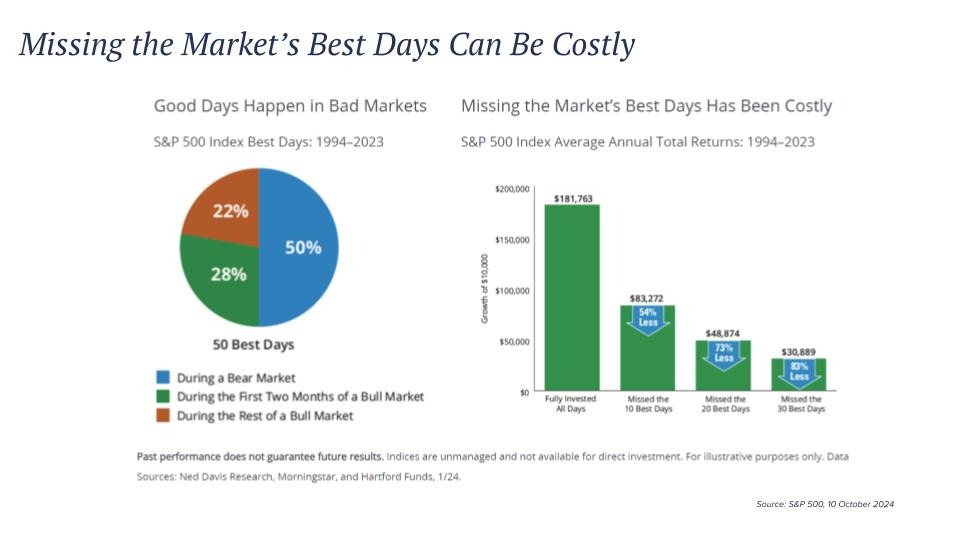
Compounding may be slow at the beginning, but interruptions like prematurely withdrawing funds or pausing contributions can significantly weaken the compounding effect. Patience is key. Starting early—even with modest contributions—can greatly outperform investing later with larger sums.
- Discipline Outperforms Emotion

Markets will inevitably test your patience and discipline. Downturns in particular can spark fear that pushes investors to sell their holdings prematurely, sometimes at a loss. Conversely, rallies can lead to excitement and impulsivity, which can lead to trend chasing or overbuying of a particular stock or asset class.
But while these reactions are natural, they are often counterproductive. As a Hyrox champion, Samantha is a big proponent of discipline over emotion.
“In these periods of heightened uncertainty, it’s when we need to go back to the foundations of staying disciplined, being consistent, looking past the noise and focusing on the long‑term,” Samantha advises. “Most investors are not investing for weeks or months. They’re investing for decades. Short-term turbulence matters far less when the horizon is measured in years.”
A structured, disciplined approach like dollar-cost averaging creates a system that is not influenced by emotion or sentiment, thus countering the tendency to take impulsive actions. Sticking to a long-term plan instead of reacting emotionally to short-term movements and market noise becomes your edge in investing.
Most financial goals span decades. Despite inevitable volatility along the way, staying invested and disciplined through market ups and downs ultimately yields better results.
- Financial Security Opens More Doors
Wealth is not purely measured in numbers like your net worth, portfolio size, or returns. A more invisible value it offers is optionality.
Financial security allows you to step away from situations that don’t serve you, pursue opportunities that you are passionate about, and align your priorities with your values. It allows you to create the life you want that feels authentic to you.
This makes investing not just a financial exercise, but a life strategy that expands your future possibilities rather than just growing money.
“For many people, money can be a source of stress, but it can also represent opportunity,” says Samantha. “A lot of people see money as the path to financial freedom, but it’s really about optionality—what it gives you is more options in life.”
- Simplify Your Approach
Having reliable structures in place that simplify decisions as well as automating your investments can reduce decision fatigue, making it easier for you to stay on track without having to constantly revise your strategy or monitor the market and your portfolio.
Diversification and setting recurring investments in place are ways to streamline your efforts and stay mostly hands-off while still reaping the benefits of consistent investing.
Build a DCA Strategy with Syfe
Syfe is designed to streamline the investing experience, so that you don’t have to actively manage every decision on your own.
With our auto-invest feature, which allows for regular automated contributions to be made through GIRO, you can make recurring contributions into diversified portfolios, cash management or brokerage accounts. This reduces the friction that often leads to inconsistency.
Managed portfolios like Core and Income+ provide exposure to global markets, which naturally diversifies your investments and reduces the risk associated with overweight or concentrated positions.
Conclusion
Before implementing any strategy, one should first approach wealth-building with the right mindset: sustainability over intensity.
Market fluctuations are par for the course, and there’s always a new investment trend emerging. But the underlying principles that drive long-term success sits on this philosophy: progress comes from showing up consistently instead of waiting for ideal conditions. Because wealth isn’t built by timing the market or reacting to its every move, but by showing up again and again, and letting time do the heavy lifting.
“A well‑designed financial life should eventually fade into the background. Put the foundations in place early—regular investing, diversification, automation—and money becomes an enabler rather than a preoccupation,” says Samantha.
For the full story and tips from her, read the full interview on Tatler.


You must be logged in to post a comment.