


Breakthrough technological innovation has transformed our lives. In the words of Klaus Schwab, Founder of the World Economic Forum (WEF): “We stand on the brink of a technological revolution that will fundamentally alter the way we live, work, and relate to one another.”
What is disruptive technology?
Popularised by scholar Clayton Christensen, the term “disruptive technology” refers to innovations that significantly change an existing industry, product, or service and/or create an entirely new one. Recent disruptive technology examples include artificial intelligence, the Internet of Things (IoT), cloud computing, fintech and 3D printing. The automobile, electricity service, and television were also once disruptive technologies in their own times.
Disruptive technologies alter the way that consumers, industries and businesses operate. For customers, these changes typically translate to decreased costs, improved user experience, and access to products and services that were previously reserved for a specific target segment. Disruptive technologies have also opened up new ways for businesses to deliver services and interact with customers.
Why invest in disruptive technologies?
Investing in disruptive technologies carries significant risk as they can take years to be adopted by consumers or businesses. That said, disruptive technology stocks and funds are often touted for their high returns precisely because of their higher risk.
However, investors should not discount the disruptive technology theme for its growth potential in the long-term. Technology is advancing at a rapid rate and investors not exposed to tomorrow’s front runners risk being left behind by a fast-changing world. As illustrated by the infographic below, today’s business leaders may become obsolete at the turn of the next decade.
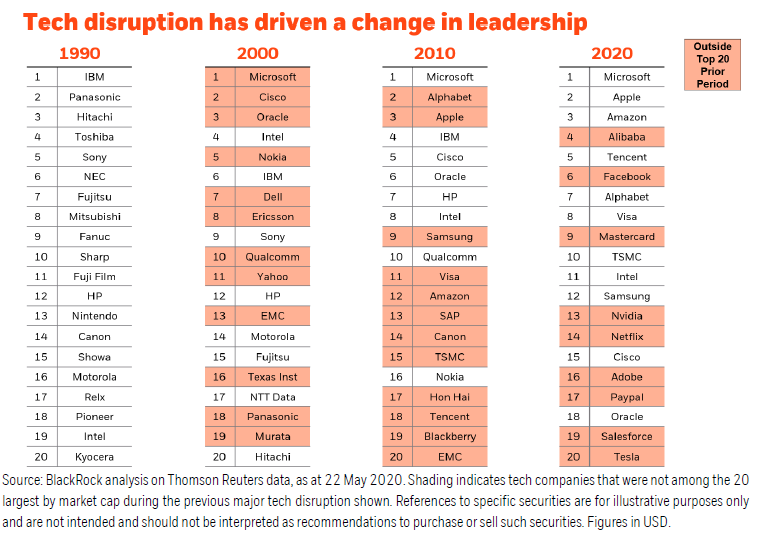
With that in mind, investors can consider disruptive technologies to future-proof their portfolios, if not for attractive returns.
A better way to approach disruptive technology
Investing in disruptive technology is notoriously difficult with the risks it entails. Investors have to do their homework to accurately pinpoint which technology will drive the next big wave of disruption, find reasonably priced opportunities and monitor their investments consistently. For those who don’t have the time to analyse individual stocks, ETFs provide broad exposure to a basket of securities that span multiple trends and innovations.
Syfe’s Disruptive Technology portfolio is a ready-made portfolio of such ETFs. The portfolio invests in companies at the leading edge of technologies and trends that are reshaping the future such as AI, robotics, cloud computing, fintech, esports, online retail, cybersecurity and more.
In order to manage risk, the Disruptive Technology portfolio is globally diversified across developed and emerging markets. Keeping in mind the ever-changing nature of disruptive technologies, emerging innovation themes are also actively monitored for possible inclusion.
Following our November 2025 portfolio re-optimization, the portfolio now holds the following:
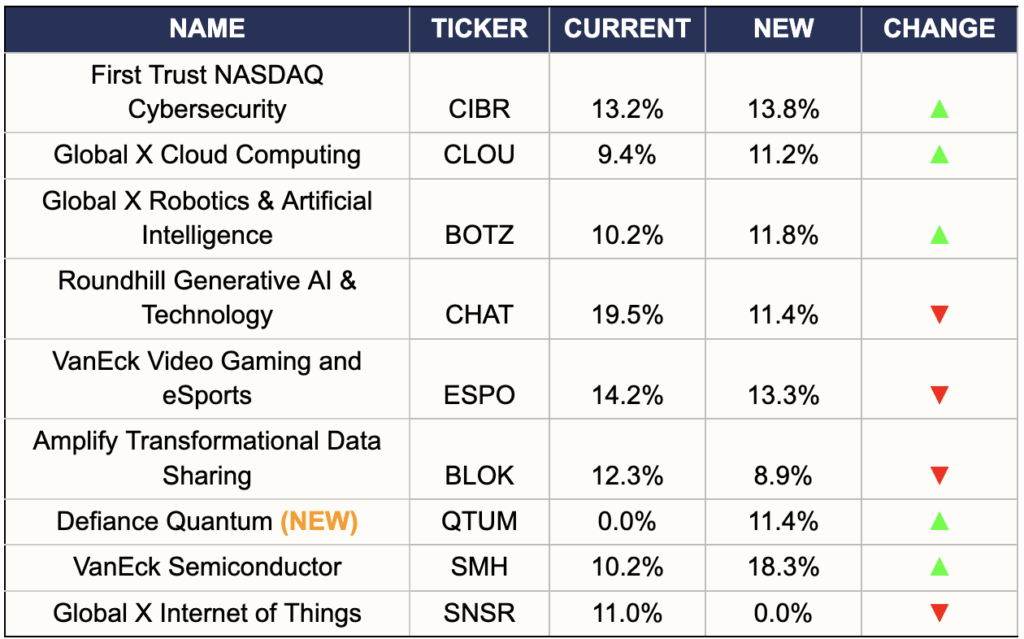
We take a closer look at underlying portfolio holdings at the forefront of these disruptive innovations.
Innovating through AI: CHAT
From Hype to Application: The Generative AI narrative has shifted from experimental chatbots to enterprise-grade deployment. We are now in the “deployment phase,” where companies are integrating Large Language Models (LLMs) into core business workflows to drive productivity. Investing in the Roundhill Generative AI & Technology ETF (CHAT) offers exposure to the full value chain—from the “Mag 7” giants building the foundational models to the application-layer companies revolutionizing software. The top 3 holdings are Alphabet Inc, Nvidia Corp, and Microsoft Corp.
Fueling the future through semiconductors: SMH
The New Oil of the Digital Economy: Semiconductors have transcended their role as mere components to become the most critical commodity in the world. As the “AI Arms Race” accelerates, the demand for high-performance computing (HPC) chips has outstripped supply. We have increased our allocation to the VanEck Semiconductor ETF (SMH) to capture this structural tailwind. This fund offers concentrated exposure to the foundries and designers that are physically enabling the AI revolution, cloud expansion, and the next generation of consumer electronics. The top 3 holdings are Nvidia Corp, Taiwan Semiconductor Manufacturing Co (TSMC), and Broadcom Inc.
Tapping into blockchain: BLOK
Institutional Adoption and Web3 Infrastructure: The conversation around blockchain has matured beyond retail speculation to institutional adoption, highlighted by the normalization of crypto ETFs and improved regulatory clarity. The Amplify Transformational Data Sharing ETF (BLOK) provides a safer, indirect entry point into this ecosystem. Rather than holding volatile coins, BLOK invests in the equity of companies building the decentralized financial infrastructure (DeFi) and the miners securing the network, offering a regulated path to digital asset exposure. The top 3 holdings are Robinhood Markets Inc, Cipher Mining Inc, and Hut 8 Corp.
Harnessing the robot revolution: BOTZ
Solving the Global Labor Shortage: With aging populations in developed markets causing chronic labor shortages, automation is no longer a luxury—it is an economic necessity. The Global X Robotics & Artificial Intelligence ETF (BOTZ) captures this paradigm shift. The convergence of AI brains with robotic bodies (humanoids and industrial cobots) is accelerating, allowing machines to perform increasingly complex tasks in manufacturing, logistics, and healthcare. The top 3 holdings are Nvidia Corp, ABB Ltd, and Fanuc Corp.
The Growth of Quantum Computing: QTUM
The Post-Silicon Era: As traditional silicon chips approach their physical limits (Moore’s Law), Quantum Computing represents the next exponential leap in processing power. The Defiance Quantum ETF (QTUM) targets the companies building the hardware and software capable of solving problems that today’s supercomputers cannot touch—such as molecular modeling for drug discovery and breaking current encryption standards. This is a strategic allocation to the technology that will likely define the next decade of compute. The top 3 holdings are Tower Semiconductor, Rigetti Computing, and Teradyne Inc.
More than fun and games: ESPO
The Convergence of Media and Tech: Video gaming has cemented itself as the dominant form of modern entertainment, with IP like The Last of Us and Fallout transcending consoles to become cultural phenomena. The VanEck Video Gaming & eSports ETF (ESPO) capitalizes on this by investing in the publishers and platform holders that command the most valuable attention spans in the digital economy. As mobile gaming grows in emerging markets and hardware improves, this sector remains a high-growth pillar of consumer tech. The top 3 holdings are Tencent Holdings Ltd, Nintendo Co Ltd, and Electronic Arts Inc.
Empowering the future: CLOU
The Infrastructure for AI: You cannot have Artificial Intelligence without the Cloud. The Global X Cloud Computing ETF (CLOU) invests in the essential infrastructure that allows AI models to run and businesses to scale. As companies move from “cloud migration” to “cloud optimization,” this fund focuses on high-growth, pure-play SaaS (Software as a Service) and PaaS (Platform as a Service) firms that provide the digital agility required in the modern workspace, distinct from the slower-moving tech conglomerates. The top 3 holdings are Akamai Technologies Inc, Dropbox Inc, and Workiva Inc.
Protecting the cyberspace: CIBR
The Immune System of the Internet: As AI lowers the barrier to entry for cyberattacks (enabling deepfakes and automated hacking), cybersecurity has become the most recession-resistant budget item for corporations and governments. The First Trust NASDAQ Cybersecurity ETF (CIBR) invests in the “defenders”—the companies providing the firewalls, threat detection, and identity management essential for national security and corporate survival. In a world of elevated geopolitical tension, digital defence is non-negotiable. The top 3 holdings are Broadcom Inc, CrowdStrike Holdings, and Cisco Systems.
Easing into disruption
Managed Volatility for Long-Term Growth: While the potential of these technologies is immense, the path of disruption is rarely a straight line. Sector-specific volatility is high, and winners can change rapidly.
Syfe’s Disruptive Technology portfolio offers a diversified, “basket approach” to these megatrends. By holding eight distinct ETFs in balanced allocations, you gain exposure to the full spectrum of innovation—from AI and robotics to cybersecurity—without betting the farm on a single niche.
Start where you are comfortable:
- No minimum investment: Start small and build up.
- No lock-ins: Liquidity when you need it.
- Fully Managed: We handle the rebalancing and dividend reinvestment for you, ensuring your portfolio stays aligned with the market’s evolution.
Ready to capture the growth of tomorrow? Explore the Syfe Select Disruptive Technology portfolio today.


You must be logged in to post a comment.