

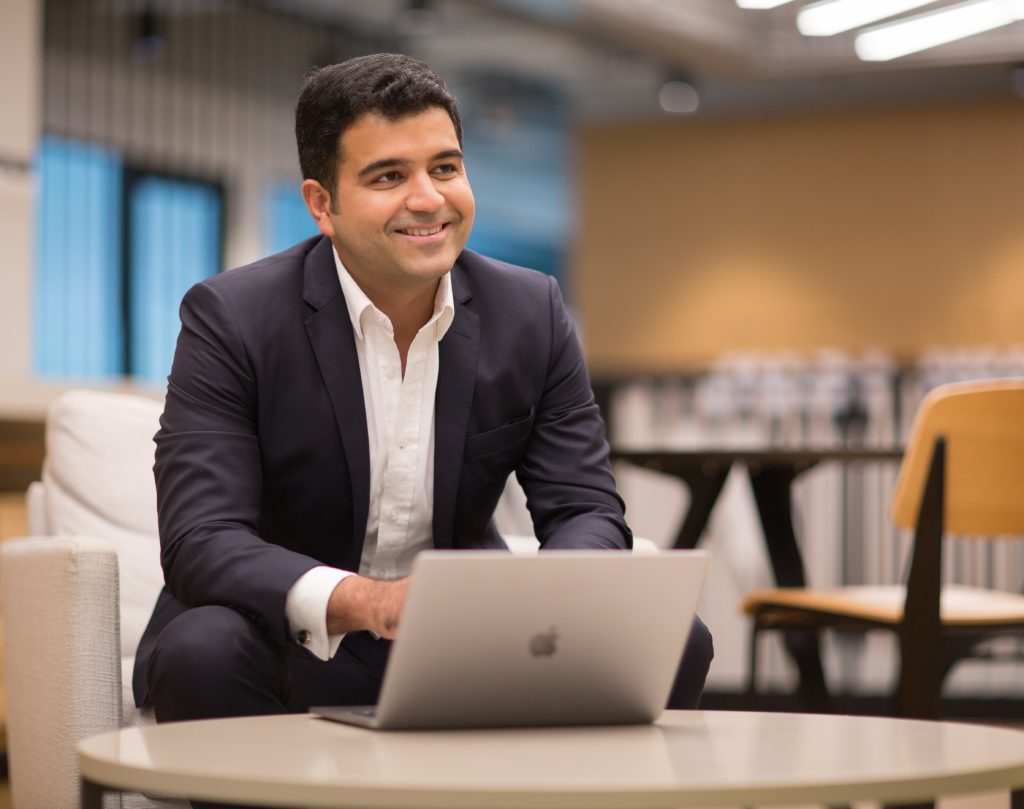
In Syfe’s recent Reddit AMA, we openly invited the community to ask our founder and CEO, Dhruv Arora, anything—unscripted and unfiltered. We received questions from curious first-time investors to seasoned market watchers that covered everything, from what makes Syfe different from other investment platforms, how we approach risk and portfolio construction, and how investors should approach uncertainty in today’s markets.
Here’s a curated selection of those questions and answers which sparked meaningful discussion.
If I want to own active managed portfolios, why shouldn’t I move forward with Avantis, which offers low cost Irish domiciled funds? Or Dimensional, which are similar but have a legacy?
I ask this because Syfe (as of time of writing) just launched a new fund: Equity Alpha, expertly designed to beat the market. Why does Syfe charge a fee (0.65% + 0.20% for a total of 0.85% TER) to access active managed funds? Wouldn’t customers be more inclined to invest into low-cost funds or funds that invest in those core strategies?
Dhruv:
Starting off with the most upvoted one!
There are several good questions in here, and I am going to try to get through all the different aspects.
On Equity Alpha
Passive investing remains Syfe’s foundation. Whether at the ETF desk or my time as a portfolio trader (at UBS) I covered many global long only funds and sovereigns and I still firmly believe in passive long term investing.
Having said that, we are living in extreme geopolitical uncertainty and we’ve had users who want different ways to navigate today’s volatility — Equity Alpha is just one of the ways we are evolving to provide that choice for our users. Users who’ve grown with us have been asking for different investing options and more hands-on, active style investing. The word here is “option” and it’s an option not typically available to retail which we’ve now added. We talk about Syfe being built for access, advice and affordability — this is access for those who want it.
Why JP Morgan?
We could have chosen any asset manager, but this is the value our team brings, we spoke to multiple asset managers, conducted rigorous back testing and forward simulations on model portfolios, pricing, taxation, and came to a conclusion these were the best for an active ETFs portfolio. These ETFs are UCITS (better tax structure), are managed actively, but their average expense ratio is only 0.23% (very close to passive ETFs). Might be worth mentioning, JP Morgan is the world’s largest active ETF manager and has achieved over 20 years of consistent outperformance.
We do not have a bias toward any one asset manager. For example, we use Dimensional for our Core portfolios. We select the best-in-class for each specific need: PIMCO for our income offering, Blackrock UCITs for Equity. That’s a core part of the Syfe value-add: we do the research and managing so you don’t have to. If you value a curated, managed experience, we have it. If you already know what you want and prefer a DIY approach, that’s also understood. But again, this is about choice and a user’s preferred way to invest, our goal is to give the choice.
On Fees, Commissions & Rebates
Syfe does not earn any commissions or rebates from JP Morgan from this relationship, and we always pass 100% trailer fee rebates to our users. Sometimes on other platforms you might get zero fees, but it’s because they work on a trailer fee model, where they charge you 0, but get kickbacks from the fund managers. It’s still the most common way most funds / unit trust platforms work (and sometimes they add entry/exit fees).
We charge a transparent fee as any business providing a service and it’s what you see. Our investment team — including top tier quant traders and researchers — play a critical role in curating and managing the portfolios along with a string of platform features that are all included.
[RELATED: Syfe Pricing]
What value add to the customer does the wealth manager add? What incentives or bonuses do your wealth manager have for their KPI, sales targets or quotas?
Dhruv:
I do get why people question the value of traditional relationship managers — I had a difficult experience with “wealth manager” at a major SG bank back in 2018, and how pushy they were selling me a fund of fund product. This made it clear for me what I don’t want Syfe to be.
For that reason, the set up and role of our wealth advisors is entirely different. They are salaried professionals with in-depth financial expertise, many coming from places like Goldman Sachs or UBS, whose role is to provide a human layer of advice on top of what technology captures.
There is also a big difference in how we measure success. There are no sales targets or product quotas, nobody is incentivised by commissions. KPIs are tied to client satisfaction and the long-term growth of the business. And with no entry/exit/switching fees — we only do well if our clients do well — this is an alignment which was uncommon when we started in 2019.
Our experts help with complex decisions like retirement planning, or transitioning from a growth-focused portfolio to one that generates steady income. They’re also there to guide during market volatility and help navigate the bigger picture. They provide comprehensive wealth advisory that helps you reach your specific life goals. Anybody can book an appointment online with one of our advisors — no minimum investment required. But the biggest difference (and this is often forgotten) is access to wealth experts is totally optional — our platform is designed for 100% self service. You don’t have to speak to someone if you’d prefer not to. But if you do, I can promise you one thing: you’ll be delighted with how non-salesy they are. We have clients who have $20K and appreciate the conversations, and then those who have $1m and have never spoken to anyone at Syfe.
The point is that we believe commission-based incentives drive the wrong behaviours.
Our fee is the same regardless of whether you choose Equity100, Income+, REIT+, etc. There is no “better” product for our bottom line, and no advantage to us if you switch between products. Most conventional platforms make money on entry fees, exit fees, switching fees and then ongoing trailer fees (which can be higher on one product over another); we only earn our all-inclusive AUM management fee — no commissions or kick backs.
The service you receive is a result of our entire team — investment, operations, tech, support and more — working together. Incentivising just one part of that (e.g. the advisers) through commissions would be wrong. Sure, they play a role, but so does everyone on the team.
Our bottom line only grows if your assets grow and you stay with us long-term. If an adviser gives bad advice just to close a sale and you leave a month later, we’ve failed. And ultimately, it’s entirely up to you whether you lean on our advisory team or not. A lot of Syfe users never speak to any of our advisers, and that’s the point of a truly self-serviceable platform — this is just not possible in traditional firms, where the first point of contact will always be an adviser.
And that’s why we are challenging the status quo — a shift from a transactional relationship to a longer-term relationship.
If Syfe ever closes down, how is our money protected and how will we get our money back? Is the money in Syfe trade SIDC insured?
Dhruv:
Thanks for asking about this, it’s a very important one. SDIC is a common point of confusion. SDIC covers cash deposits in bank accounts. Investments, even if made through a big bank, are not SDIC protected. Since Syfe is an investment platform (CMS licensed), and like any other investment platform/bank you might use for investing, they are also not covered for SDIC.
So how do we safeguard client funds? What we deliberately do is use asset segregation. Your investments are held by the world’s largest custodians (HSBC, Citibank, etc). This means your assets are ring-fenced from Syfe’s own corporate funds — your assets remain 100% yours. In the unlikely event Syfe goes into liquidation, client money remains protected and cannot be claimed by Syfe or Syfe’s creditors. Watertight systems are in place to safeguard our users.
Even though I’ve had this question (and rightly so) from the day we started the business, it’s a good moment to highlight the position we are in today as a business. We’re licensed and regulated by MAS, as well as two of the other most respected regulators in the region, ASIC (Australia) & SFC (Hong Kong). Syfe reached Group-wide profitability in last quarter, despite the growth in the business and that’s important because we have achieved it through cost-discipline and steady, measured growth. It also means we’re self-sustaining and here to stay!
Is it fair to say that investing in low cost index funds (let’s say VOO or VT) beats a large majority of active fund management? If this is true, why should a retail investor ever pay a fee for active management?
Dhruv:
Is it fair to say low-cost index funds beat most active managers? In short, yes. At Syfe, we’ve always believed that passive investing is the most reliable foundation for long-term wealth building. This is why our core portfolios are built on a passive, diversified foundation.
So, why would a retail investor ever pay for active management? While passive is the foundation, active management is an option for specific outcomes. We’re living in extreme geopolitical uncertainty and some users want different ways to navigate today’s volatility. Active management is one option to cover that. The fee, as with any business as a service, is for the convenience of institutional-grade stock-picking, research and portfolio management i.e. rebalances that some investors don’t have the time or experience to perform themselves. Again, that’s not needed or wanted by everyone; it’s an option that some users prefer and it’s now available.
Do you believe in active stock-picking for retail investors?
Dhruv:
If you have the knowledge, the interest, and the time to stay informed, stock picking might be a powerful way to learn about the world and potentially capture outsized returns. But to the point above, do you then become the active manager?
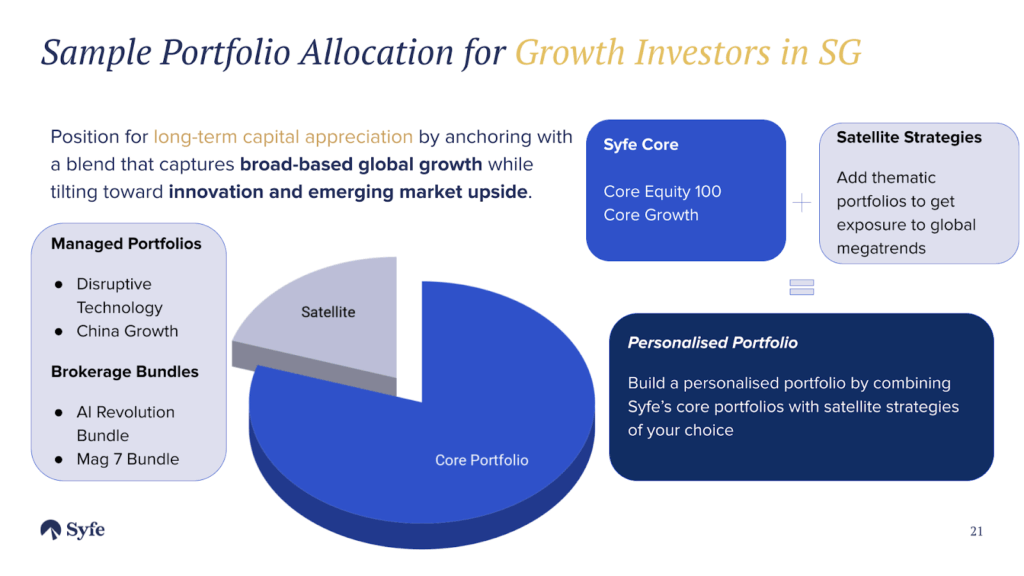
For many, having a “core” passive portfolio for safety and a “satellite” stock-picking portfolio for interest could be a good balance.
[RELATED: Core-Satellite Investing In Singapore: A Practical Guide]
How do you explain Syfe’s heavy weightage into China for its Core portfolios just before it crashed a few years ago, before cutting exposure to China and missing out on the subsequent rebound from end-2024? Why should I trust Syfe’s weightage instead of just going with VWRA?
Dhruv:
Glad you asked this question, as there’s some misunderstanding and clarification is needed.
We have always maintained a strategic overweight to China in our Core portfolios. This was true in 2021, and this is true today. We’ve never drastically cut any allocation, which allowed us to capture the subsequent rally in 2024. In fact, we’ve only rebalanced due to small drifts in our model, with no changes made in 2021 or 2022, and a first change of a 1.5% weightage decrease in Sep 2023, and a ~2.8% decrease in Sep 2024. Meaningful but hardly drastic relative to China’s scale in the portfolio which was ~16% at its high. For simplicity, I am referring to our flagship Equity100; the shift is even lower as you move to more defensive portfolios, given their lower overall equity allocation.
We are overweight in China because it is fundamentally under-represented in global equity benchmarks compared to its GDP contribution. China contributes ~20% of world GDP and ~30% of world growth, yet its allocation in the MSCI ACWI is ~3-4%. The indices have not captured the evolution of the world’s economies, even though China’s GDP is growing 3x faster than the US, and is expected to overtake the US in the next decade. This is one of the main reasons why Syfe’s Core Equity100 portfolio has historically had higher-than-benchmark allocations to China compared to the traditional benchmarks.
You are correct to say it impacted portfolio performance later in 2021 and 2022 as China came off sharply, but we captured a big part of the recovery in the 2024 rally. Even today, China is ~9% of E100 (even after the significant Mark-to-Market moves that have pulled this allocation down). Still overweight vs benchmark, and our core strategy has not changed.
The increase and decrease of China or any allocation cannot be seen in isolation. It has to be seen in the overall context of the entire portfolio and based on these factors: the risk reward (Sharpe ratio), expected return, risk modelling and more, things we do at each rebalance — so that points to marginal trimming (we are talking 4% in 4 years? 1% a year in absolute terms). So while something might look like a buy high and sell low in hindsight (who would do that intentionally?), what about something that was bought at that point at the lows which outperformed? That’s the point of a portfolio: diversification.
Our long-term view is that as the market broadens and US exceptionalism wanes, it is important to have the core principles of diversification embedded into your equity portfolios. Following global benchmarks that are majorly concentrated and dominated by US mega caps poses its own significant drawdown risks. Instead, our strategy allows us to continue capturing the upside from the resurgence of Chinese equity markets as and when that happens.
Ultimately, different investors have different views on strategy, and you should choose the model you have the most conviction in. If you prefer a pure market-cap weight that leans heavily into US Mega Caps, VWRA is great. If you believe in a core strategy that aligns more closely with global GDP and growth fundamentals, then our approach might resonate more.
Why did you venture into brokerage since it’s already so competitive? What competitive edge does Syfe have over the robot advisory?
Dhruv:
It wasn’t about having another product, we launched Syfe Trade as a key step to our all-in-one wealth hub where users can save, invest, trade. We’ve always felt that wealth for anyone should not be seen across multiple apps and platforms, but in one place holistically. As digital advice scales and becomes better each day, we also ensure that we can offer the complete picture to any individual irrespective of how big or small their overall portfolio is.
Back in 2022 when we launched our brokerage offering, a lot of investors were using us as a digital wealth manager (the “robo-advisor” era — a name we seldom use, by the way) for their long-term wealth, and then had to jump to a different, often complex platform for trades — and this remained a pain point for our users. By launching brokerage, we closed that loop.
Syfe Brokerage is not built like incumbent or overseas platforms which are often copy pasted from home markets. We built it here in Singapore with user feedback on what matters to them — a simple belief that trading should not be complicated or hard and that simplicity and ease must sit at the heart of our platform and it’s why the offering exists. We made it super easy to use, while ensuring all the relevant information and data points are there for informed decisions.
We set the scene as the first brokerage to offer fractional trading for US stocks, free monthly trades, and we’ve continued to expand, adding SG and HK markets, UCITS ETFs, and in the coming weeks, full LSE access. Options trading is a great recent example. Most platforms make them look and feel very complicated, but we launched ours differently because you should be able to manage your risk or generate income without needing a PhD in Finance. The proof of all of this is the uptake of Syfe Brokerage that we’ve seen and continues growing.
What competitive edge does Syfe have over others?
Dhruv:
Ultimately, the ‘best’ platform depends on what you need as an investor. But the TL;DR on why Syfe:
We are the only ones offering truly holistic wealth management. You can move between Managed Portfolios (if you need advice/curation), brokerage (if you want to do it yourself), cash management (higher yield on your spare cash) and more — all under one roof. No app-hopping to manage all your investments.
We aren’t restricted to just one type of product type (e.g. funds). We use whatever provides the best outcome — whether that’s through ETFs, institutional funds (always with 100% trailer fee rebates), or even single stocks. It’s more expensive and cumbersome for us to manage than a funds-only model, but it’s the right thing for the user.
We partner with the world’s best — BlackRock, J.P. Morgan, PIMCO — to give you access to the best products (many unavailable in the past) but also where it makes sense, build our own products. Syfe REIT+ is proprietary and cheaper to access than any ETF, and has consistently outperformed benchmark.
This has helped us become one of the largest digital wealth platforms in APAC with which, we also reached group profitability last quarter, so we’re self-sustaining and here for the long haul.
Can there be more frequent trade on UCITs rather than one per week?
Dhruv:
We heard your feedback. Real-time execution is coming soon to the London Stock Exchange (LSE)! This includes both a broader set of UCITs as well as the entire gamut of LSE stocks.
What is one investment lesson/advice in your journey you learned early on and still applying today? Where do you see Syfe 10 years from now?
Dhruv:
Start early, don’t wait for a “corpus” to begin because now it’s possible to start even with small amounts and top-up consistently. It’s more about time in the market than timing the market.
In a lot less than 10 years from now, we’d love it if people referred to “Syfe it” as the default way to build their wealth. We want to take stress and time away from managing money — and have it working for you at all times.
If you have to give your kid $25K today, how would you invest for them until they turn 21?
Dhruv:
I would invest in a 100% Equity portfolio as my child is young and has time (and hence a higher risk taking appetite). Over a long term, equity portfolios will give better risk adjusted returns and besides a longer duration helps one ride out market volatility. I’ve done exactly this for both of my children — created a portfolio of 100% equities and it’s a set and forget.
Thank you for making the Syfe user interface user-friendly. Thank you for simplifying Options trading too. I find Syfe useful for beginner-investors. The interface is pleasing to the eye and doesn’t overwhelm me.
Dhruv:
Fantastic to hear! Thanks a lot for the great feedback on Options. We felt really strongly that a sophisticated product like this shouldn’t have to look and feel as complicated as it is on so many other platforms. It should be intuitive whether you’re a pro or just starting out.


You must be logged in to post a comment.