

Not all cash is meant for the same goal.
The money you’ll need next month shouldn’t be treated the same as the money you’re saving for five years from now. By giving every dollar a clear purpose, you can make smarter decisions about where to keep your cash—balancing accessibility, certainty and returns according to what each dollar is meant to achieve.
This guide explores how you can structure your money according to its purpose, timeline and the trade-offs you are comfortable with.
Every Dollar Has a Job
One of the biggest misconceptions in personal finance is that cash is just cash.
Many people keep all of their money in a single savings account, whether it’s for next month’s bills, next year’s holiday, or a home purchase several years away. This might feel simple, straightforward and fuss-free, but it can also mean that your money isn’t working as effectively as it could.
Think of your money as a team of employees. Each employee has a different role. Some are responsible for handling today’s expenses, some are preparing for future opportunities, and others exist solely to protect you from life’s curveballs.
Your dollars deserve the same clarity.
Rather than asking, “Where should I put my cash?”, a better question is “What is this particular dollar meant to do?”
Once you know its purpose, choosing where to keep it becomes much clearer.
Why All Cash Shouldn’t Be Treated the Same
Knowing when you will need the money is the first step—but time horizon alone does not determine where it should go.
Two goals may both be 12 months away, yet require different approaches. You may need to draw on one fund progressively, while another may be tied to a fixed payment date. You may also be comfortable accepting some short-term fluctuations for higher potential returns on one goal, but not another.
Once you know when the money is needed, consider three further factors: liquidity, certainty and your tolerance for volatility.
Liquidity
Might you need to withdraw the money at short notice or in stages? The more immediate or unpredictable the need, the more important liquidity becomes.
Certainty
Do you need to know how much will be available on a particular date? For fixed commitments, certainty may matter more than pursuing higher potential returns.
Tolerance for volatility
Can you accept temporary fluctuations while the money remains invested? A longer time horizon may create more room to pursue higher potential returns, but it does not remove investment risk.
The right solution therefore depends not only on when you need the money, but also on the access, certainty and level of volatility you are comfortable with along the way.
Different Cash Strategies For Different Goals
Emergency Fund
Your emergency fund is your financial safety net. Whether it’s an unexpected medical bill, urgent home repairs or a sudden loss of income, this money needs to be available when life happens, not after waiting through lock-in periods or market recoveries.
The priority here is accessibility, followed by capital preservation. Returns are a bonus, but shouldn’t come at the expense of being able to access your funds quickly.
Holiday Savings
Saving for a holiday usually comes with a known timeline. If you’ve planned a family trip in 12 months, your objective isn’t to maximise returns. Instead, you want your savings to grow steadily while remaining available when it’s time to book flights and accommodation.
This type of goal often benefits from balancing accessibility with the opportunity to earn more than a regular transaction account.
Home Renovation
Renovation costs can be substantial, and they often arrive in stages—from paying deposits to settling final invoices.
Because the timeline is usually planned in advance, your money can potentially be placed somewhere that offers more attractive returns while still providing confidence that the funds will be available when contractors need to be paid.
Predictability often matters just as much as returns.
Home Purchase
A property down payment is one of the largest financial milestones many people work towards.
If your purchase is expected within the next few years, preserving your capital becomes increasingly important. A sudden market downturn shortly before completion could affect your purchasing power if those funds are invested too aggressively.
For goals like these, certainty and disciplined saving often outweigh the pursuit of higher-risk returns.
Future Investments
Sometimes cash is waiting to be invested instead of spent.
Perhaps you’re gradually building funds before deploying them into the markets, or you’re waiting for the right opportunity while continuing to contribute regularly.
In this case, your money still deserves to earn competitive returns while remaining ready when investment opportunities arise.
The objective is to avoid having idle cash sitting unproductively while you wait.
A Simpler Way to Organise Your Money
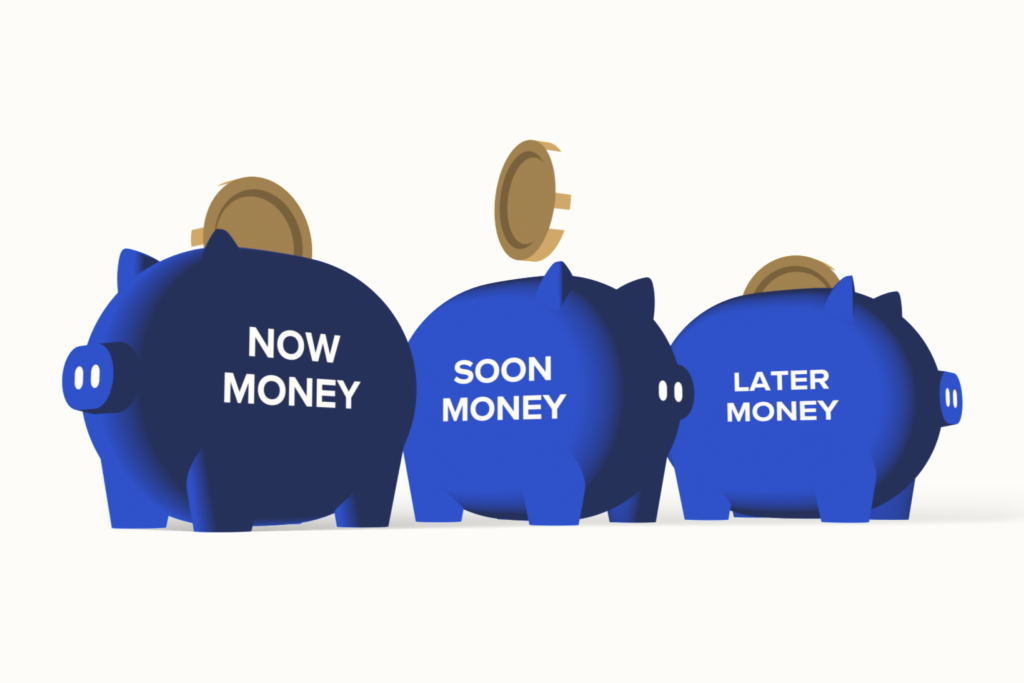
Instead of creating dozens of separate accounts, consider organising your cash into three broad categories: “Now” cash, “Soon” cash, and “Later” cash.
| Type of Cash | “Now” Cash | “Soon” cash | “Later” cash |
| When it might be needed | Immediately or unexpectedly | Within the next 1–3 years | More than five years away |
| Main Priority | Ready access | Depends on the goal: access, certainty or attractive yield | Long-term growth |
| Questions to ask | Can I access it quickly? | Is the date fixed? Might I need it early? Can I accept fluctuations? | Should this money remain in cash or be invested? |
| Examples | Emergency fund, monthly expenses, everyday spending | A holiday, wedding expenses, renovation costs, car purchase, education fees or home down payment | Retirement and other long-term goals |
Thinking in terms of “Now”, “Soon” and “Later” creates a clearer financial system than viewing all your cash as one large pool.
Instead of asking where to put your money, you simply ask which bucket each dollar belongs in.
Beyond timing: what does your money need to do?
Once you have identified when the money may be needed, consider what must happen between now and then:
- Could I need to withdraw it unexpectedly or in stages?
- Is there a fixed date by which I need the full amount?
- Can I leave it untouched for a set period?
- Can I accept temporary fluctuations for attractive yields?
Two goals with similar timelines may lead to different choices. A renovation fund may need to be drawn down progressively, while another planned expense may have a fixed payment date.
Matching your cash to the right solution
Once every dollar has a purpose, choosing an appropriate cash solution becomes much more straightforward.
The next step is deciding what you need from that money along the way. Rather than relying on a single account to do everything, different solutions can work together to support different priorities.
| Situation | Main priority | Trade-off | Potential fit |
| The money may be needed at short notice | Liquidity and stability | More modest return potential | Cash+ Flexi |
| The money is not needed for at least 12 months | Attractive yields while retaining access | Possible short-term volatility | Cash+ Enhanced |
| The money is needed on a known date and can be locked away | Certainty at maturity | A fixed lock-in period | Cash+ Guaranteed |
For money that needs to remain readily accessible, Cash+ Flexi is designed for those who value liquidity while still seeking attractive returns on their idle cash.
For savings with a defined medium-term goal, Cash+ Enhanced offers attractive yields on funds you will not need for 12 months or more, with no lock-in or minimum investment.
For cash set aside with an emphasis on certainty, Cash+ Guaranteed is designed for those who prefer knowing what they’ll receive at maturity, making it suitable for planned future milestones where predictability matters.
Rather than competing with one another, each solution serves a different purpose within an overall cash strategy.
Together, they allow you to organise your money according to what each dollar is meant to accomplish.
Final thoughts
There’s no single “best” place to keep your cash because not all cash has the same job.
The money you’ll need tomorrow should be treated differently from money you’ll need in three years and money you’re setting aside for longer-term opportunities.
By organising your cash according to purpose instead of convenience, you can strike a more thoughtful balance between accessibility, certainty and return potential.
Ultimately, every dollar should have a role. And when each dollar knows where it belongs, your financial plan becomes simpler, more intentional and better aligned with your goals.
Explore options for your money with Syfe’s cash management solutions today.


