Investing is rarely a straight line. The decision to start, the amount people feel able to invest and the goals they set for their money can all change as life unfolds.
A first job may bring new opportunities to build wealth. Buying a home or supporting aging parents can put pressure on available income. Retirement can change the purpose of accumulated savings, while confidence in investing may vary across age groups and gender.
Syfe commissioned a YouGov study across Singapore, Hong Kong and Australia to explore how people approach investing, what holds them back and – importantly – how their financial behaviour changes at different stages of life.
The findings reveal a recurring tension: wanting to invest is not always the same as feeling able to do so. We call this the intention gap. It can reflect competing financial commitments, concerns about potential losses, uncertainty about investment choices or changing priorities.
The study reveals important differences across markets and generations. From the notable confidence decline with age in Singapore, to the reverse trend in Hong Kong, to the gender financial gap that doesn’t close in Australia, there is no single experience of investing.
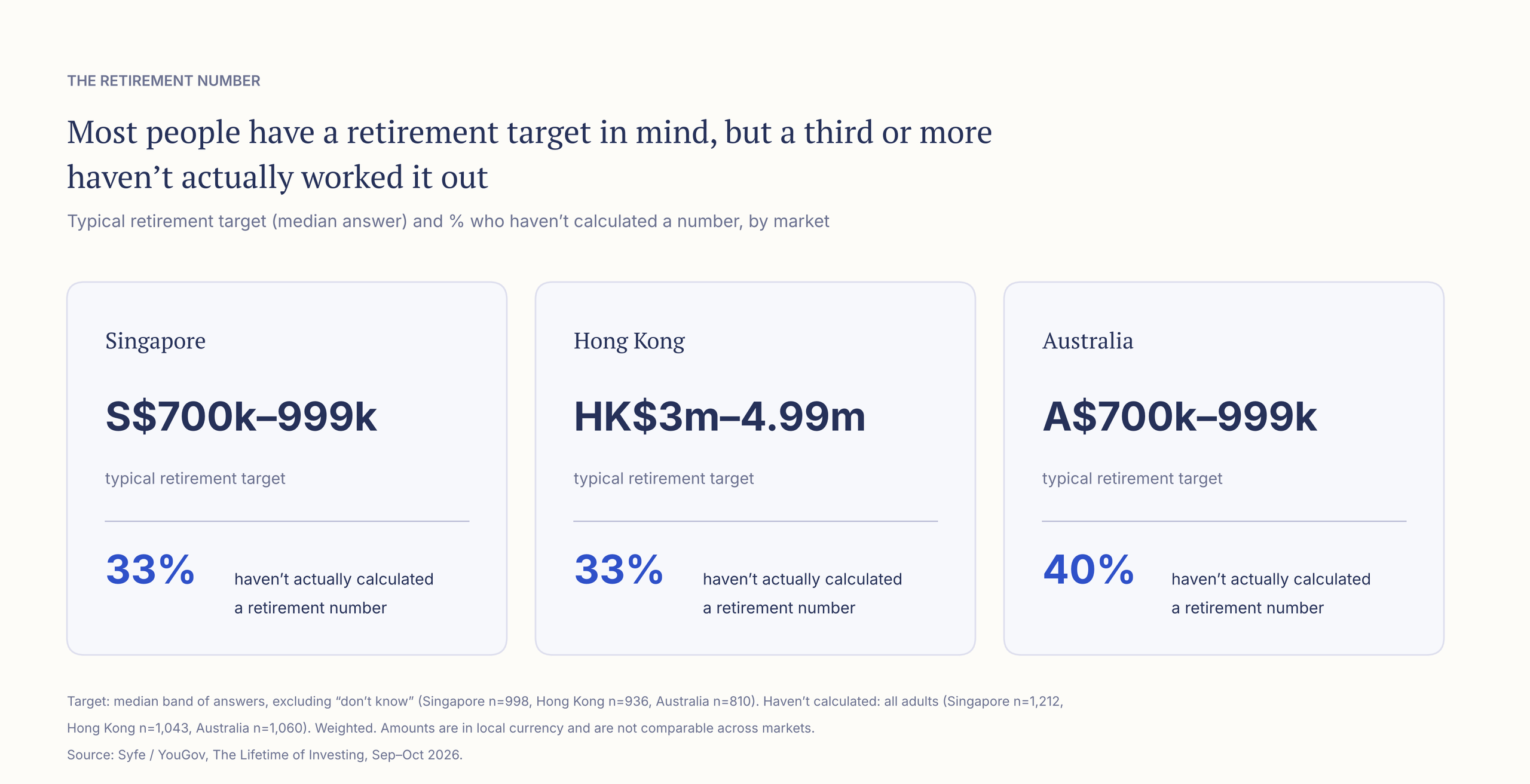
Retirement plans are also shifting. Fewer people are aiming for a traditional full retirement, and many are guessing what it will cost: a third or more have never calculated a savings target, and 1 in 5 simply picked a round number.
Understanding these differences offers a clearer picture of what investing looks like over a lifetime.
Below are the five key findings at a glance. Further down, we explore each one in more depth, with a note for investors at the end of every section.
Key findings: Five things the study reveals
1. A first salary isn’t a guaranteed start to investing, and life’s milestones can put the brakes on.
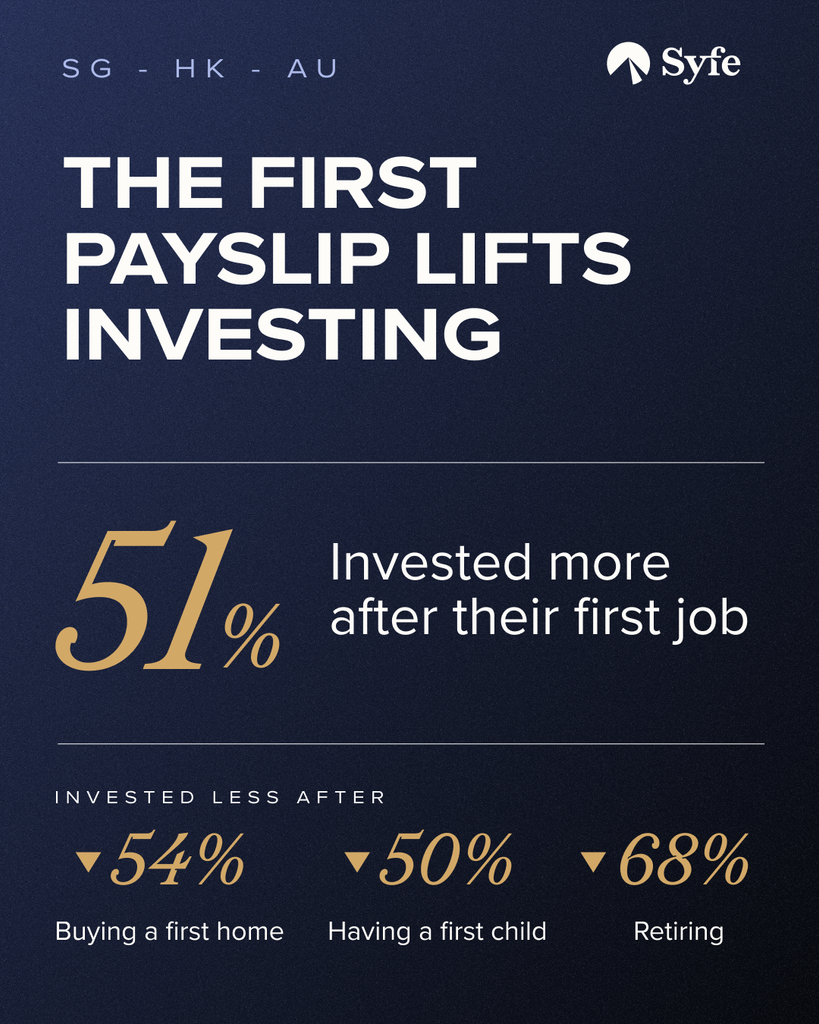
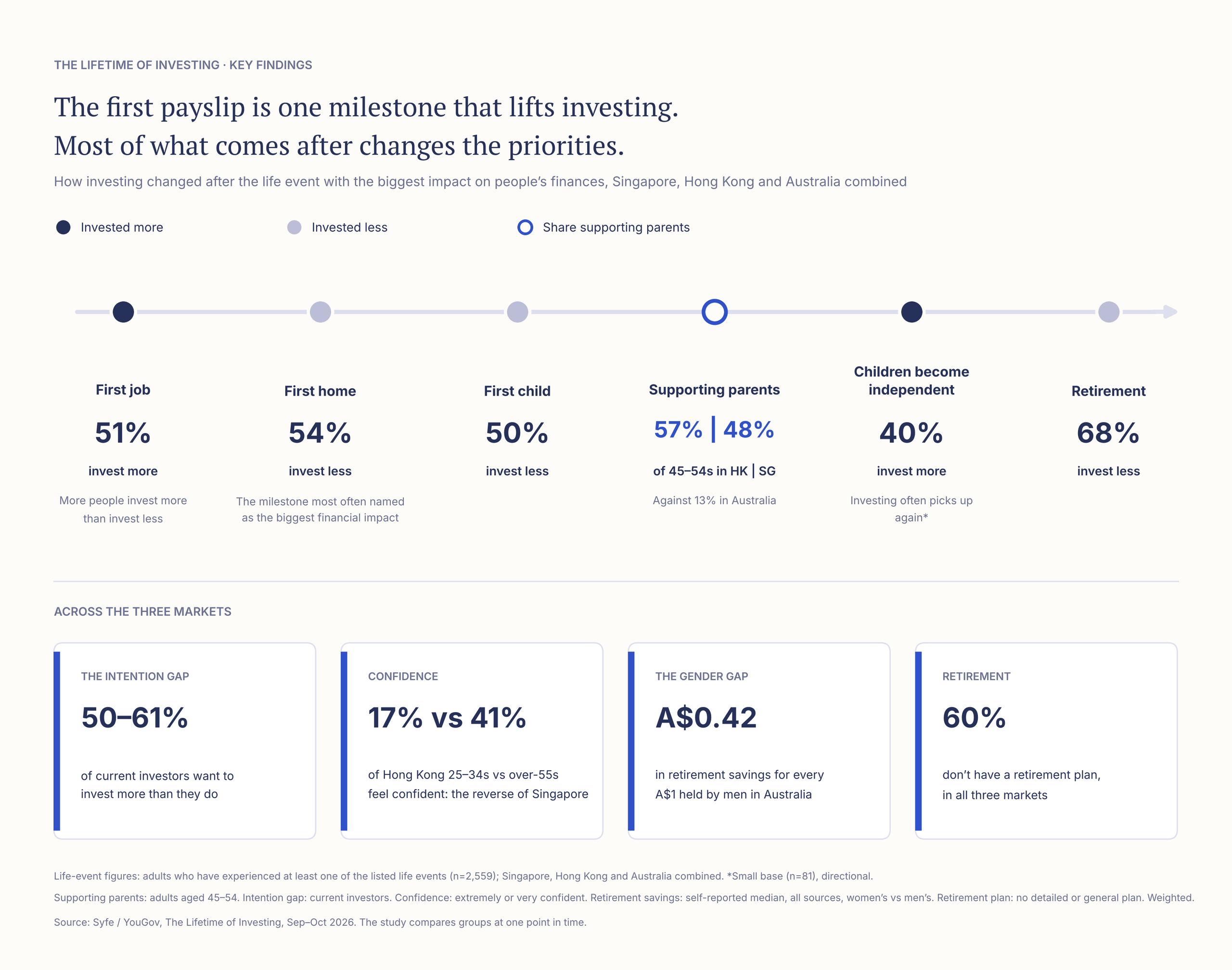
Our survey found that only half (51%) of people invested more after starting their first job. The rest held steady (38%) or even invested less (11%). This indicates that starting to earn a regular wage doesn’t necessarily translate to people investing more.
Most later milestones pull investing back: buying a first home (54% invested less), having a first child (50%) and retiring (68%). Housing stands out in the budgets of those who say they can’t afford to invest: in Australia, 56% of them list it among their biggest costs, against 35% of others. In Hong Kong and Singapore, supporting aging parents adds further pressure.
2. The desire to invest more is strong. What holds people back is budget and caution about losses.
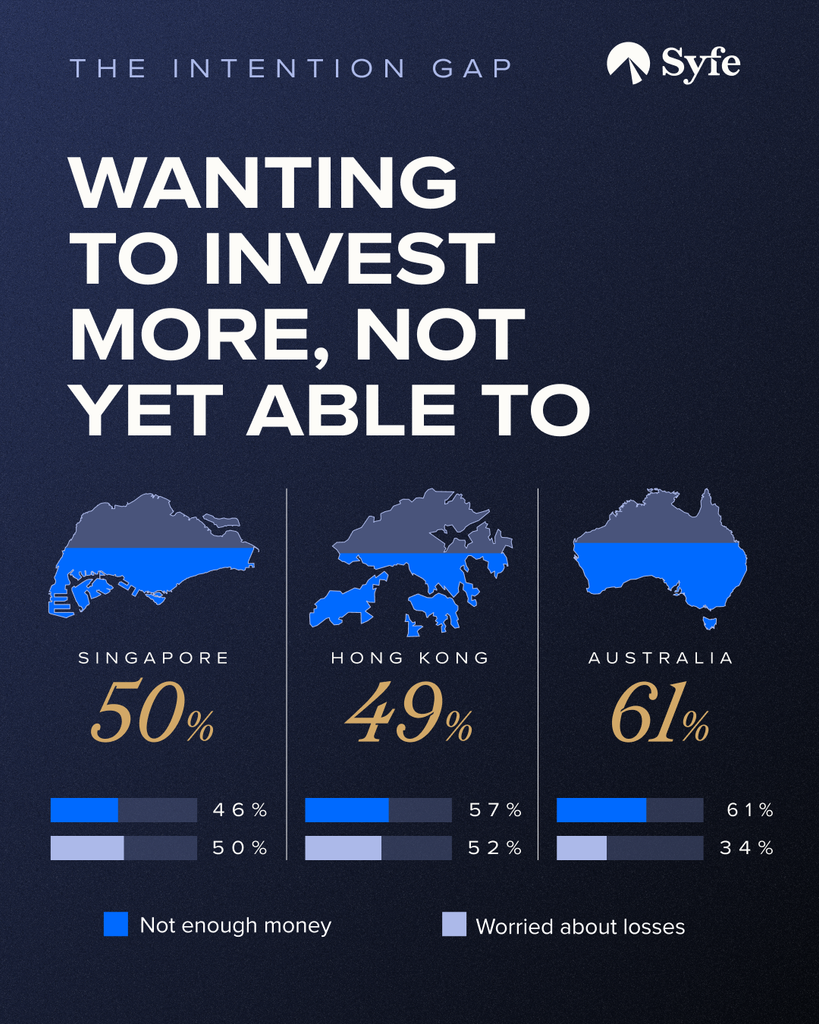
Half or more of current investors want to invest more than they do across all three markets (50% Singapore, 49% Hong Kong and 61% Australia). In Singapore and Hong Kong, concern about losing money weighs almost as heavily as having enough to invest. In Australia, affordability is the main barrier. That caution shows in what people look for: across the three markets, 52% rank stability among their top two priorities when choosing an investment, against 40% for growth.
3. Investment confidence varies sharply by market and age.
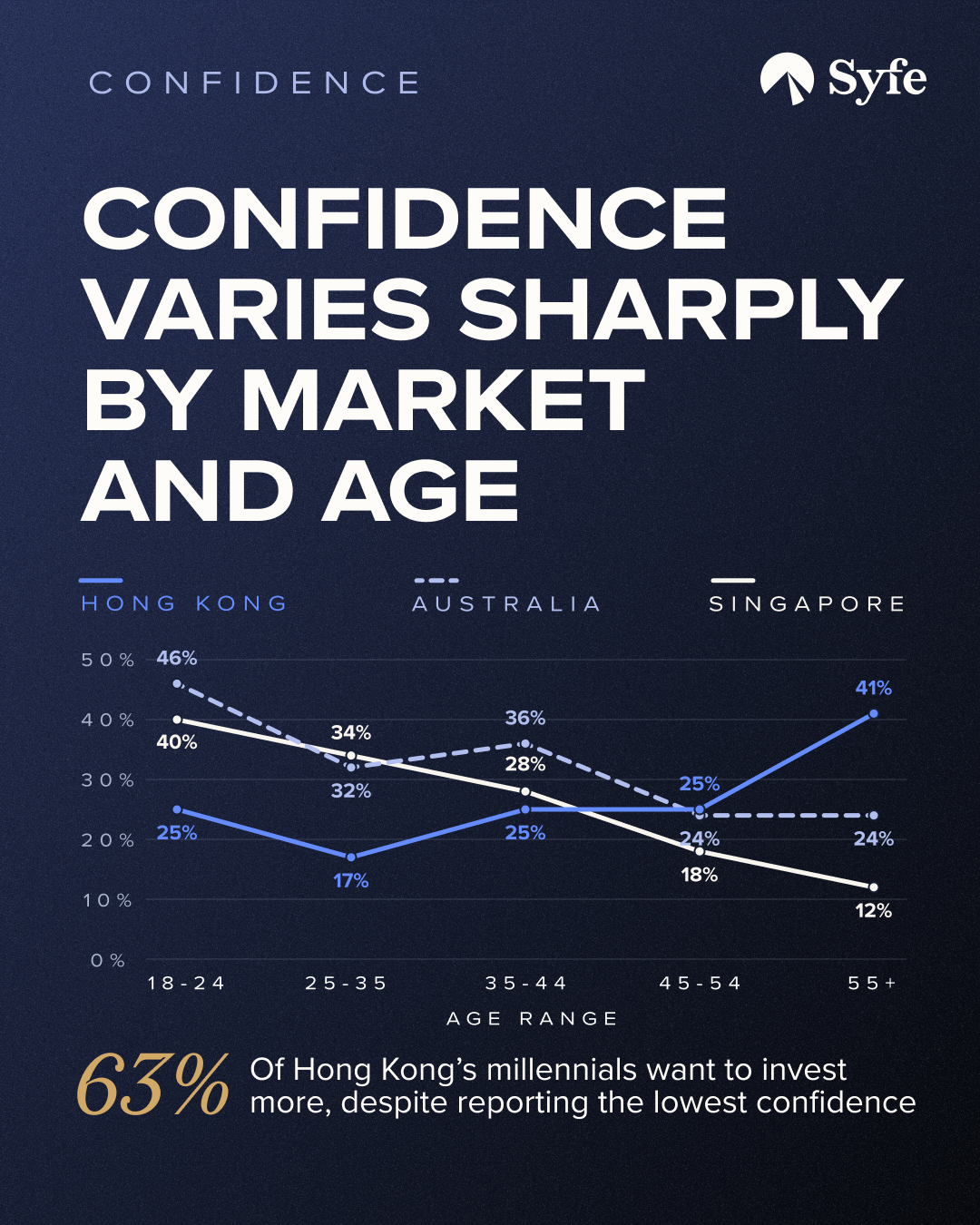
37% of Singaporeans, 32% of people from Hong Kong and 31% of Australians say they’re not very or not at all confident making investment decisions. In Singapore and Australia, younger adults are the most confident. In contrast in Hong Kong, confidence is highest among over-55s. Hong Kong’s 25–34s stand out: they’re the least confident age group (only 17% feel confident) yet among the most eager to invest more (63%).
4. Women are just as motivated to invest, but gender gaps persist in confidence and retirement savings.
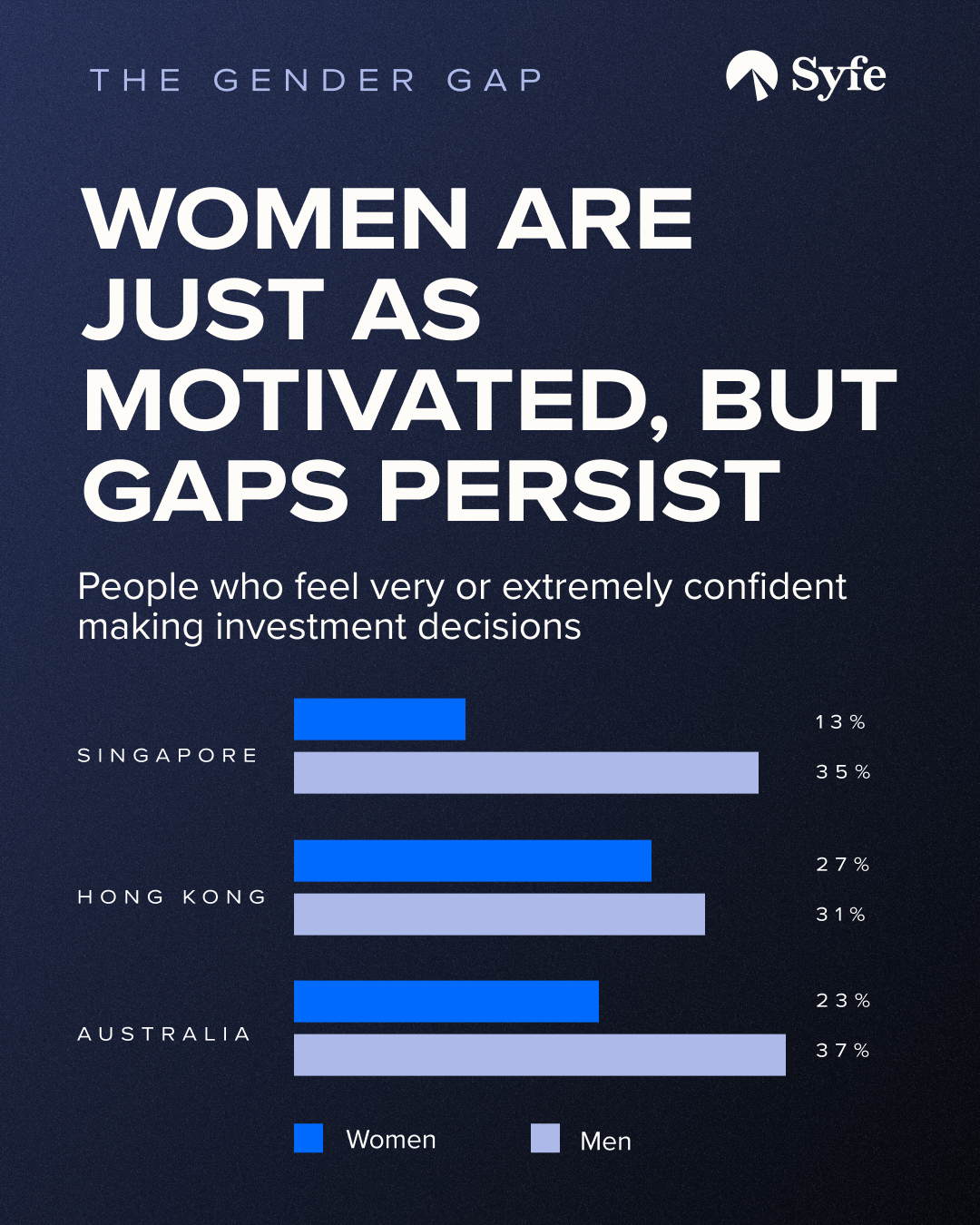
Singapore has the widest confidence gap (35% of men vs 13% of women), while Australia has the largest retirement savings gap (A$120,000 for men vs A$50,000 for women). Hong Kong comes closest to gender parity on both measures.
5. Most people are behind on their retirement savings, and many are aiming for a round number they never calculated
Between 72% and 86% say their savings are below what they expect to need, yet 33–40% have never calculated their retirement target. Despite changing retirement ambitions, only 40% of adults in each market have a retirement plan.
1. Starting work isn’t a guaranteed start to investing
Starting a first job is a major life milestone where more people increase their investments than reduce them, but the response is far from universal. Across the three markets, 51% of people whose biggest financial milestone was starting their first job invested more afterwards. Singapore leads at 65%, compared with 49% in Hong Kong and 42% in Australia. This suggests that entering the workforce can create an important window for building investment habits.
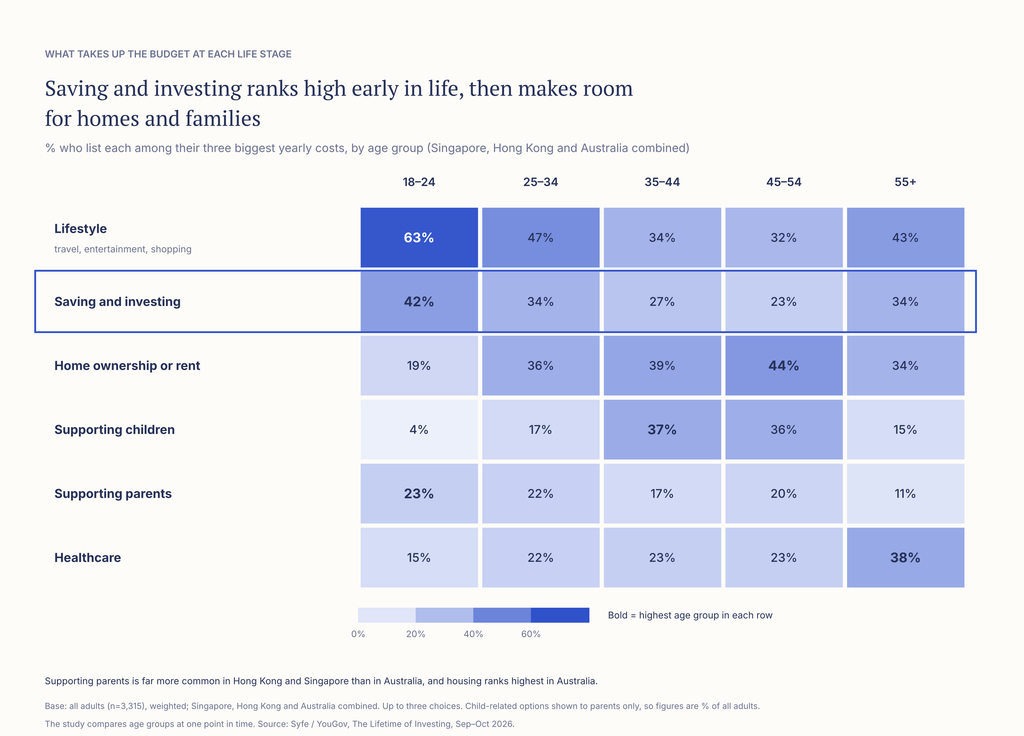
However, the pattern changes as financial responsibilities accumulate. More than half reduced their investments after buying a first home (54%) or having a first child (50%), rising to 68% on retirement. In Hong Kong and Singapore, supporting aging parents adds another layer of financial pressure. Among respondents in Hong Kong aged 35–54 who support their parents, half say they lack sufficient money to invest, compared with 39% of those who do not.
What fills the budget helps explain why. In all three markets, people who say they don’t have enough money to invest are about twice as likely to list debt repayments among their biggest yearly costs: 17% against 8% in Singapore, 17% against 9% in Hong Kong and 15% against 9% in Australia. Housing adds to the pressure in Australia, where 56% of those who say they can’t afford to invest list it among their biggest costs, against 35% of others, and to a lesser extent in Hong Kong (43% against 37%). In Singapore, the housing gap is concentrated among 25 to 34-year-olds (41% against 24%). Lifestyle spending such as travel and entertainment is a major outlay for younger adults in every market, but it’s almost as common among those who do feel able to invest. It’s fixed commitments like debt and housing, not lifestyle choices, that most separate the two groups.
The good news is, there are signs that investment capacity can recover over time: 40% invest more once their children become financially independent. This highlights how investment behaviour is closely tied to changing financial responsibilities, rather than simply age or income.
A note for investors
Big moments in life change what your money is for. It’s normal for investing to take a back seat to a first home or a growing family for a while. What helps is keeping it in the plan, even at a smaller size. A modest regular amount, set to go in automatically, keeps the habit going while the budget is stretched, and it can be stepped up again when costs ease. Looking at your investing at these points of change, not just once a year, helps it keep pace with what matters to you now.
2. The intention gap: wanting to invest more, not yet able to
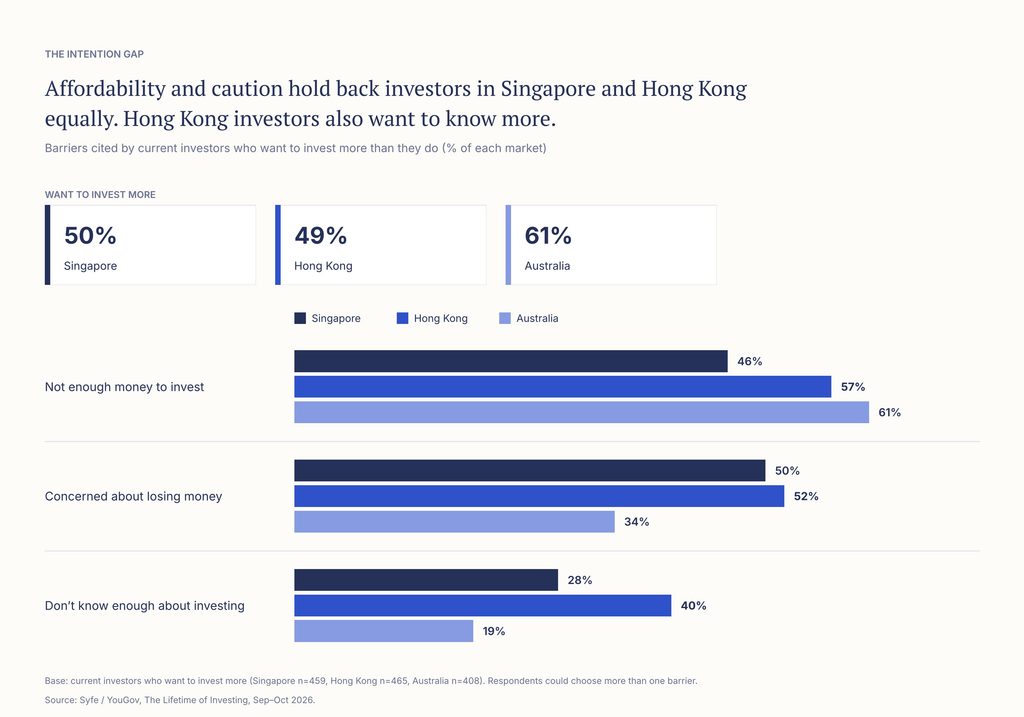
The appetite to invest is clear in all three markets. Half of current investors in Singapore (50%) and Hong Kong (49%) want to invest more than they do now, and in Australia it’s even higher at 61%.
The gap is widest among adults aged 25-34s, as much as 72% of Australians whom want to invest more.
What holds people back and creates the gap differs by market. In Singapore and Hong Kong, affordability and caution about losses weigh almost equally. In Singapore, 46% of those who want to invest more say they don’t have enough money, while 50% are concerned about potential losses. Hong Kong shows a similar pattern (57% and 52%), but interestingly, knowledge is a key obstacle, with 40% saying they “don’t know enough about investing.
Australia presents a different picture. Here, not having enough to invest is the dominant factor, cited by 61%, while only 34% are concerned about losses. Among Australians 25-34, 54% prioritise building savings before investing.
The caution shapes what investors look for in an investment. Across the three markets, 52% rank stability among their top two priorities, against 40% for growth. The preference is strongest among people who don’t yet invest. In Hong Kong, 40% of non-investors put stability first and just 7% put growth first. Among confident investors in every market, growth comes out on top.
Caution is understandable, but holding back has its own, less visible cost. Money left in a low-interest account can lose purchasing power over time as prices rise. Many people are relying on that cash for the long term: in Singapore and Hong Kong, more than 7 in 10 expect savings to help fund their retirement, compared with around half who expect investments to.
A note for investors
Concern about losses is natural and can be shaped by how often you look. Over days, weeks or months, investment values move up and down with the market, so frequent checking can over-emphasis normal ups and downs. Investing is usually meant for the long term, and stepping out during the difficult moments can be costly – an investor who missed just the 10 best days in the S&P 500 over the past 20 years would have ended up with less than half as much as one who stayed invested throughout, and most of those best days came within two weeks of the market’s worst days. Looking at performance over a period that matches your goals, often years rather than months, gives a more balanced picture.
Investing a fixed amount at regular intervals, known as dollar-cost averaging, can also help. It removes the need to pick the right moment, and because the same amount buys more units when prices are lower and fewer when they are higher, it spreads your investing over time. It doesn’t guarantee a profit or protect against losses in a falling market, but it can make market movements easier to live with.
Think about investing only money you won’t need in the short term and understand what you’re investing in. Not investing carries a risk too: over long periods, cash that earns little can lose purchasing power to inflation.
3. Investment confidence follows different generational patterns
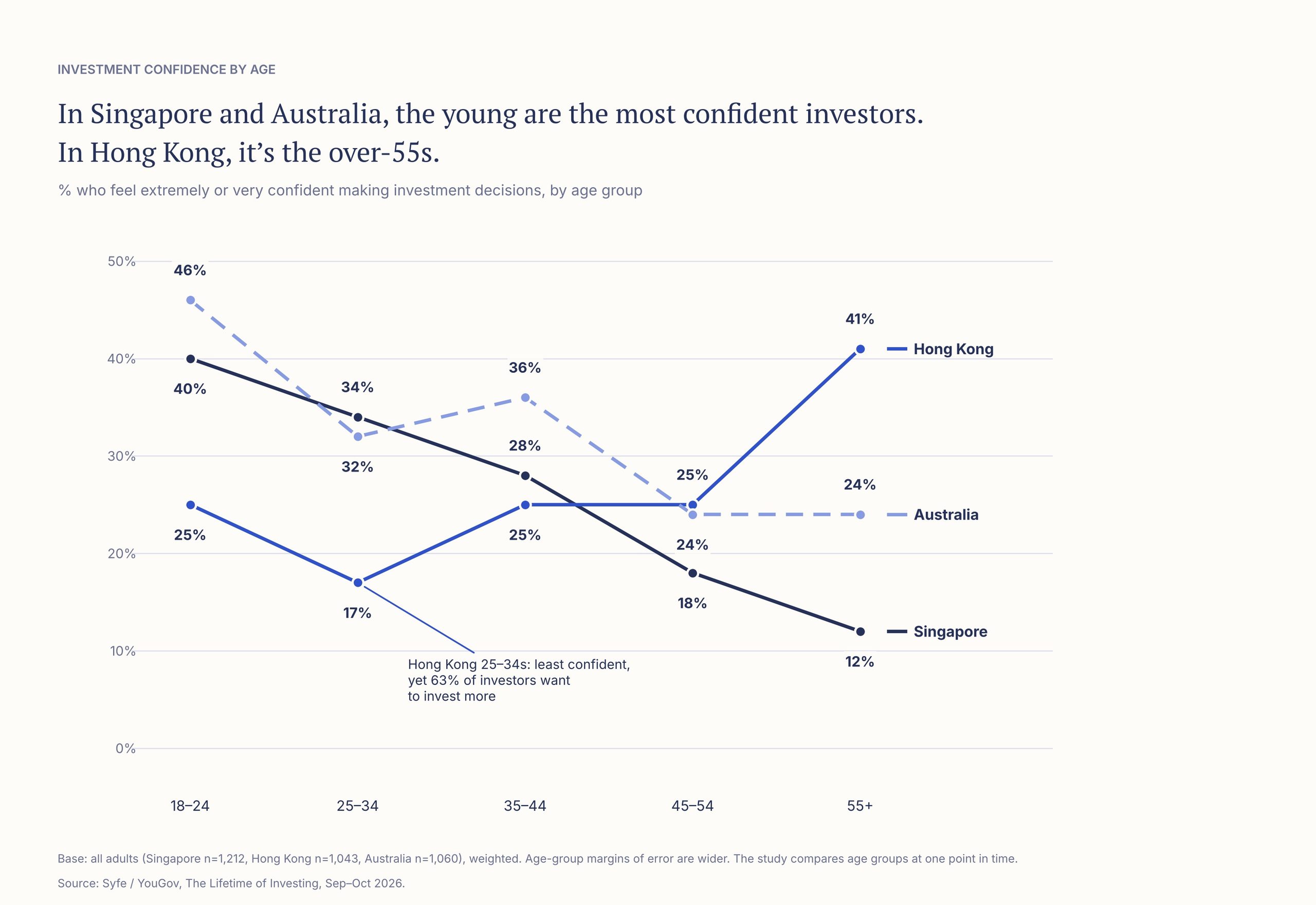
Confidence in making investment decisions varies considerably across the three markets, both in overall levels and across age groups. Overall, only 23% of Singaporeans feel extremely or very confident, compared with 29% in Hong Kong and 30% in Australia. Roughly 4 in 10 in each market are somewhat confident, and the rest are not confident. However, beneath these headline figures are distinctly different age patterns.
In Singapore and Australia, the youngest adults are the most confident: 40% and 46% of 18–24s, compared with 12% and 24% of over-55s. Hong Kong shows the opposite pattern — confidence is lowest among 25-34s, but 63% say they want to invest more despite being the lowest confidence group, and confidence is highest among over-55s (41%), especially in higher-income households.
What goes with confidence is more consistent than who has it. In every market, people with a retirement plan are two to three times as likely to feel confident (32% vs 17% in Singapore, 47% vs 17% in Hong Kong and 45% vs 20% in Australia). And it shapes how people see their future. Among those behind on their retirement target, 48–63% of confident investors still feel on track, against 9–16% of others.
Taking the first step
If you’re unsure where to start, you’re not alone: most people in all three markets don’t feel highly confident about investing.
A good first step is to get clear on your goals and the timeframe you’re investing for. That shapes one of the biggest influences on how your investments behave over time: your asset allocation, or how you split your money between growth assets such as equities and steadier ones such as bonds and cash. A longer timeframe generally gives more room to ride out market ups and downs, while nearer-term goals usually call for a steadier mix. Deciding on the mix before choosing individual products makes investing simpler to start and easier to stick with. Our guide to building a portfolio explains how this works in practice.
Starting with an amount you’re comfortable with and won’t need in the short term lets you build understanding gradually. If you’re unsure what suits your circumstances, speaking to a licensed financial adviser can help. At Syfe, our wealth advisers don’t earn commission on the products they recommend, so their advice is focused on your circumstances and financial goals.
4. The gender gap: different challenges in each market
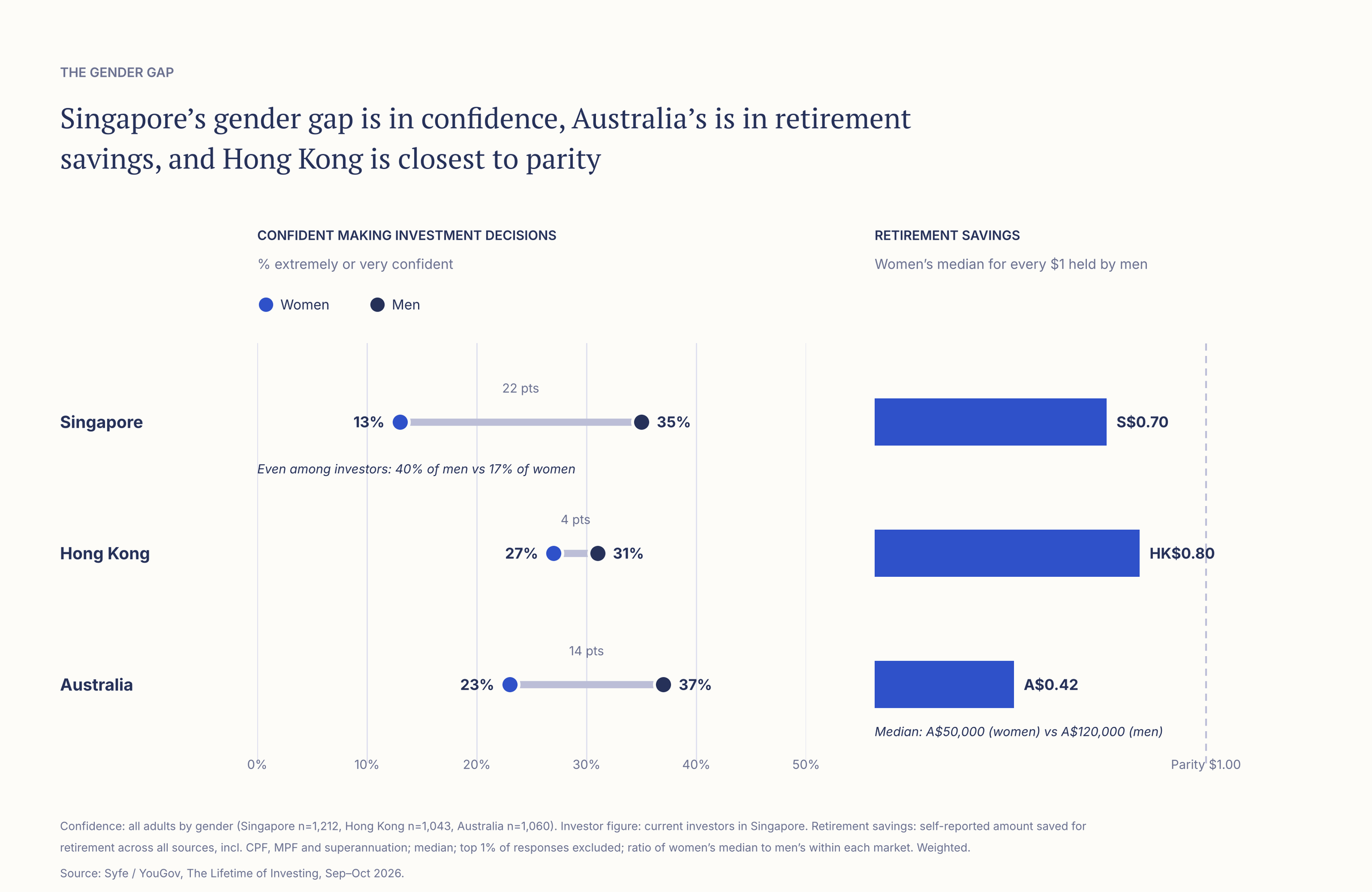
Across all three markets, women are just as keen as men to invest more. Where they differ is in confidence, in how they plan, and in what they’ve saved.
Singapore has the widest confidence gap. 35% of men feel extremely or very confident making investment decisions, against only 13% of women, and women are twice as likely not to invest (32% versus 15%). The gap isn’t simply because fewer women invest. Among Singaporeans who already invest, men are more than twice as likely as women to feel confident (40% vs 17%). Singaporean women are also more likely to be planning without a clear target. 23% can’t name the amount they’ll need for retirement, compared to 12% of men.
In Australia, the widest gap is in retirement savings. Women’s median retirement savings stand at A$50,000, less than half the A$120,000 reported by men. Australian women are also less likely to feel confident investing (23% versus 37%) or to know their retirement target (30% can’t name one, against 18% of men).
Hong Kong comes closest to gender parity in investing. Women’s investment confidence (27%) is relatively close to men’s (31%), while their median retirement savings of HK$800,000 represent 80% of men’s HK$1 million.
In every market, women are less likely than men to count on investments to fund their retirement (42% vs 60% in Singapore, 47% vs 57% in Hong Kong and 26% vs 38% in Australia). With women typically living longer, that shapes how far their savings need to go.
A note for investors
Confidence in investing usually builds with understanding and experience, not the other way round. As we mentioned earlier, if you feel less sure than others seem to, you’re far from alone: most people in all three markets don’t feel highly confident making investment decisions. Starting with your own goals, whatever they are, makes choices easier to judge. It also helps to understand how different investments work, what risks they carry and how long you plan to stay invested. Beginning with an amount you’re comfortable with lets you learn as you go.
5. Retirement readiness: savings fall short, and the goal is moving
Behind on a target many haven’t worked out
Across all three markets, most people say they are not on track to meet their retirement savings needs: 86% in Hong Kong, 76% in Singapore, and 72% in Australia. Yet, the challenge is not simply how much people have saved, because many might not even have established how much they actually need.
A third of adults in Singapore and Hong Kong (33%) and 40% in Australia have never calculated a retirement target. Around 1 in 5 picked a round number that “felt right”, and only 11–15% have used a calculator or sought advice.
How people set their target matters. Those who picked a round number aim lower than those who worked it out. In Singapore, those who picked a round number have a median target of S$700,000–999,999. That’s compared to S$1–1.99 million for those who based it on their expenses, and Hong Kong and Australia show the same pattern.
The headline shortfall also understates the problem: around 9 in 10 people who have set a retirement target say their savings are below it.
What people are aiming for differs by market. The most popular goal in Singapore is semi-retirement (27%), in Hong Kong it’s early retirement (26%), and in Australia it’s a traditional full retirement (26%). Even in Australia, though, many younger adults plan to stop work early: one in four under-35s expect to retire before 60, the age at which most Australians can first access their super. That means funding those years from savings and investments outside super.
But whatever the goal, and whatever the pension system, 6 in 10 adults in each market don’t have a retirement plan. That consistency points to a shared need for better retirement guidance and earlier planning.
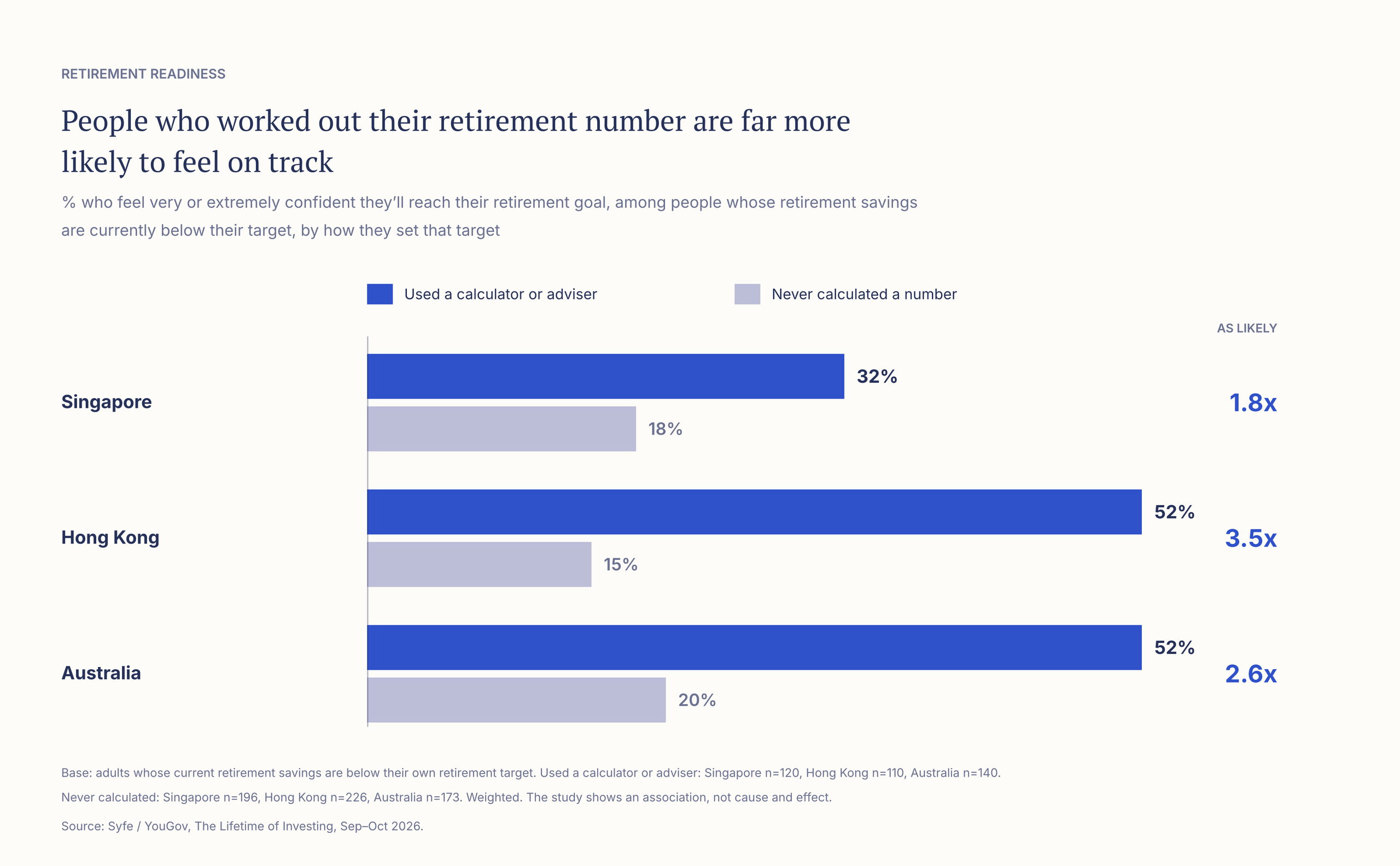
Working out your number goes hand in hand with confidence. Even when their retirement savings aren’t yet where they want them to be, people who used a calculator or an adviser to set their target are much more likely to feel confident they’ll get there. In Hong Kong and Australia, more than half (52%) feel on track to reach their goal, compared with 15–20% of those who haven’t calculated a number. In Singapore, the figures are 32% and 18%.
What people are really aiming for
For most people, retirement no longer means stopping work at a set age. Only 15% of Singaporeans, 20% of people in Hong Kong and 26% of Australians are working towards a traditional full retirement. The rest are spread across very different goals:
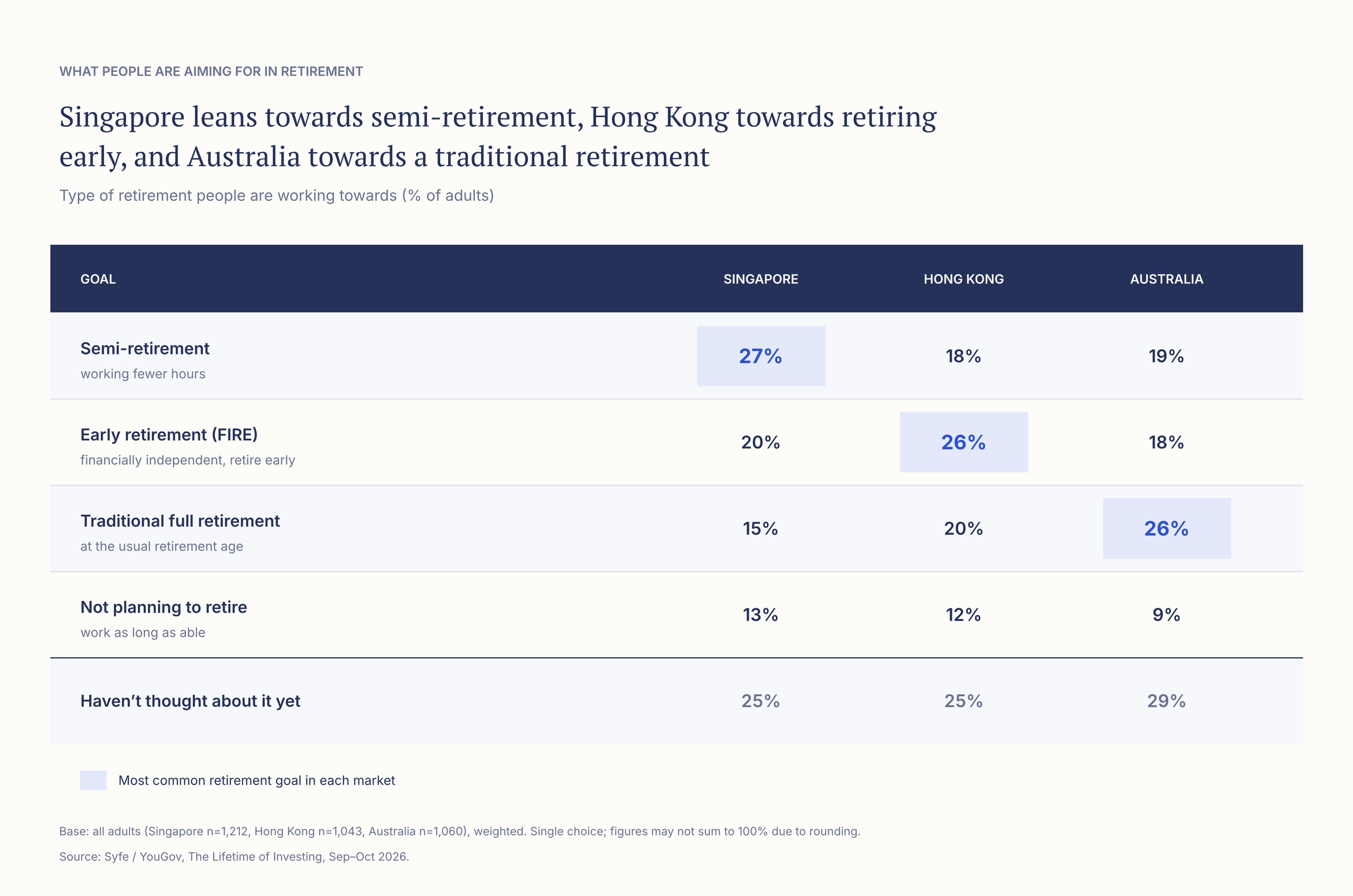
Each market leans a different way. Singapore leans towards stepping back gradually: semi-retirement is its most common goal (27%), and together with the 13% who don’t plan to retire at all, 4 in 10 Singaporeans expect to keep working in some form. Hong Kong leans towards stopping early: 26% are aiming for financial independence and early retirement, the highest of the three markets. Australia is the most traditional, with full retirement at the usual age the most common goal (26%).
Expectations also differ sharply by age. For example, in Australia, 1 in 4 under-35s expect to retire before 60, the age most can first access their super.
Most people expect to fund retirement from a mix of sources, and savings often play a bigger part than investments. Savings and pension schemes (CPF, MPF and Super) are the main sources in every market. Many also plan to keep earning: 43% of respondents in Hong Kong and 38% of Singaporeans expect to fund retirement partly by continuing to work, against 24% of Australians. Investments feature for half of Singaporeans and in Hong Kong (50%, 52%), but only a third of Australians (32%), who rely most on super (65%). In Singapore and Hong Kong, savings top the list: more than seven in ten (71%, 72%) expect to rely on them, more than on CPF or MPF. For money meant to last decades, how it’s held matters too: cash that isn’t growing can lose value in real terms as the cost of living rises.
A note for investors
Retirement looks different for everyone, so it helps to plan for the retirement you actually want. If you hope to stop work early or step back gradually, think about how you’d cover the years before your CPF, MPF or Super becomes available, and how much of your income might still come from work. Putting a number on your goal is the most useful first step. People who used a calculator or an adviser to set their target are far more likely to feel on track to reach it, and if you’d prefer to do your own calculations rather than speaking to someone, Syfe’s free financial calculators can help you estimate how much you’ll need and how your savings could grow. Your plans will change as your life does, so revisit your number every year or two, or after a major milestone such as a new job, a home or a family.
Conclusion: Investing for a lifetime
The lifetime of investing is shaped by more than a person’s willingness to build wealth. Most people want to invest more. What holds them back isn’t ambition but the practical realities of life – a budget stretched by a home, a family or aging parents, caution about losing money, and not knowing where to start. These barriers look different in Singapore, Hong Kong and Australia, but each one can be addressed.
The study reveals a clear intention gap between wanting to invest and feeling able to do so. Affordability shouldn’t decide who gets to invest. Starting with small, regular amounts means investing can begin with a first salary and carry on through the years when other costs take priority, rather than stopping altogether.
Caution deserves respect, not pressure. Half of people rank stability among their top priorities, and investing doesn’t have to mean taking on more risk than they’re comfortable with. Diversified, long-term approaches, and clear explanations of how investments behave in the ups and downs, can help people stay invested with confidence.
And confidence grows with understanding. People with a plan, and who have worked out their retirement number, are far more likely to feel confident and on track. Knowing your goals, and getting guidance when you need it, matters as much as how much you invest.
Ultimately, investing is not a one-time decision or a straight line towards a fixed goal. It is an ongoing process of reassessing priorities, understanding trade-offs and adapting to changing circumstances.
At Syfe, we believe investing should fit around life, not the other way round. Our mission is to empower people to build wealth for a better future, at every stage of life, whatever that future looks like.
About the study
The study was commissioned by Syfe and conducted by YouGov. It surveyed 3,315 adults aged 18 and over online between late September and early October 2026: 1,043 in Hong Kong, 1,212 in Singapore and 1,060 in Australia. Results are weighted to be representative of adults aged 18 and over in each market.
The study examined investment appetite, barriers to investing, investment priorities, reported changes in investment contributions following significant financial milestones, confidence in investing and retirement readiness.
The findings presented in this report are based on the survey figures supplied for the analysis The results describe respondents’ reported attitudes, behaviours and experiences. They should not be interpreted as establishing that a particular life event or characteristic directly caused a change in investment behaviour or confidence.