


These key themes will shape market outcomes and investment strategies. Find out how you can stay ahead of the curve with your portfolio in 2026.
The biggest theme of markets in 2026 is transition, not disruption. With inflation pressures easing, growth slowing but holding up, and monetary policy is moving away from peak restriction, markets are shifting into a new baseline.
At the same time, elevated valuations, market concentration, and rising capital intensity mean that returns are likely to be more selective and harder earned than in the immediate post-pandemic rebound.
This article delves into the key themes that will shape market and portfolio outcomes in 2026. Understanding them will impact how you balance your investment portfolio to capture growth, manage risk, and maintain flexibility.
Top Investment Themes for 2026
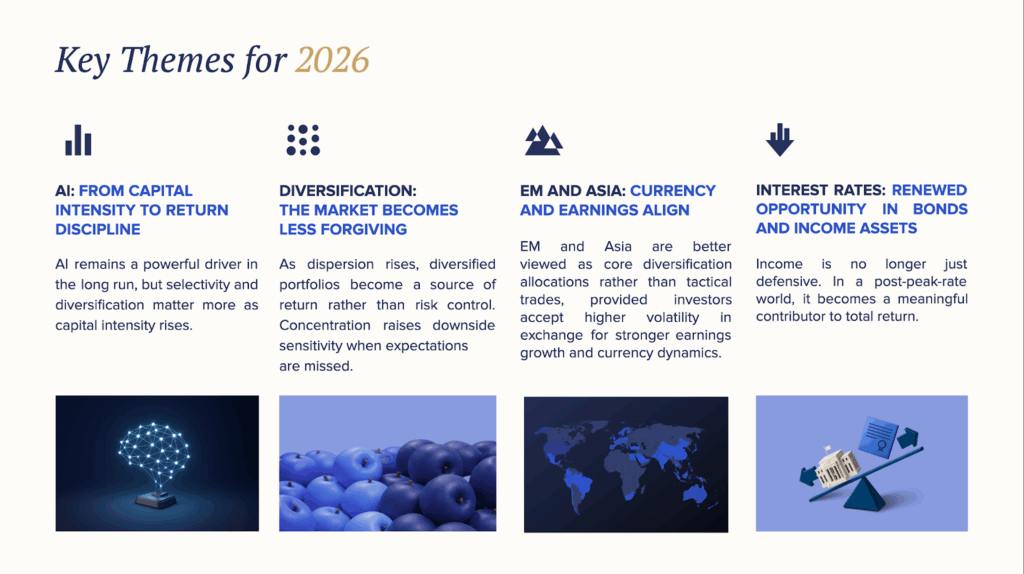
In 2026, the bull market may continue, led by AI and supported by steady growth, lower inflation, and accommodative policy. With earnings accelerating globally and China’s AI sector gaining international traction, returns are broadening across regions. In a post-peak-rate world, fixed income is emerging as a meaningful driver of total returns rather than just a defensive hedge.
Theme 1: AI – From Capital Intensity to Return Discipline
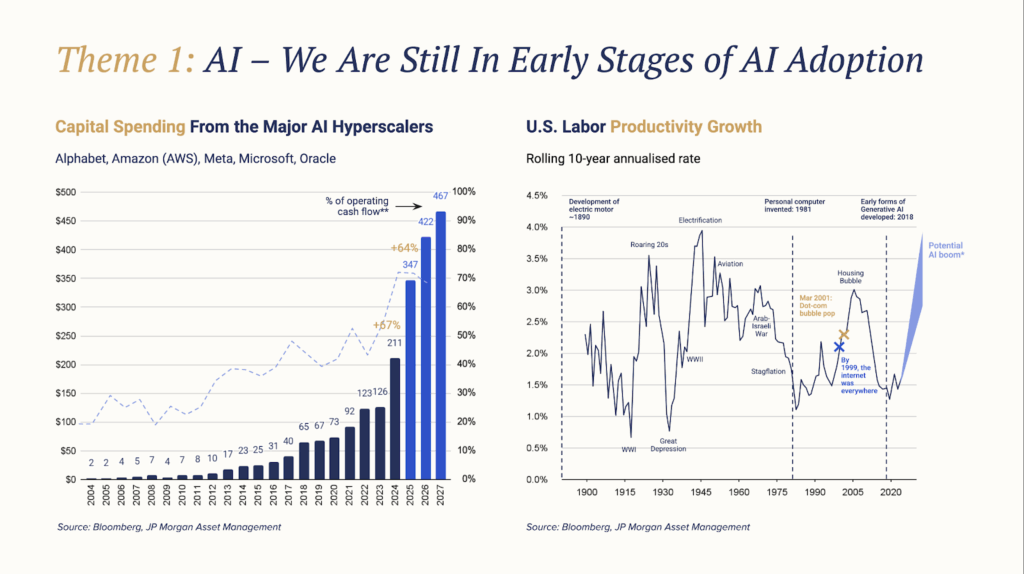
AI has entered a full-scale infrastructure build-out phase. We expect annual AI-related infrastructure spending to exceed US$400–500 billion by 2026, driven by accelerated data-centre construction, higher-density compute requirements, and rising power and cooling needs. At this level, AI infrastructure investment approaches ~2% of US GDP, placing it alongside past general-purpose technology cycles such as cloud computing and telecommunications.
Adoption is now measurable. Around 9–10% of US firms have embedded AI into production processes, while 40–45% are paying for AI models or platforms. Early adopters report 5–15% productivity gains in functions such as software development, customer service, and logistics.
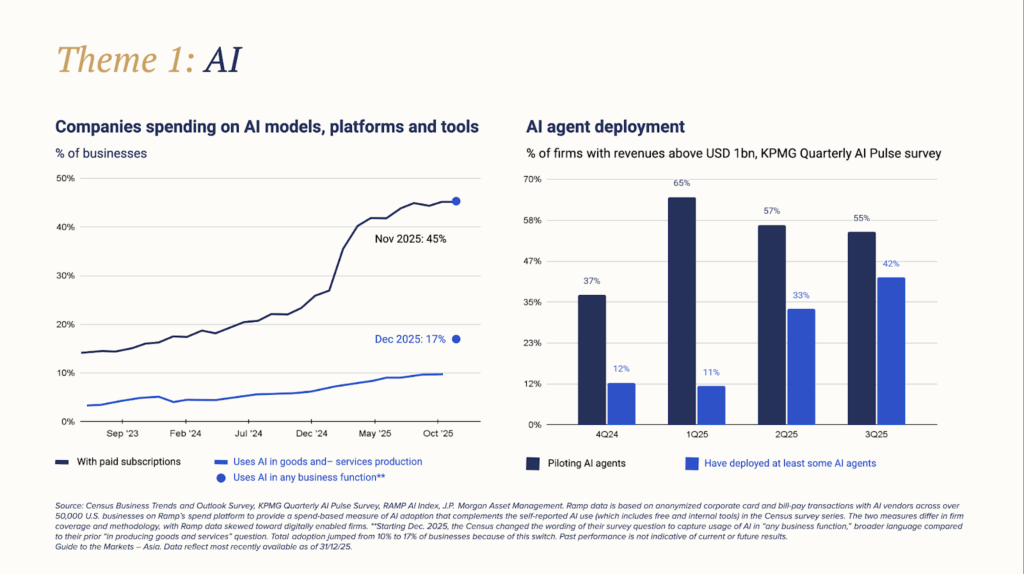
However, this remains a front-loaded capital cycle. Cash outflows precede revenue, and monetisation remains uneven across sectors. For current equity valuations to be sustained, the AI ecosystem must ultimately generate US$1.7–2.5 trillion in incremental annual revenue by the end of the decade.
As infrastructure spending accelerates into 2026, balance-sheet discipline becomes increasingly important. Large cloud and infrastructure providers operate with average debt-to-equity ratios around 0.5x, higher than pre-AI levels. A further ramp-up in capex raises sensitivity to funding costs, utilisation rates, and monetisation timelines. The risk is no longer whether AI adoption happens, but whether capital intensity runs ahead of returns at the margin.
While monetisation remains uncertain, consensus is building that AI represents the next general-purpose technology capable of lifting productivity by 1–3% per annum. With adoption still at an early stage, this supports sustained optimism around the theme.
This shift from narrative to execution is reflected in the positioning of Syfe’s Disruptive Technology portfolios, which retain exposure to AI’s structural upside while emphasising monetisation, visibility, profitability, and diversification across the value chain rather than concentration in the most crowded segments.
Portfolio implications:
AI remains a powerful long-term driver, but returns in 2026 are increasingly shaped by ROI discipline, balance-sheet strength, and execution. Selectivity and diversification matter more as capital intensity rises.
Theme 2: Diversification and Dispersion – The Market Becomes Less Forgiving
Market structure has shifted materially.
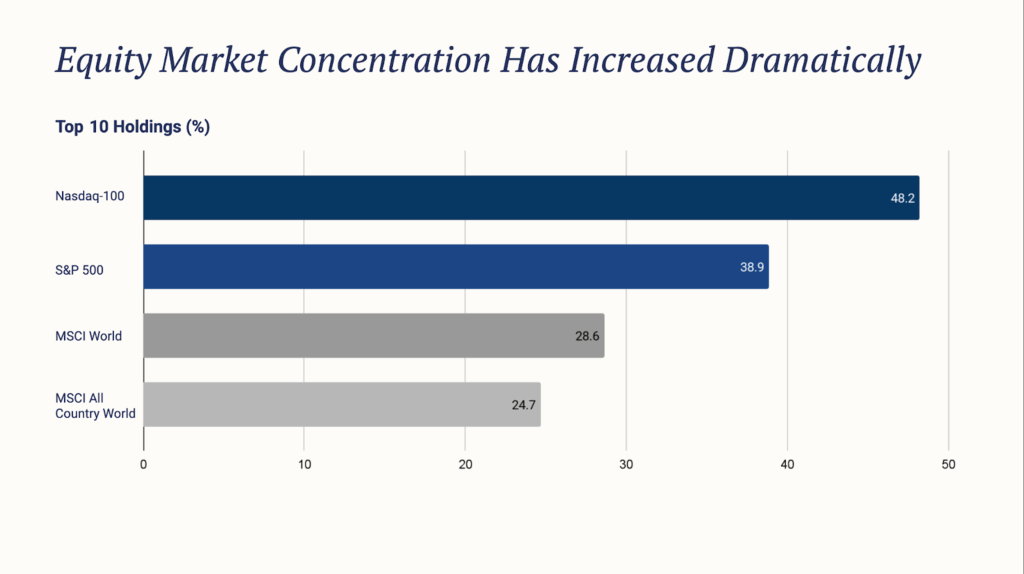
The top 10 US stocks account for roughly 40% of S&P 500 market capitalisation, a level historically associated with higher return dispersion and lower tolerance for valuation mistakes.
At the same time, valuation dispersion across regions and factors remains wide:
- US large-cap growth trades at a premium to long-term averages
- Europe and Japan trade at discounts despite improving earnings momentum
- Emerging Markets remain cheaper than developed markets on both P/E and P/B measures
Crucially, earnings breadth has improved. In 2025, earnings upgrades extended beyond a narrow group of US mega-caps into Europe, Japan, and parts of EM, driven by better cost discipline, margin resilience, and more shareholder-friendly capital allocation. Factor strength is starting to emerge as growth stocks face valuation test and value stocks show signs of revival.
This combination of elevated concentration, improving earnings breadth, and wide valuation dispersion marks a transition from a beta-driven phase to an allocation- and selection-driven phase.
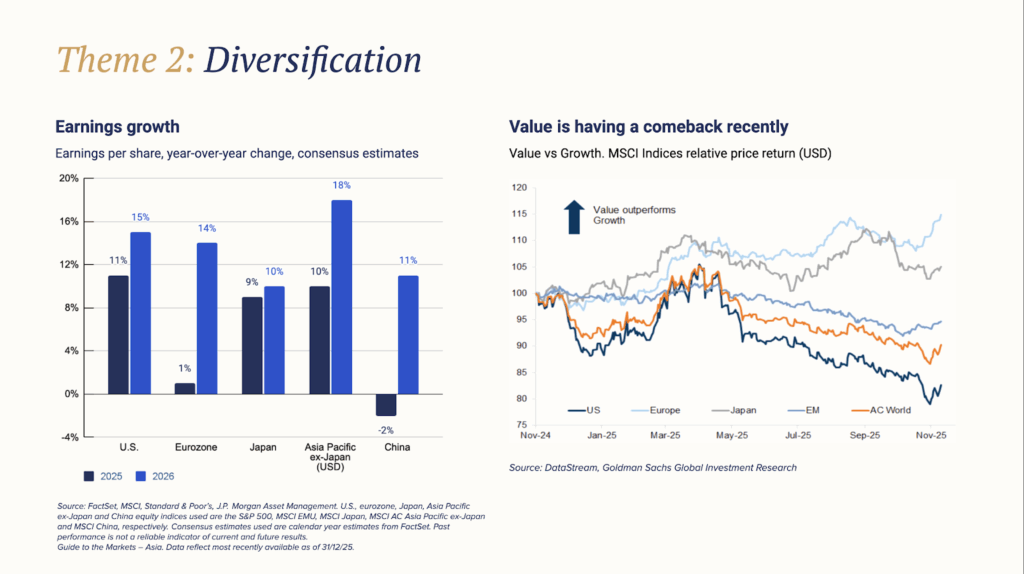
This regime shift is directly reflected in the construction of Syfe’s Core portfolios, particularly Core Equity100, which was rebalanced to reduce reliance on narrow leadership and increase exposure to profitable companies across regions.
Portfolio implications:
As dispersion rises, diversified portfolios become a source of returns rather than risk control. Concentration increases downside sensitivity when expectations are missed.
Theme 3: Emerging Markets and Asia – Currency and Earnings Align
Emerging Markets and Asia stand out as beneficiaries of a weaker USD and improving earnings dynamics.
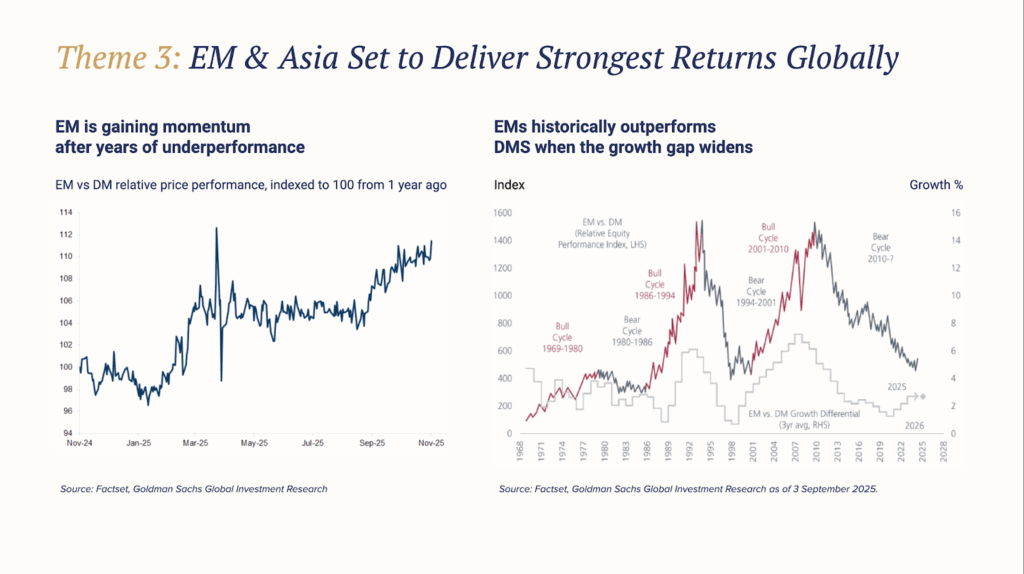
Historically, periods of meaningful USD weakness have coincided with EM equity outperformance of 10–20 percentage points over developed markets. The USD’s ~9.5% decline in 2025 already improved return translation for non-US assets.
Consensus expectations point to mid-to-high single-digit earnings growth across EM and Asia, outpacing developed markets.
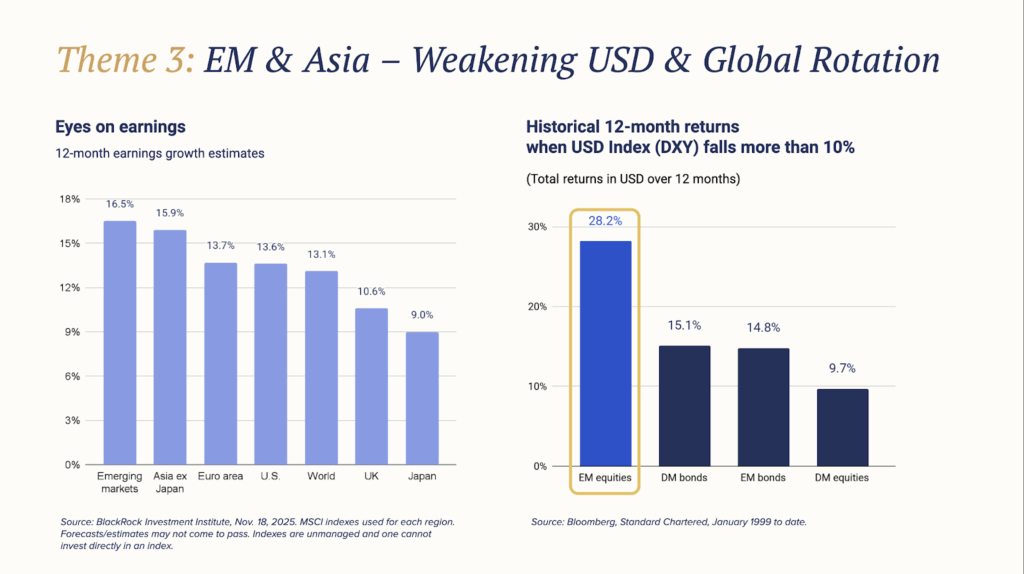
Regional nuance matters:
- India remains a structural growth story, but FX and valuation require disciplined sizing
- China is selective rather than broad-based, propelled further with an expanding AI footprint and supported by policy beneficiaries and balance-sheet strength
- ASEAN, including Singapore, benefits from steady global growth and the global tech cycle
Within Syfe portfolios, this view is expressed through Core allocations that treat EM and Asia as structural diversification components, complemented by our thematic China Growth portfolio for more targeted regional exposure.
Portfolio implications:
EM and Asia are better viewed as core diversification allocations rather than tactical trades, provided investors accept higher volatility in exchange for stronger earnings growth and currency dynamics.
Theme 4: Bonds and Income Assets Re-Enter the Opportunity Set
Bond markets now offer a markedly improved setup:
- 10-year US Treasury yields ~4.2%
- 2-year yields ~3.5%
- BBB US corporate yields ~5.0%
With policy rates expected to drift toward neutral, bonds offer both carry and potential capital gains. Income assets also benefit as rate volatility declines.
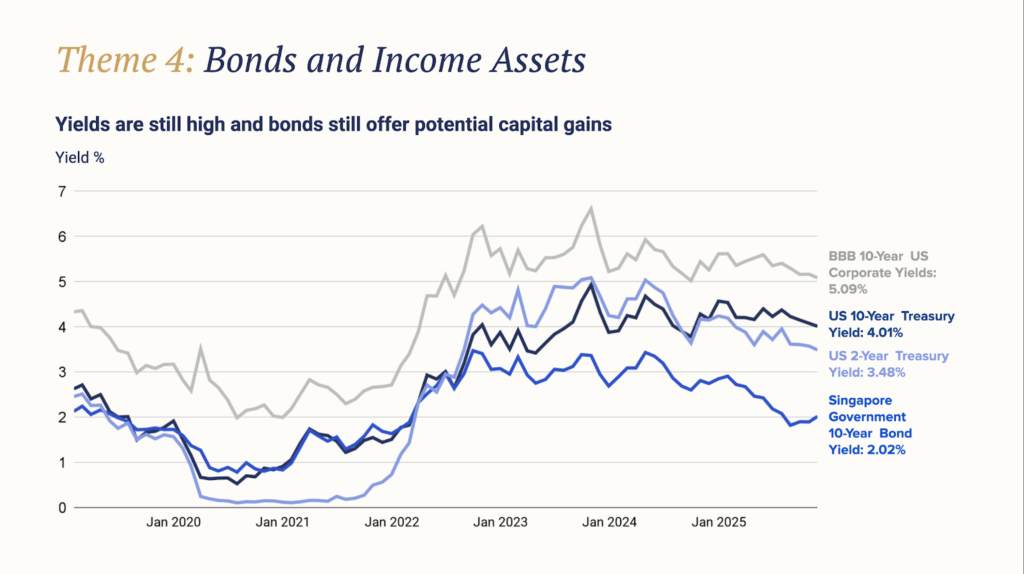
This environment aligns closely with the construction of Syfe’s Income+ and REIT+ portfolios, which are designed to capture diversified income streams while managing duration and credit risk.
Portfolio implications:
Income is no longer just defensive. In a post-peak-rate world, it becomes a meaningful contributor to total returns.
Conclusion
2026 is a year of transition—from inflation to disinflation, from restriction to neutrality, and from concentration to broader opportunity. The objective is not to predict a single outcome, but to compound across a range of plausible scenarios while managing concentration and valuation risk.
Portfolios positioned for that transition are better placed to deliver resilient outcomes in the year ahead.
Ready for 2026? Dive into expert insights on key trends, risks, and opportunities that could shape your portfolio this year. Read more: Syfe 2026 Outlook: Growth, Disinflation, and Monetary Transition


