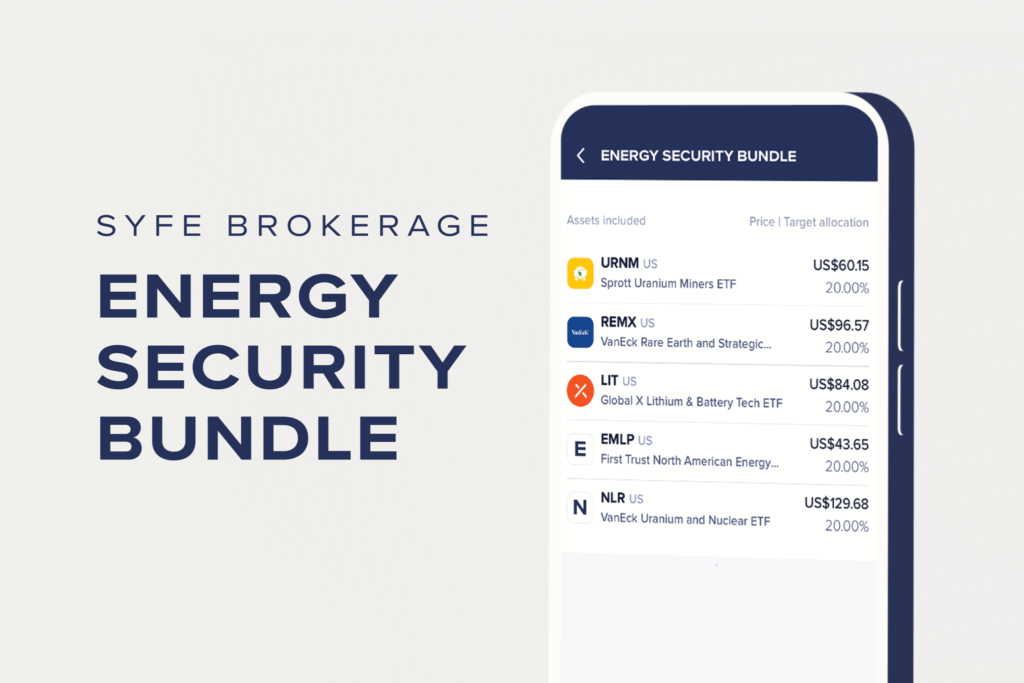
Wars, tariffs, and the AI power surge are forcing every government to rethink where its energy comes from. For investors, that scramble presents an appealing structural opportunity – one that is now tradeable through the Energy Security ETFs bundle on Syfe Brokerage.
What exactly is energy security?
Energy security is a country’s ability to keep the lights on reliably and affordably. Historically, countries leaned into the resources they had — oil, gas, coal — and traded for the rest. It was a system built on trust and open markets.
When energy flows become less reliable, countries exporting more energy than they import are more secure. The United States suffered badly from the oil shock in the 1970s when it was beholden to oil from the Middle East. Today, it is a net energy exporter – a status that kept its financial markets and economy much more resilient during the Iran War sell-off in March 2026.
Oil is not the only measure, though. Australia, for example, is a net oil importer but an overall energy net exporter, thanks to its liquified natural gas (LNG) production capability. China, while a net importer, has also drawn on strategic reserves and a mature ecosystem of renewable energy during the latest energy shock. By contrast, an emerging economy like the Philippines – a net energy importer with little to fall back on – has proved to be much more vulnerable.
Chart: The Long Road to U.S. Energy Independence
Exports Exceeded Imports for the First Time in Decades in 2020
U.S. Primary Energy, 1950-Present (quadrillion British thermal units)
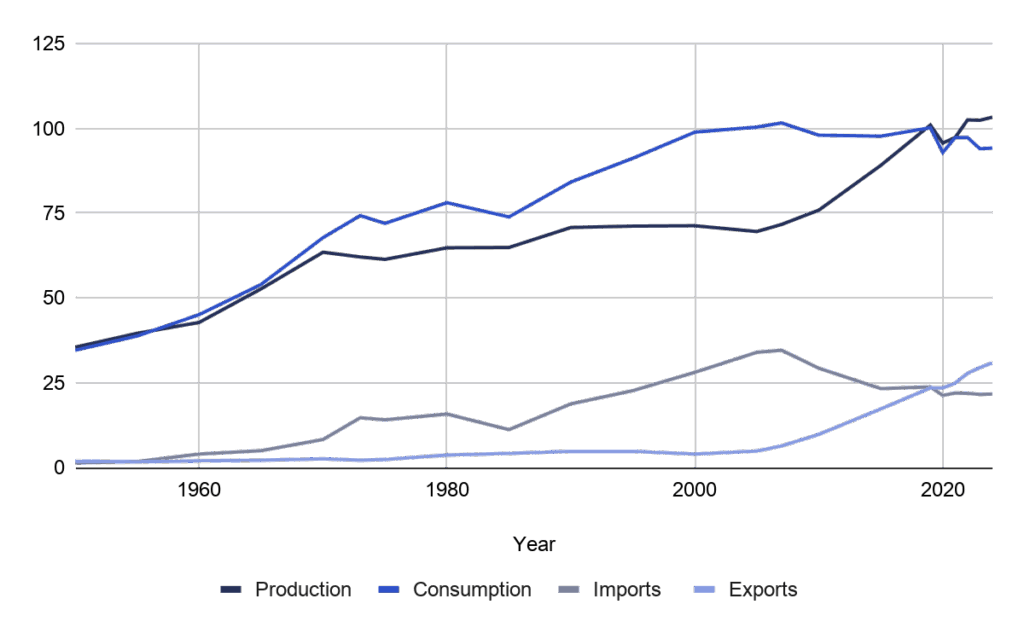
Source: U.S. Energy Information Administration, April 2025.
Why does it matter now?
The world has entered a new era where energy security can no longer be taken for granted, as demonstrated by the ongoing military conflicts in Iran and Ukraine. This will likely remain a key priority for governments in this decade, underwriting capital flows into energy industries.
The disruptions in the Strait of Hormuz — through which around a quarter of the world’s oil and LNG normally flows — have created the largest oil supply disruption in history and will probably cast a long shadow. Even if the war ends soon, there could be more “downstream” impact to come i.e. price shocks passing on to related products from fertilisers to chemicals and food.
Beyond geopolitics, AI will further fuel demand. The International Energy Agency (IEA) projects that global data centre electricity demand will more than double to around 945 terawatt-hour (TWh) by 2030 — equivalent to Japan’s electricity consumption today. Big Tech has responded by contracting over 10 GW of new nuclear capacity in the past year alone.
Goldman Sachs estimates US power demand will grow around 3.2% annually through 2030, potentially reaching 3.8% if “agentic” AI — the next generation of AI tools — takes off faster than expected. Agentic AI runs multiple models simultaneously in constant feedback loops and is estimated to be 15–50x more energy-intensive than today’s chatbots.
Chart: Global data centre electricity consumption by equipment, IEA Base Case, 2020-2030 (TWh)
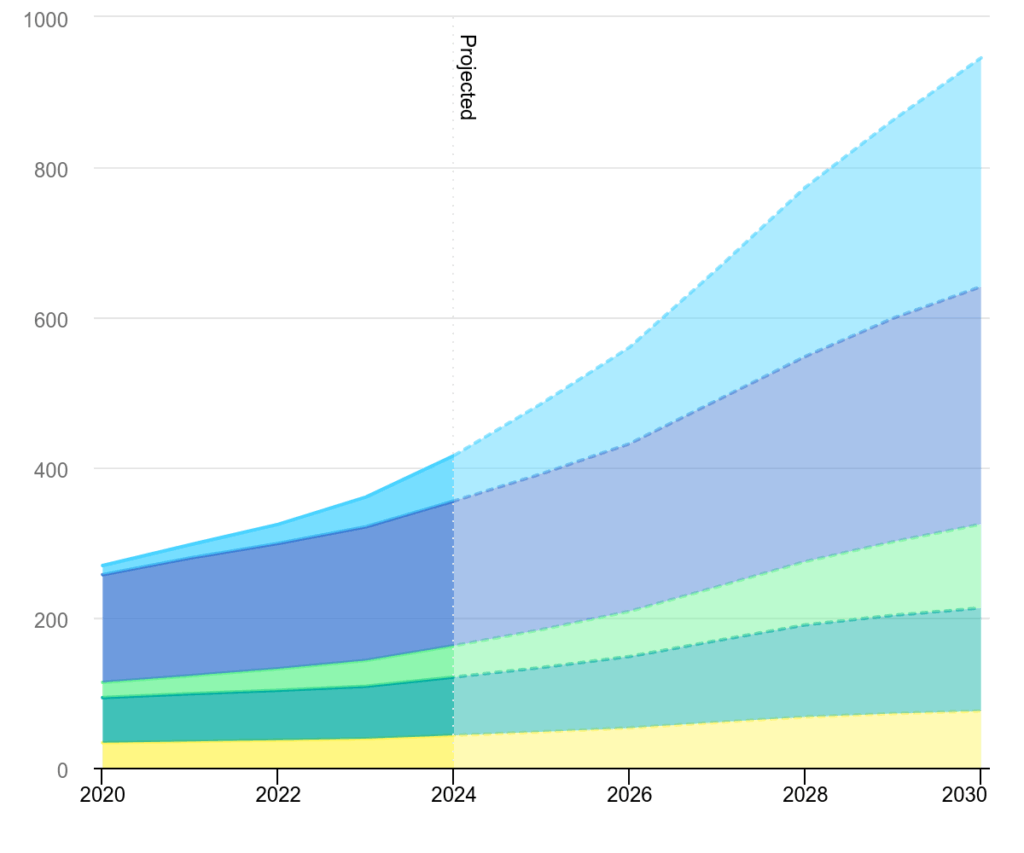

Source: IEA, May 2026.
What does this mean for investors?
Investors are already betting on alternative sources of energy. More than US$3 billion poured into clean energy ETFs in April alone — the biggest monthly inflow since 2021, according to Morningstar. We believe several sub-sectors stand out as clear winners of this shift:
- Nuclear and uranium: Nuclear is the primary answer to the energy security challenge — always-on, carbon-free, and scalable. Companies producing uranium, the primary fuel used in nuclear power plants, are also in focus as the supply of the material globally remains short of reactor demand.
Institutions are taking note. Sustainable fund managers globally are lifting long-standing nuclear exclusions as energy security overtakes climate change as the primary policy driver. Microsoft, Amazon, and Google have each signed landmark nuclear power deals. - Energy infrastructure: Demand for pipelines, LNG terminals, and midstream networks is booming as countries look to secure power that doesn’t flow through a chokepoint, and as the US seeks to cement its position as the world’s largest gas exporter. Power grids are also aging (40% of Europe’s are more than 40 years old), and $600 billion annually is needed to meet decarbonisation and electrification goals by 2030.
- Critical minerals: Critical minerals (e.g. cobalt) go into everything from magnets to batteries that are crucial in clean energy production, transmission, and storage. Having been weaponised in the trade fight by China, which controls over 60% of rare earth mining and 90% of processing, the West is spending billions of dollars to secure alternative supplies.
Chart: Projected Growth of Electricity Generated by Nuclear Energy
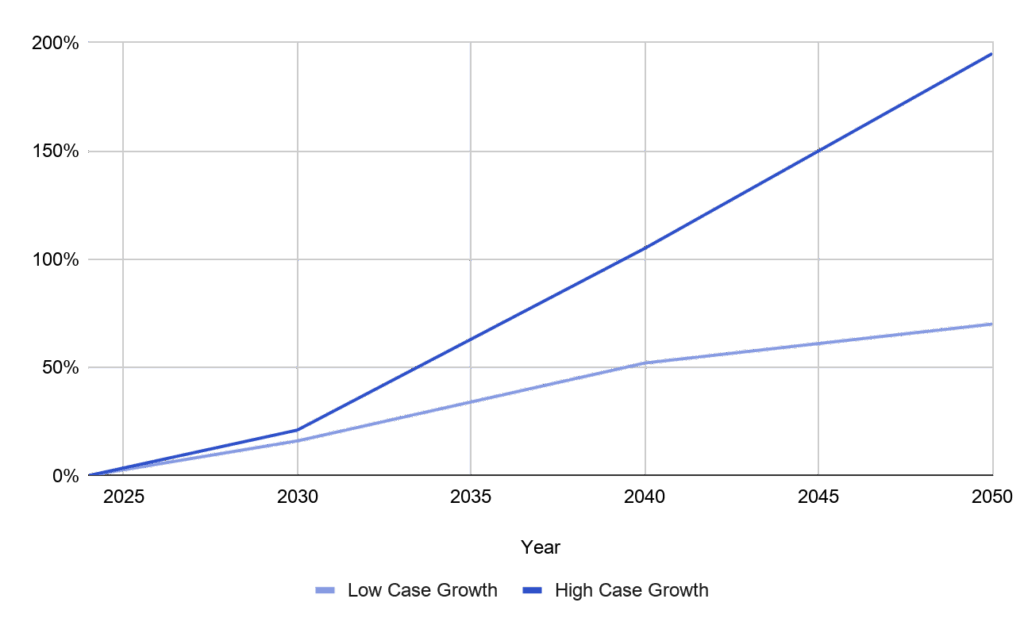
Source: “Energy, Electricity and Nuclear Power Estimates for the Period up to 2050” report, International Atomic Energy Agency (IAEA), September 2025.
Should I invest in this theme?
If you have a diversified portfolio, you’re probably already invested in the forces shaping the modern economy — AI companies, consumer brands, and financial institutions.
Investing in energy security takes you one step further, capturing growth from the energy, fuel, and materials that those industries depend on to operate and grow. From that perspective, it could complement what you already own.
This is a long-term investment theme, which means it may require patience. Critical mineral projects take 10–15 years from discovery to production. Midstream infrastructure requires years of permitting and construction. Near-term price action might be more headline-driven i.e. affected by events ranging from trade negotiations to peace talks.
Get Your Energy Security Bundle Today
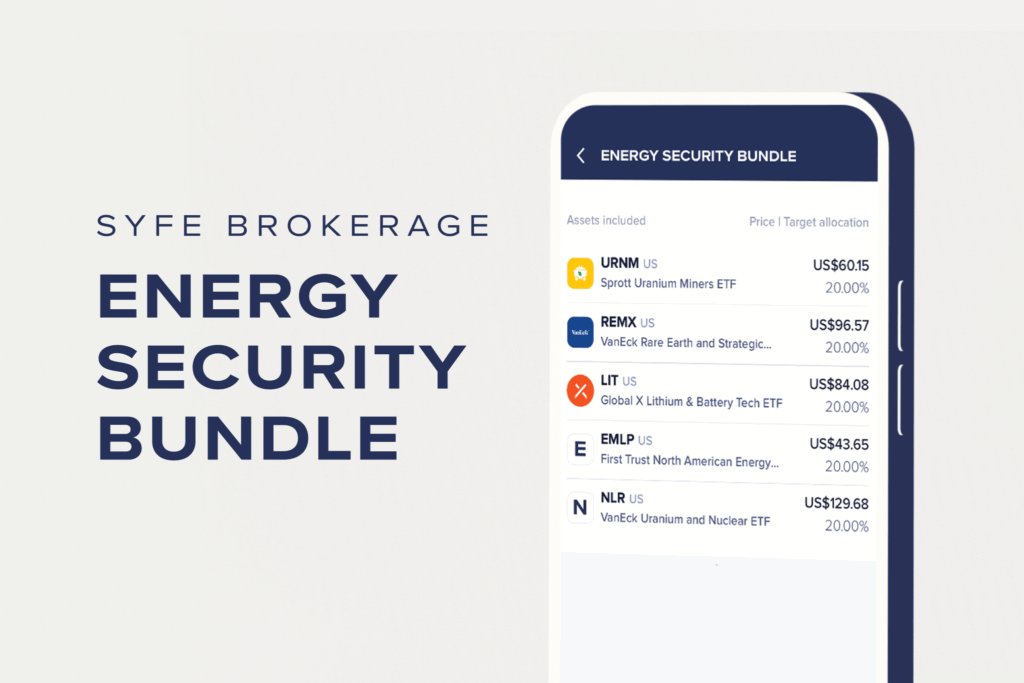
To make it easier for you to benefit from the shift to energy security, we’ve built the Energy Security bundle so you can access this theme with one click. The bundle is built with equal weighting across five ETFs, meaning no single commodity or country dominates. All ETFs are New York-listed and liquid. Build your Energy Security bundle on Syfe Brokerage today.