


How much cash should you hold? The answer depends on the financial outcomes you are building towards, as much as it does on the changing market environment.
With the Lunar New Year just around the corner, many people will soon be receiving red packets filled with crisp notes. While that traditional cash windfall is welcome, it comes with an important question: how much cash should I really be holding?
Why care about cash?
The answer matters more in 2026 than it did just a year or two ago. In a reversal of monetary policy, central banks around the world are cutting rates, confident that inflation is contained and convinced that economic growth urgently needs support.
The temptation of many investors may be to “set and forget” cash in legacy savings accounts, or rotate out of cash entirely and into higher-yielding assets. But both approaches would come with significant costs.
Cash plays a distinct and irreplaceable role in modern portfolio construction. Equities drive growth, bonds provide income and stability. But cash provides liquidity, flexibility, and resilience in ways no other asset can. This is invaluable, especially in an era of uncertainty and market volatility.
How “liquid” is your “cash”?
Before we go any further, let’s be clear about what we mean by cash. We are not just talking about the physical currency or the balance in your bank savings account. For the purpose of portfolio construction, cash covers a range of short-term, low-risk instruments:
- Fixed deposits
- Money market funds
- Short-term debt, e.g. Treasury bonds and T-bills
The “cash equivalent” tenor is considered typically to be within 90 days.
Some of these cash instruments, for example, time deposits, do not provide immediate liquidity. They require you to lock up funds for specific periods. Understanding how liquid your cash is crucial to determining how much of it you should hold.
How much cash do you need, and why?
Vanguard highlights three key factors to consider before answering this question :
- Risk tolerance – how much volatility you can emotionally and financially withstand
- Time horizon – when you will need the money
- Funding level – how well-funded your financial goals already are
The real question these factors will help you answer is why cash exists in your portfolio. An investor on the verge of retirement has very different liquidity needs and funding levels from the professional who has just entered the job market.
The Strategic Role of Cash in a Portfolio
As a starting point, Merrill Lynch recommends maintaining at least three to six months of expenses in highly liquid cash as emergency reserves. This prevents forced asset sales during market downturns or personal emergencies.
UBS recommends further dividing liquidity into three strategic buckets:
- Everyday cash for daily expenses
- Core liquidity for upcoming obligations
- Investment cash for longer-term deployment
This structure ensures that while cash remains accessible, it doesn’t sit entirely idle. It allows investors to rebalance portfolios, deploy capital during market dislocations, or fund near-term needs without disrupting long-term compounding.
For investment cash, money market funds stand out as a compelling alternative to traditional bank savings accounts. Unlike standard deposits, money market funds invest in short-term, high-quality debt instruments and offer several advantages:
- Historically higher yields than savings accounts
- Daily liquidity
- Diversification across multiple issuers and instruments
- Transparent pricing and professional management
Of course, for their superior returns, money market funds take on more risks than deposits. They are, for example, impacted by changes in short-term interest rates and issuers’ creditworthiness.
This matters because, over time, the opportunity cost of holding unproductive cash compounds quietly but significantly.
Put It Into Practice: Build Your 2026 Cash Strategy
Syfe’s Cash Management suite offers two approaches aligned with different cash needs:
Cash+ Flexi delivers daily returns with zero lock-in period, projecting 1.6-1.7% p.a. in SGD and 3.8-3.9% p.a. in USD after fees. This suits emergency funds and tactical reserves requiring same-day access. The portfolio invests in SFC-authorised money market funds, maintaining the low risk and high liquidity that characterise effective cash management.
Cash+ Guaranteed locks in guaranteed returns over 1-12 month terms at 1.15% p.a. (SGD) or 3.7% p.a. (USD), with capital and returns guaranteed subject to underlying bank risk. This works for money earmarked for specific upcoming expenses where the time horizon is defined.
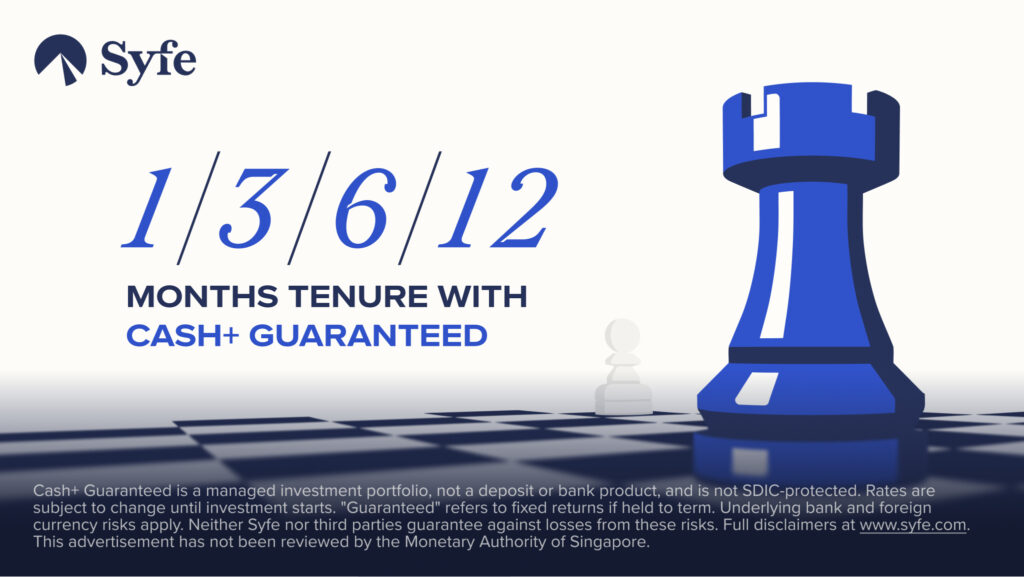
This portfolio features no minimum investment and support automatic recurring transfers, allowing systematic optimisation of cash positions without sacrificing accessibility.
Summary: Make Your Cash Work This Lunar New Year
Cash is about more than income. It is about funding stability, emotional discipline, and portfolio resilience.
The right approach is built on intentional balance, recognising cash as a key component of a diversified portfolio, sized appropriately to your risk tolerance, time horizon, and funding level.
When viewed correctly, cash is not a drag on returns — it is the quiet enabler of long-term compounding. And in a world of normalising rates, broadening market opportunities, and uncertainty, that role has never been more relevant.
Read More:
- Safe and Low-Risk Investments in Singapore for Guaranteed Returns: What Are Your Options?
- 6-Month T-Bills Rate Falls to 2.05%. Where Else Can You Invest Your Money?
- Lock in Fixed Deposits or Invest in SSBs & T-Bills: Where Should You Park Your Money Now?
- Differences Between Syfe Income+ vs T-Bills, SSBs and Fixed Deposits


You must be logged in to post a comment.