

The US Federal Reserve’s interest rate decisions may seem far removed from your everyday finances. But as the world’s largest market holding the most sought after currency, the US and its policies impact large parts of the global market.
Whether you hold cash, invest in stocks and bonds, borrow money, or exchange Singapore dollars for US dollars, Fed interest rate movements can affect your money in several ways.
So, whether it’s a hike or a cut, what does it mean for you?
What is the Fed interest rate?
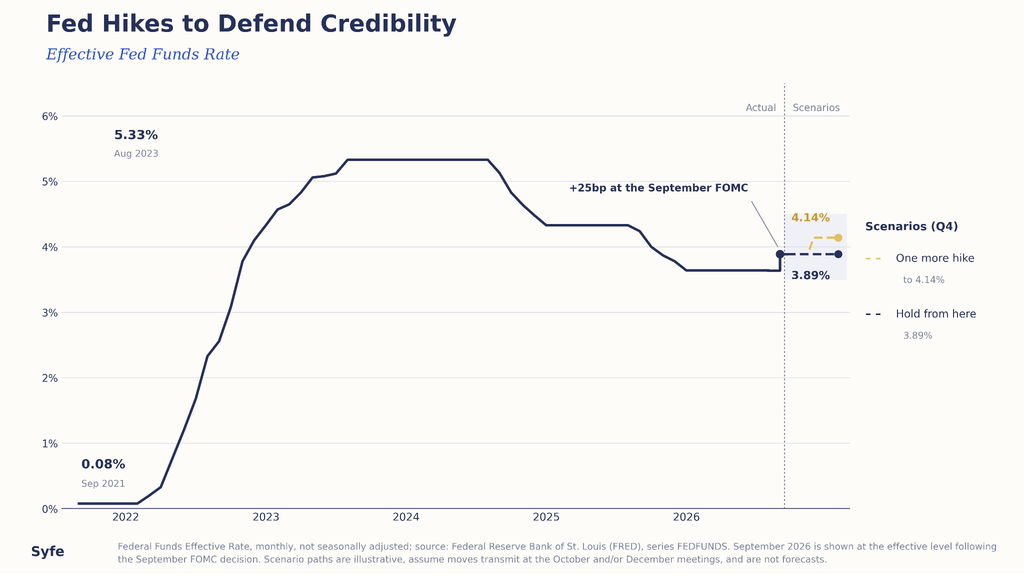
The federal funds rate is the benchmark interest rate for overnight borrowing between US banks. Although it doesn’t directly determine every interest rate, changes in the Fed’s policy rate can ripple through borrowing costs, bond yields, savings rates, currencies and financial markets.
When a central bank raises rates, it generally makes money more expensive to borrow. When it lowers rates, borrowing conditions generally become easier.
How do Fed rate hikes affect your money?
1. Savings and cash yields may rise
When Fed rates rise, cash products typically pay more.
Higher rates can make cash and short-term interest-bearing instruments (e.g. Treasury bills) more attractive because yields tend to rise across parts of the short-term interest-rate market.
However, rates on savings accounts and cash products do not necessarily move exactly in line with the Fed. They depend on the product, underlying assets and market conditions.
Instead of trying to predict every Fed move, consider matching your cash to when you expect to need it.
For money you may need in the near term, cash management solutions can provide an alternative to leaving excess cash idle. For example, Syfe Cash+ Guaranteed USD invests in USD-denominated fixed deposits with 1, 3, 6, and 12-month terms and currently offers a guaranteed return of *4.4% p.a. with no lock-in.
(*The guaranteed capital and returns apply only to the USD value of your portfolio, regardless of the currency it’s deposited in. Funding or withdrawing in a non-USD currency may impact your returns due to exchange rate fluctuations.)
2. Borrowing may become more expensive
Higher interest rates can push up the cost of borrowing. This can affect (floating) loans, credit and other forms of financing, although the impact and timing vary by product and country.
While US rates can affect global funding costs and financial markets, the Fed does not directly influence Singapore borrowing rates. Given the open nature of Singapore’s economy and market, the Monetary Authority of Singapore (MAS) uses the exchange rate to fine-tune monetary conditions, and the SORA (the benchmark rate in Singapore) is heavily influenced by global financial conditions.
3. Bonds may come under pressure
Bonds are essentially debt — when you buy a bond, you’re lending money to companies or countries. How much they pay investors is determined at the time of the debt issuance, referencing the benchmark interest rates at the time.
And so, when interest rate rises, these existing bonds with lower coupons (i.e. lower-paying bonds) can become less attractive relative to newly issued bonds, all else being equal. Their prices would reflect that and fall.
The reverse can happen when rates decline: existing bonds with higher coupons may become more valuable.
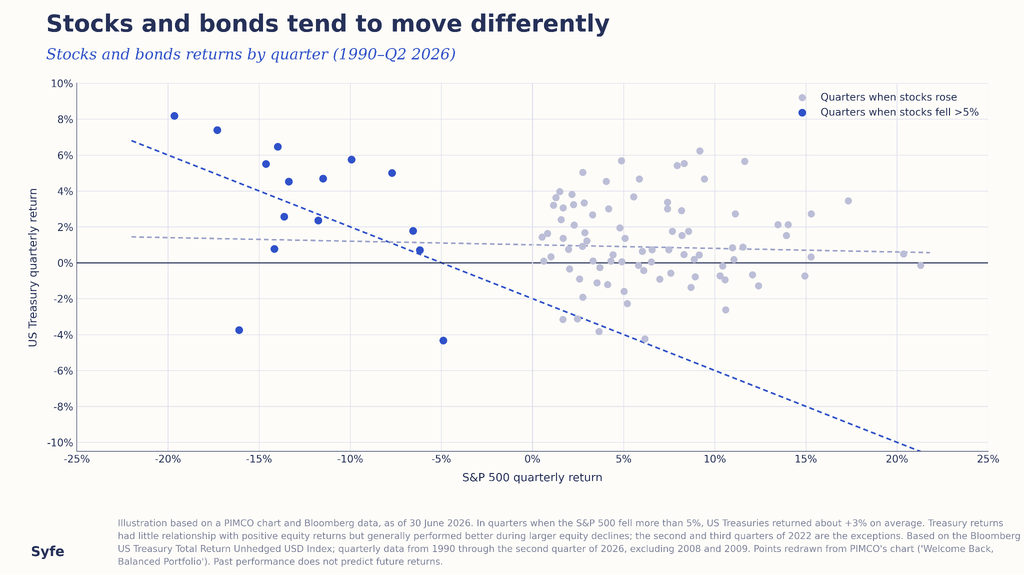
Another benefit of holding bonds is diversification. They typically behave differently from equities, especially in episodes of severe drawdowns, as this chart shows:
4. Stocks may react
Higher rates can affect companies through increased financing costs. Investors value companies by discounting their future earnings with today’s interest rates so when rates go up more of those future earnings get discounted. Rate-sensitive sectors such as financial (banking and insurance), REITs, and housing may therefore react differently from others.
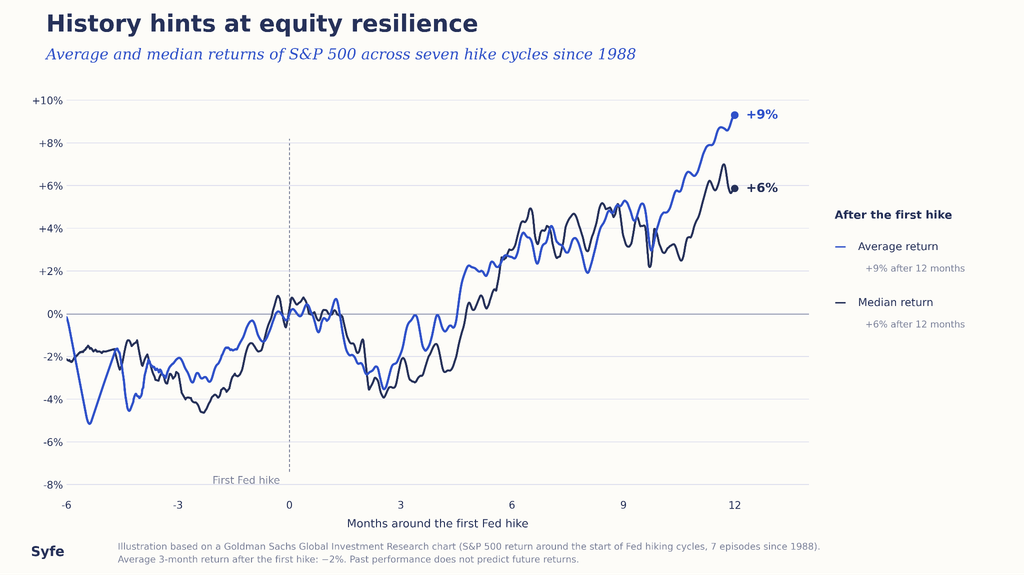
However, markets respond to more than just the Fed rate. Inflation, economic growth, company earnings and expectations about future policy all factor into how the stock market reacts. In seven hiking cycles over the last four decades, US stocks averaged a 9% advance in 12 months following the first hike.
In turn, earnings growth can offset the impact of rate hikes, which is highly likely now (at the time of writing) given the exceptional earnings due to AI spending.
5. The US dollar may move
The USD typically benefits from higher US interest rates – because that makes income in USD more attractive compared to in other currencies. The caveat there is whether other countries also move their interest rates (that difference or “spread” is what counts).
The USD, however, is also impacted by safe haven demand underpinned by the greenback’s reserve currency status. Should that come under challenge, or if US debt continues to spiral, investors might think the dollar is worth less in the long term and discount dollar assets accordingly.
For Singapore investors holding US assets, currency movements can add to — or subtract from — investment returns when converted back to SGD.
Speculating on foreign exchange is a game that even the professionals don’t always get right. For most investors the answer is to hedge out the risk — and that’s why our managed portfolios are offered in SGD to match your financial needs.
Conclusion
The bottomline: a Fed rate cut is not automatically good or bad for every asset or investor. What matters is how the rate change interacts with inflation, growth and market expectations.
For investors, this reinforces an important principle: don’t make decisions based on the next Fed meeting alone. Different parts of your portfolio serve different purposes, and your time horizon matters.
Put your money to work with Syfe Cash+.
If you have cash that you don’t expect to spend in the next year or two, consider exploring our cash management suite — available in both SGD and USD — as a home for your savings.
Investments involve risks and returns are not guaranteed. Projected yields may change. Please refer to Syfe’s product terms, fees and risk disclosures before investing.


