


Environmental, social, and governance (ESG) investing has evolved from a niche strategy into a mainstream financial movement. Today, both institutional giants and individual investors are increasingly integrating ESG criteria into their stock selection and financial analysis.
The shift in sentiment is backed by data. A global study by the CFA Institute revealed that 76% of institutional investors and 69% of retail investors now actively express interest in ESG investing. Furthermore, the Morgan Stanley Institute for Sustainable Investing tracked a significant jump in sustainable investing interest among the general population—rising from 71% to 85% over a four-year period. This trend is particularly dominant among millennials, with 95% expressing a strong desire for sustainable investment solutions.
What is ESG investing?
In essence, an ESG strategy involves directing capital toward companies that demonstrate high standards across environmental, social, and governance pillars. It moves beyond looking solely at a balance sheet to assess how a company interacts with the world.
To ensure objectivity, corporations are rated by independent third-party research groups. MSCI ESG Research, one of the world’s leading providers, aggregates data from government databases, company disclosures, and thousands of media sources to monitor companies systematically.
Based on this data, MSCI rates companies on a scale from ‘AAA’ (Leader) to ‘CCC’ (Laggard). These ratings reflect a company’s exposure to ESG-specific risks and how effectively they manage those risks compared to their industry peers.
Beyond the ethical appeal, a major driver for ESG adoption is financial performance. Research from S&P Global and ISS Governance suggests a positive correlation between strong ESG practices and long-term returns. Historically, top-rated ESG companies have shown resilience and have frequently outperformed the S&P 500 average over the last five years.
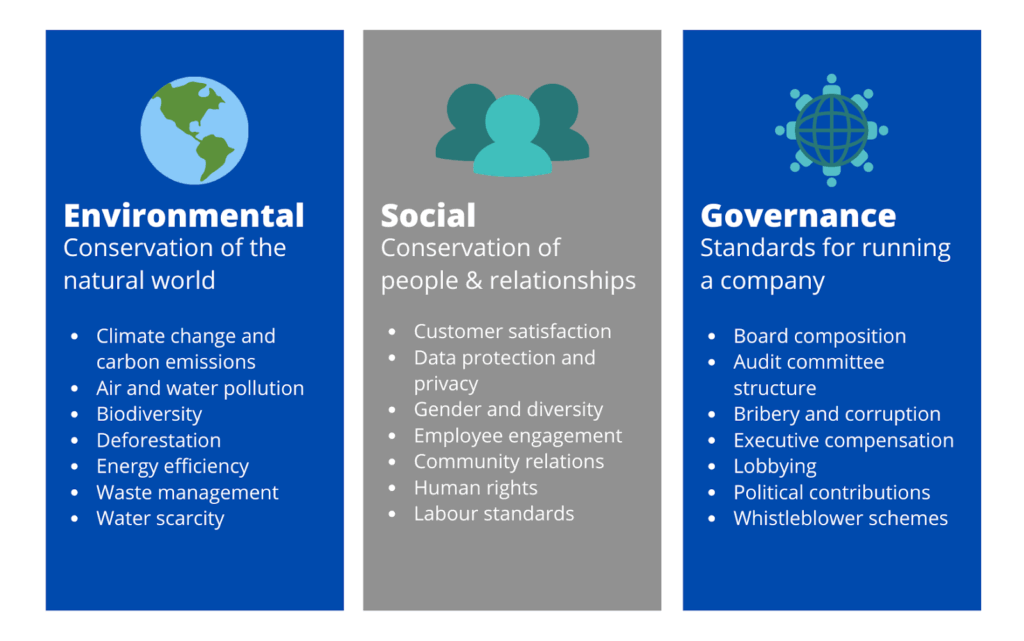
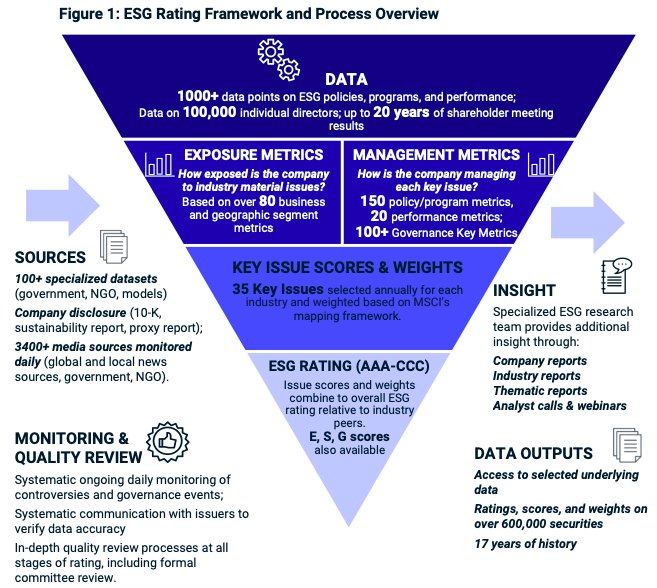
Corporations are rated by third-party, independent research groups on ESG scales. One of the largest independent providers of ESG ratings is MSCI. MSCI ESG Research collects data from multiple sources including government databases, company disclosures, and over 3,400 media sources to monitor and review companies systematically.
MSCI then rates companies on a ‘AAA to CCC’ scale according to their exposure to ESG risks and how well they manage those risks relative to peers.
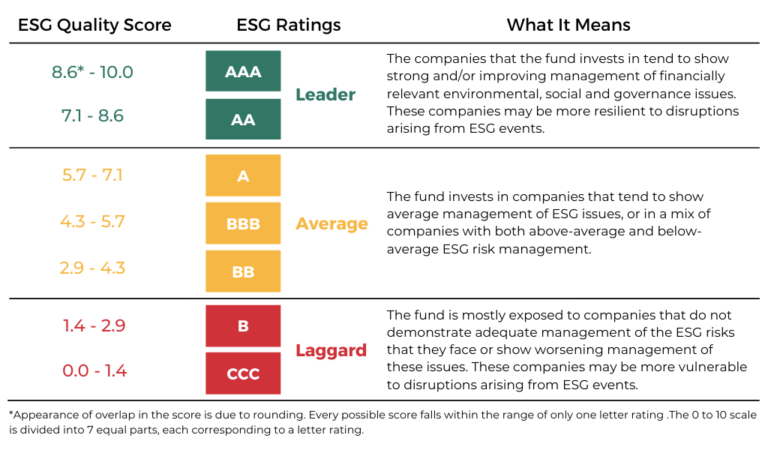
One major incentive for investors to embrace ESG investing is financial performance. Studies by S&P Global and ISS Governance suggest a positive correlation between ESG factors and long-term investment performance. Additionally, top-rated ESG companies have consistently outperformed the S&P 500 average in the last five years.
A simple approach to ESG investing
Syfe’s ESG & Clean Energy portfolio offers a streamlined entry point into this space. By pooling eight world-class exchange-traded funds (ETFs), it is a ready-made portfolio with significant growth potential and an average MSCI ESG Rating of AA (Leader). This means that the underlying companies are efficient at managing ESG risks and are better positioned to weather disruptions.
Nearly half of the portfolio is allocated to ETFs that score highly across all three ESG pillars, providing broad exposure to US, developed, and emerging markets. The remaining half focuses on specific thematic shifts, such as clean energy, water sustainability, and low-carbon technologies. This construction ensures investors capture growth in heavyweight ESG themes without sacrificing diversification.
Below, we take a deep dive into the specific ETFs that drive this portfolio and the impact they generate.
Following our November 2025 portfolio re-optimisation, the portfolio now holds the following:
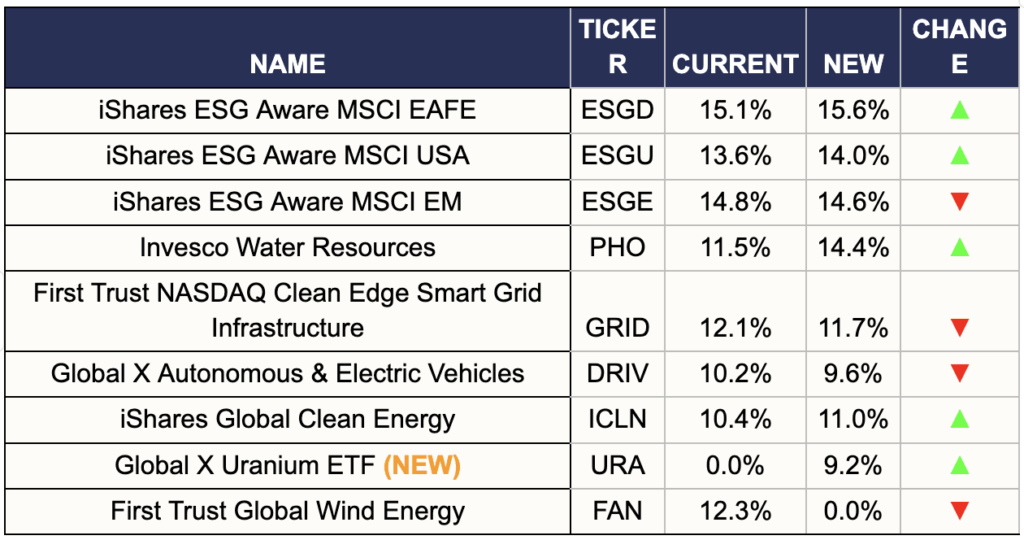
Broad ESG Aware Funds (ESGE, ESGD, ESGU)
Building the core with resilience: The foundation of the ESG & Clean Energy portfolio rests on a “core-satellite” approach. For the core, we selected the iShares ESG Aware MSCI EM (ESGE), EAFE (ESGD), and USA (ESGU) ETFs. These funds track benchmark indices while screening out controversial industries like civilian firearms and tobacco. In a world increasingly sensitive to supply chain ethics and regulatory scrutiny, these funds offer resilience. By tilting toward companies with better management of environmental and social risks, investors gain exposure to the broader market—including tech giants driving the AI boom—while maintaining a sustainable baseline that aligns with UN Sustainable Development Goals.
Global X Uranium ETF (URA)
Powering the AI and data center boom: As the world transitions from fossil fuels, nuclear energy has shifted from a debated alternative to a necessity—specifically for “baseload” power. The primary driver today is the explosive energy demand from Artificial Intelligence and data centers; major tech firms are actively seeking nuclear solutions to power their cloud infrastructure 24/7 without carbon emissions. The Global X Uranium ETF (URA) captures this “nuclear renaissance.” With governments extending reactor lifespans for energy security and the supply deficit for uranium widening, URA offers targeted access to the miners and component makers fueling this resurgence. Top holdings are Cameco Corp, Sprott Physical Uranium Trust, NexGen Energy Ltd.
iShares Global Clean Energy ETF (ICLN)
Capitalizing on policy tailwinds and rate cuts: The iShares Global Clean Energy ETF (ICLN) is a pure-play investment in the global transition to renewables. While the sector faced headwinds from high interest rates in previous years, the shifting monetary environment and continued government incentives (such as the U.S. Inflation Reduction Act) provide renewed momentum for solar and wind projects. ICLN focuses on the hardware essential for decarbonisation. This includes First Solar, which is expanding U.S. manufacturing capacity, and Vestas, a leader in wind turbines. As grid modernisation becomes urgent to handle new energy loads, these infrastructure providers are critical. Top holdings are First Solar, Enphase Energy, Vestas Wind Systems.
Invesco Water Resources ETF (PHO)
investing in the world’s most finite resource: Water scarcity is no longer just an environmental issue; it is an economic choke point affecting agriculture, semiconductor manufacturing, and data center cooling. The Invesco Water Resources ETF (PHO) is the largest ETF dedicated to water sustainability, holding companies that purify, conserve, and transport water. The portfolio benefits from industrial demand. For instance, top holding Ecolab provides water solutions essential for industrial cooling, while Xylem creates smart infrastructure to prevent water loss in aging municipal pipes. As urbanisation peaks, the “blue economy” is becoming a defensive growth play. Top holdings are Roper Technologies, Ferguson Enterprises, Ecolab, Xylem, Veralto Corp.
Global X Autonomous & Electric Vehicles ETF (DRIV)
The next phase of mobility: Software defined vehicles: The Global X Autonomous & Electric Vehicles ETF (DRIV) moves beyond just the “car chassis” to invest in the brain and heart of modern mobility: autonomous software and battery technology. While EV adoption rates fluctuate, the digitisation of transport is constant. This ETF captures the convergence of auto and tech. It holds Tesla, not just as a car maker but as a leader in autonomy data; Nvidia, whose chips power self-driving systems; and Alphabet, parent of Waymo. With Chinese EV makers pushing global competition and the U.S. focusing on domestic battery production, DRIV covers the entire geopolitical value chain. Top holdings are Tesla, Nvidia, Alphabet, Microsoft, Toyota Motor.
Incorporate ESG into your portfolio effortlessly
Syfe’s ESG & Clean Energy portfolio allows investors to seek sustainable outcomes while pursuing their financial goals. By targeting sectors with structural tailwinds like nuclear energy for AI, water scarcity solutions, and next-gen mobility the portfolio is positioned for modern growth trends.
Beyond ESG filters, the portfolio is optimised to achieve better risk-adjusted returns by selecting cost-efficient ETFs with the lowest tracking errors and decent AUM size. Our allocation strategy is also optimised for volatility to reduce the maximum drawdown of the portfolio.
This portfolio is ideal for investors who want to get into ESG investing or are looking for a “satellite” strategy to complement their core holdings, offering exposure to the specific themes shaping the next decade.
As with all Syfe portfolios, there are no lock-in periods, no brokerage fees, and no minimum investment. We fully manage the rebalancing and dividend reinvestment for you, ensuring your exposure remains optimised as market conditions change.
Now that you’re covered on the basics on ESG investing , it’s time to make your money work for you. Get started on sustainable investing in Singapore today.


You must be logged in to post a comment.