With London Stock Exchange (LSE) now available on Syfe Brokerage, explore how investing in London-listed stocks and ETFs can help Singapore investors diversify beyond the US, access global opportunities, and optimise long-term returns.
If your investment portfolio is heavily tilted toward US markets, you’re not alone. Many Singapore investors gravitate toward familiar names on stock exchanges like the New York Stock Exchange (NYSE) or Nasdaq.
However, relying too heavily on one market can expose you to concentration risk and potentially higher taxes.
An increasingly popular alternative is the LSE, one of the world’s most established exchanges where investors can access globally diversified, tax-efficient UCITS ETFs and a range of global companies. Investing in stocks and ETFs listed on the LSE not only provides the opportunity to diversify beyond the US stock exchange and optimise your investment portfolio, but can also improve long-term returns through lower dividend withholding taxes if you invest in UCITS ETFs.
Start investing in London-listed stocks and ETFs on Syfe Brokerage today.
Table of Contents
- What Is the London Stock Exchange and Why It Matters
- Why Many Investors Are Overweight US Stocks
- Why Consider the LSE for Your Investment Portfolio
- What You Can Trade on the LSE
- How LSE Investments Complement Your Existing Portfolio
- How to Buy LSE Stocks and ETFs in Singapore: A Step-by-Step Guide
- Conclusion
What Is the London Stock Exchange and Why It Matters
The London Stock Exchange is one of the world’s oldest and most established financial marketplaces. With thousands of securities listed—including stocks, bonds, and over 2,000 ETFs—it serves as a gateway to both European and global markets.
Investing in LSE-listed stocks can provide access to multinational giants such as Shell, Unilever, and HSBC. Beyond individual stocks, the exchange is especially attractive for its wide selection of UCITS ETFs, which are not typically available on US exchanges.
For Singapore investors, trading hours are also convenient, running from late afternoon into midnight (SGT), making it easier to invest after work.
Why Many Investors Are Overweight US Stocks
The dominance of indices like the S&P 500 has led many investors to concentrate heavily in US equities. While this has worked well historically, it also introduces risks like:
- Overexposure to a single economy
- Heavy weighting toward a few mega-cap tech companies
- Reduced diversification
A portfolio that’s too reliant on one market may struggle when that market underperforms.
Why Consider the LSE for Your Investment Portfolio
While US markets have delivered strong returns, many investors are now looking beyond them—and for good reason. Unlike US exchanges, the LSE features internationally diversified ETFs, making it easier to build a global portfolio on one exchange.
Adding LSE-listed securities and ETFs can help balance your portfolio in the following ways:
1. Reducing Overconcentration in US Markets
Indices like the S&P 500 dominate global portfolios, but they are heavily weighted toward a handful of large tech companies. This means your portfolio performance can become disproportionately tied to the performance of a small group of companies, which increases your risk if that sector underperforms.
Investing in LSE-listed securities and ETFs can help spread risk across different regions and industries. A variety of companies with different revenue drivers and economic cycles can help stabilise returns when US markets face volatility.
2. Lower Withholding Taxes
For Singapore-based investors, UCITS ETFs listed on the LSE can offer meaningful tax advantages, especially when investing in US equities. Since Singapore does not have a tax treaty with the United States, individuals investing directly in US-listed ETFs are typically subject to a 30% withholding tax on dividends. In contrast, many UCITS ETFs are domiciled in Ireland, which benefits from a favourable US tax treaty that reduces this rate to 15% at the fund level. As a result, investors can retain a larger portion of dividend income.
For instance, if you invest $100,000 in an ETF that generates $2,000 in annual dividends, a 30% withholding tax would reduce your income by $600. With a UCITS ETF benefiting from a 15% withholding tax instead, only $300 is deducted, so you get to retain an additional $300 each year.
3. Diversifying Currency
Investing solely in US markets doesn’t just concentrate your exposure in one country, it also ties a large portion of your portfolio to the US dollar. This creates currency concentration risk.
When your investments are heavily USD-denominated, your returns can be significantly impacted by exchange rate movements between USD and SGD. For example, even if your holdings in the S&P 500 perform well, a weakening USD against SGD could reduce your actual returns when converted back into Singapore dollars.
LSE-listed securities often trade in GBP, USD, or EUR. Over time, this multi-currency approach can help smooth out volatility caused by foreign exchange fluctuations and help mitigate currency risk. Instead of your entire portfolio rising or falling with USD movements, you get a more balanced exposure across global currencies, making your overall investment strategy more resilient.
What You Can Trade on the LSE
Global Blue-Chip Stocks: Companies such as Rolls-Royce Holdings, Shell, Unilever, and more generate revenue globally, giving you exposure beyond just the UK economy.
Exchange-Traded Funds (ETFs) that:
- Track global markets
- Focus on specific sectors
- Provide exposure to emerging economies
Many of these ETFs are structured to be more tax-efficient for international investors, making them especially attractive for Singapore-based portfolios.
LSE-listed UCITS ETFs offer:
- Lower dividend withholding taxes
- Access to accumulating ETF structures
- Broader global diversification
- Exposure beyond US-centric portfolios
For long-term investors, these advantages can translate into better risk-adjusted returns.
How LSE Investments Complement Your Existing Portfolio
A well-diversified portfolio often includes multiple regions. Rather than replacing US investments in your portfolio, LSE-listed ETFs can complement them.
Here’s how:
- Balance geographic exposure by including Europe and emerging markets or pairing a US-focused ETF with a global UCITS ETF. This also enhances resilience during different economic cycles.
- Capture global growth opportunities—especially beyond US mega-cap tech—by adding emerging market exposure
- Use accumulating ETFs to automate reinvestment. This allows you to weather market cycles and stick to your long-term strategy without getting distracted by short-term noise.
This approach reduces reliance on any single region and sector while improving resilience across market cycles.
Things To Know When Trading on the LSE
Scheduled vs Real-Time Orders
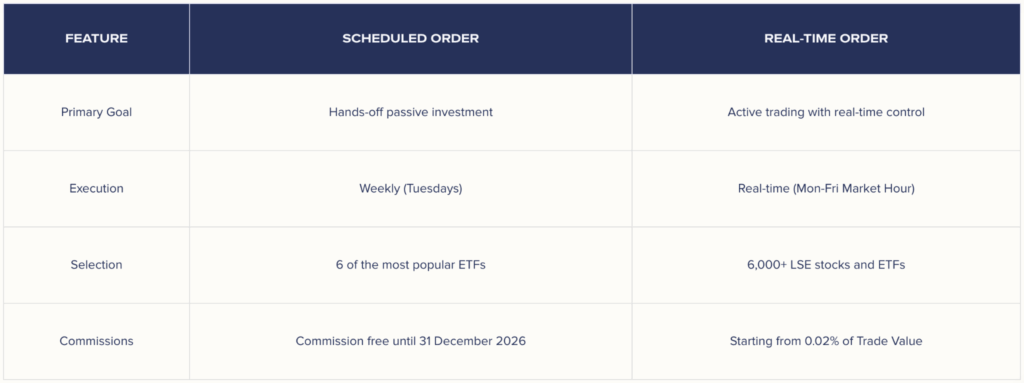
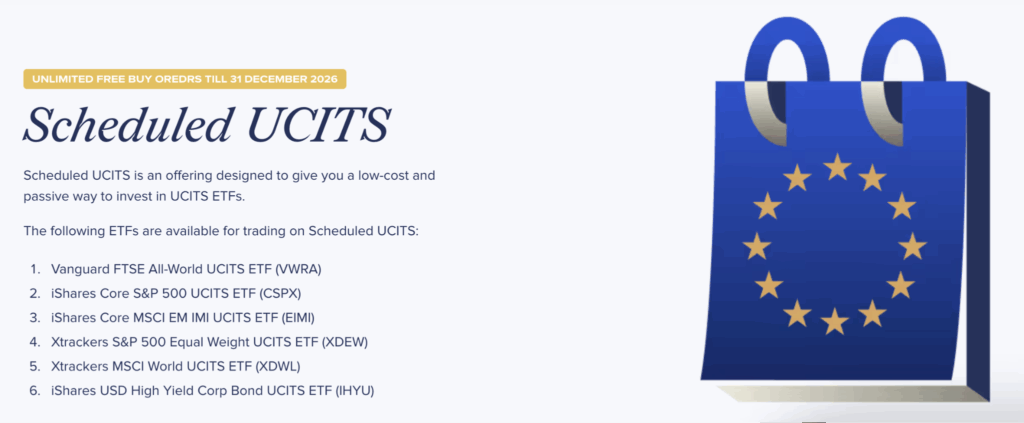
If you prefer a hands-off approach, scheduled orders complement a dollar-cost averaging strategy that lets you build your positions consistently over time. On the other hand, more active investors may prefer real-time orders to capitalise on market opportunities.
Fees and Trading Hours
What makes trading LSE-listed stocks and ETFs accessible and cost-efficient for Singapore investors is low trading fees and commission-free scheduled investments.
The LSE’s trading hours are late afternoon to midnight Singapore time, and the standard settlement cycle is T+2 days.
How to Buy LSE Stocks and ETFs in Singapore: A Step-by-Step Guide
1. Set up your brokerage account
Start by opening an account on Syfe Brokerage, which offers access to over 5,000 LSE-listed stocks and ETFs.
2. Choose your investment
Browse available stocks and ETFs based on your investment goals, whether you’re seeking growth, income, or diversification.
3. Place your order
You can choose between:
- Real-time orders – Executed instantly at market price
- Scheduled orders – Automated, commission-free trades at set intervals
4. Monitor and rebalance
Track your portfolio and adjust periodically to stay aligned with your investment strategy.
Conclusion
Investing beyond the US is no longer complicated or inaccessible. Investing in stocks and ETFs listed on the LSE can enable Singapore investors to unlock tax efficiencies with UCITS ETFs, diversify globally, and mitigate overconcentration risk.
Whether you’re just starting out in your equity investment journey or looking to optimise an existing portfolio, the London Stock Exchange is a compelling alternative worth considering.
LSE is now available on Syfe Brokerage.