

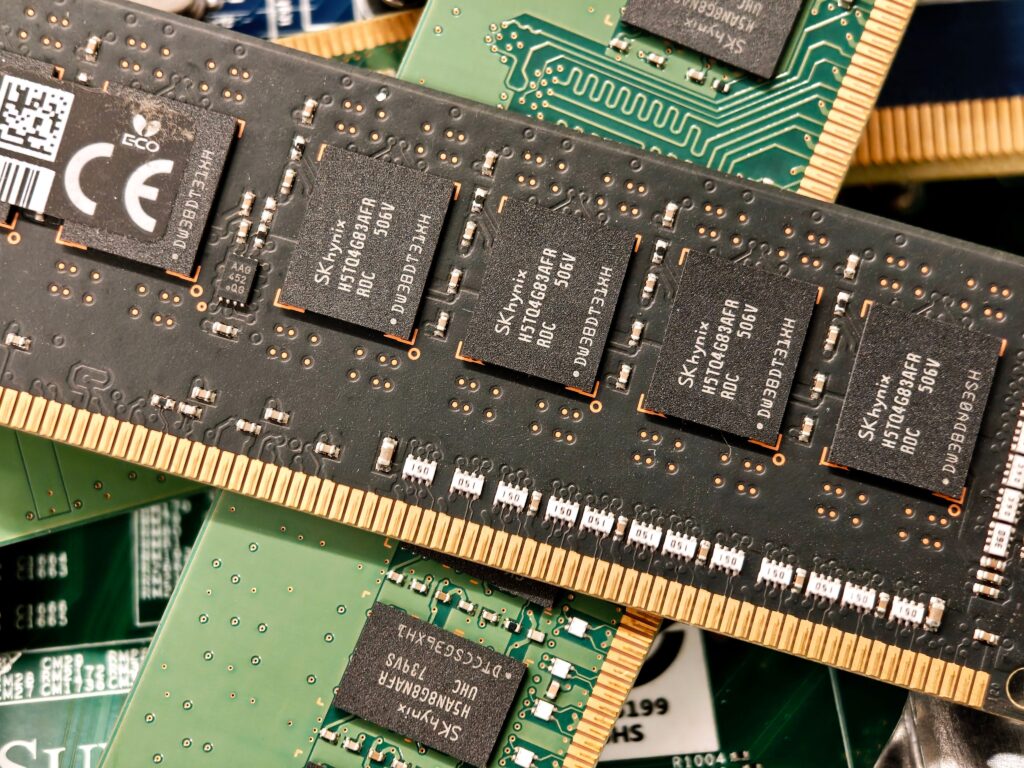
SK Hynix is preparing one of the biggest public listings in history, giving retail investors easier access to one of the world’s most important AI chipmakers. Here’s what the IPO means, why it’s attracting so much attention, and what investors should know.
AI investing has largely revolved around household names like Nvidia, Microsoft and Broadcom. But behind every AI accelerator is another critical component that receives far less attention: memory chips.
One company sits at the centre of that market—South Korea’s SK Hynix. It’s the world’s leading producer of high-bandwidth memory (HBM) chips—a critical component used alongside AI processors in data centres.
Now, through its upcoming Nasdaq listing, Singapore investors will have a simpler way to invest in one of the world’s leading AI memory chip manufacturers.
The listing has already attracted exceptionally strong investor demand, reflecting the market’s continued enthusiasm for AI-related businesses. It’s anticipated to raise around US$28 billion, making it one of the largest share offerings ever completed globally.
But size and popularity alone do not automatically make an investment attractive. Before deciding whether to buy the stock after it begins trading, retail investors should understand what SK Hynix actually does, why this listing matters, and what risks come with investing in one of the hottest companies in the semiconductor industry.
What is SK Hynix and What is the IPO About?
SK Hynix is one of the world’s largest semiconductor manufacturers, specialising in memory chips. Unlike companies that design AI processors, such as Nvidia, SK Hynix focuses on producing the memory that allows those processors to perform increasingly complex AI workloads.
Over the past several years, SK Hynix has emerged as the industry’s technology leader in high-bandwidth memory (HBM)—a specialised form of memory that delivers much faster data transfer speeds than conventional memory chips, enabling AI accelerators to process enormous amounts of information efficiently.
This leadership position has translated into rapid revenue growth, improving profitability and a significant increase in its market value.
The company plans to use the capital raised to expand manufacturing capacity, build new fabrication facilities and purchase advanced semiconductor equipment. Those investments are intended to help SK Hynix meet surging global demand for AI memory chips over the coming years.
Why SK Hynix’s Nasdaq IPO is Significant
The headline figure alone makes this listing remarkable. At approximately US$28 billion, it ranks among the largest public share offerings ever completed. But the significance extends beyond its size.
Memory chips gain importance
The IPO reflects how central memory chips have become in the AI ecosystem. Much of the attention surrounding artificial intelligence has focused on companies building AI models or designing GPUs. But without high-performance memory, even the fastest AI processors cannot operate efficiently. Memory has effectively become a critical bottleneck for AI infrastructure.
Exposure to the broader AI value chain
The listing gives global investors direct exposure to a different part of the AI value chain. Until now, many investors seeking exposure to AI semiconductors primarily bought companies like Nvidia, AMD or Micron. SK Hynix adds another option—one that specialises in a segment where demand continues to exceed supply.
Accessibility to a South Korean-based company
Previously, retail investors who wanted direct exposure to the company typically needed access to the Korean stock market, which wasn’t available through every brokerage platform and could involve additional costs.
Now, SK Hynix’s listing on the Nasdaq allows retail investors to invest in it without having to trade directly on the Korean stock exchange. With an American Depositary Receipt (ADR) —a US dollar-denominated certificate issued by a US bank that represents shares of a foreign company—investors can buy and sell foreign stocks on US exchanges without dealing with overseas brokers, cross-border currency conversions, or complex international regulations.
Higher trade liquidity
A US listing may also increase trading liquidity, attract broader analyst coverage, and potentially lead to inclusion in major semiconductor indices over time, which could bring additional demand from institutional and passive investors.
The IPO demonstrates that investors are still willing to back companies seen as long-term beneficiaries of AI, even amid concerns about whether the sector’s rapid growth can continue indefinitely. Strong demand for the offering suggests confidence that AI infrastructure spending will remain robust for years, although expectations are now correspondingly high.
Key Opportunities and Risks for Investors
On the positive side, the company is widely regarded as a technology leader in HBM, and demand for AI memory continues to outstrip available supply. If investment in AI infrastructure remains strong, SK Hynix could continue benefiting from higher sales volumes and favourable pricing.
The proceeds from the IPO are also being invested back into the business rather than simply allowing existing shareholders to cash out. Expanding manufacturing capacity could strengthen the company’s competitive position over the longer term.
However, investors should also recognise that semiconductor memory has historically been one of the industry’s most cyclical businesses. Prices can swing dramatically depending on supply and demand, and periods of rapid expansion are often followed by oversupply and weaker profitability.
Valuation is another important consideration. Much of the optimism surrounding AI has already been reflected in semiconductor share prices over the past two years. When expectations become elevated, companies must continue delivering exceptional results just to justify current valuations.
Retail investors should also expect heightened volatility immediately after the listing. Large IPOs often experience significant price swings during their first few weeks of trading as institutional investors build or reduce positions and the market settles on a fair valuation.
Rather than focusing solely on first-day price movements, long-term investors may want to monitor several key indicators:
- Whether demand for AI infrastructure remains strong
- Growth in HBM production capacity
- Margins and profitability as new factories come online
- Competition from Samsung Electronics, Micron and emerging memory technologies
- Management’s execution on its expansion plans.
SK Hynix gives investors with a diversified portfolio and a long investment horizon the exposure to one of the foundational technologies enabling AI. However, ADRs come with the risks of currency fluctuations (the home currency dropping against the dollar), geopolitical instability (sudden changes in foreign laws), and administrative fees. It should therefore be viewed as one component of a broader investment strategy rather than a guaranteed winner.
Where can you invest?
Once the American Depositary Receipts begin trading on Nasdaq, retail investors will be able to buy SK Hynix just like any other US-listed stock.
If you’re investing through Syfe Brokerage, you’ll be able to access the listed shares after trading commences, alongside thousands of other US-listed companies and ETFs.
As with any newly listed company, consider whether the investment fits your overall financial goals, risk tolerance and portfolio diversification strategy before placing an order. It may also be worth observing how the stock trades during its first few sessions before making a decision.
Conclusion
SK Hynix sits at the heart of one of the fastest-growing areas of semiconductor technology, supplying the advanced memory that powers modern AI systems. Its Nasdaq debut represents a milestone for the AI investment landscape, giving global retail investors easier access to a business that was previously more difficult to own, while also highlighting the growing importance of memory chips in the AI ecosystem.
However, investors should remember that even exceptional companies can become overvalued when enthusiasm runs high. Semiconductor cycles remain unpredictable, competition continues to intensify and newly listed stocks can experience significant short-term volatility.
Rather than focusing on short-term price movements in the newly listed shares, investors should evaluate SK Hynix through a long-term lens, understanding its competitive position, monitoring industry trends, and considering how it fits within a diversified portfolio.
Read More:
- Don’t (Just) Hug the Index: Three Reasons to Go Beyond Passive ETFs
- How to Protect Your Investment Portfolio When the Stock Market Dips
- London Stock Exchange (LSE) Now On Syfe Brokerage: A Practical Investing Guide
- CSPX vs VWRA vs IWDA vs SPYL vs VUAA: Which UCITS ETFs to Invest In?
- Fractional Trading in Singapore: A More Accessible Way to Buy US Stocks
- How To Buy US Stocks: A Beginner’s Guide
Disclaimer
This content is for general information only and should not be viewed as financial advice. It is not meant to market any specific investment, or offer or recommend the purchase or sale of any specific investment product or security. Syfe makes no representations and gives no warranties about the accuracy or suitability of any information provided. All forms of investments carry risks, including the risk of losing all of the invested amount. You should carefully consider whether any investment views and products/ services are appropriate in view of your personal investment experience, objectives, financial resources, and relevant circumstances. You may wish to seek financial advice through a financial advisor or the Syfe platform [remove reference to Syfe platform if Brokerage] and/or independent legal, accounting, regulatory or tax advice, where appropriate and/or necessary.
This article has not been reviewed by the Monetary Authority of Singapore.


