


The stock market has been on a rollercoaster ride this past year, with equities hitting all-time highs and plunging upon tariff and Fed rate announcements, geopolitical events and Fed chair nomination, among other news. If you’re riding out the volatility, dividend investing can be a way to counter the wild market swings and improve your portfolio performance.
Dividend stocks provide two sources of returns:
- income from dividend payments
- capital appreciation of the stock price.
Together, these two components form an investment’s total return. Dividends, when reinvested, can boost your total returns over time. Case in point: Over the past 30 years, the total return for the S&P 500 (which includes dividends reinvested) has significantly outstripped the price return of the index (i.e. growth in price only).
Table of Contents
- What is a dividend?
- How often are dividends paid?
- Is dividend investing a good strategy?
- S&P 500 total return vs price return
- Dividend investing for stock returns
- How to pick dividend stocks?
- Best Singapore blue-chip stocks
- Invest in dividend stocks with Syfe Brokerage
What is a dividend?
Dividends are payments made to investors as a form of profit-sharing. Not all companies pay dividends. Young, fast-growing companies rarely pay dividends; the cash is reinvested into the business to fuel growth.
Established companies in mature industries don’t need to reinvest as much money. Thus, they are more likely to pay out dividends to reward shareholders and encourage them to continue holding the stock.
How often are dividends paid?
Dividend-paying companies often do so on a fairly consistent basis. Depending on the company, dividends can be paid out quarterly, semi-annually or annually.
However, do note that dividend payments are not guaranteed. They can be reduced or even removed at any time. That said, companies usually try to maintain their dividends. If they fail to do so, investors tend to devalue the stock, leading to a fall in share price.
You can find a stock’s upcoming dividend payout on the company’s website.
Is dividend investing a good strategy?
Dividend investing comes with multiple upsides:
- Consistent passive income
- Dividend compounding
- Portfolio diversification — many dividend-paying companies come from diverse sectors such as consumer staples, energy, healthcare, and financials.
Historically, dividend-paying stocks also tend to be less volatile than other stocks. Amid sell-offs, dividend stocks tend to decline significantly less than the broader S&P 500.
With the Federal Reserve reducing interest rates poised to continue with its aggressive rate hikes to tame inflation, there may be little end to market volatility in sight. Dividends could potentially stabilise the total returns of your stock portfolio while offering extra income. Additionally, quality dividend-paying companies tend to continue with their dividend payouts, regardless of market conditions.
S&P 500 total return vs price return
Looking at historical data from the 1940s to February 2025 (below), dividends have accounted for approximately 40% of total stock returns.
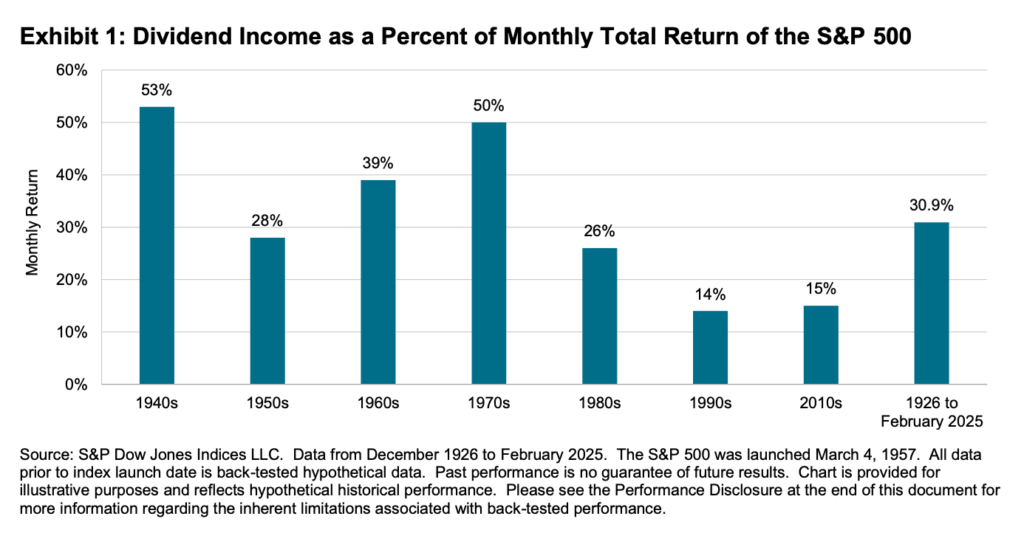
Image credit: S&P Global
Dividend investing for stock returns
Here’s another way to look at dividend stocks. Imagine that you own a dividend-paying stock and the price drops 3% that year—but the annual dividend yield is 5%. The dividend acts as a cushion to offset the fall in share price and improves your total return to 2%.
The benefit of dividend investing is such that even if the stock price tumbles, you’d still be receiving a steady stream of income from your dividends as long as the company continues to pay them out.
Dividends also come in handy when markets rise. Say the stock price rises 3% in a year and the dividend yield that year is 5%. Your total return is 8%, assuming your dividend is reinvested into the stock.
How to pick dividend stocks
First, we need to understand the key metrics to look at.
Dividend Yield: This is the dividend expressed as a percentage of a current share price. It’s crucial to balance the dividend yield with the company’s ability to sustain such payouts in the long term. Stocks with a solid history of dividend growth often have stable profitability and a stronger commitment to return value to shareholders.
Payout Ratio: This is the proportion of earnings paid to shareholders as dividends. A lower payout ratio may suggest that a company has potential to grow its dividends, but the company’s debt-to-equity ratio also matters—a lower debt-to-equity ratio indicates better financial health and a more sustainable dividend policy.
Share Price Performance: The stock’s price performance over the past 12 months can provide insights to the company’s current market standing and growth potential. Debt levels and long-term profitability can also help an investor assess the company’s viability and stability.
Generally, you’d want to pick dividend stocks that can offer you steady, attractive income for the long term. Look out for companies that have been paying (or even raising) dividends consistently over many years.
Tips for Strategic Selection
- Historical Dividend Performance: Opt for companies with a history of maintaining or increasing dividends. This consistency is a good sign of their financial health and shareholder value.
- Dividend Dates and Yield: Look at the ex-dividend date to check eligibility for dividends, and the dividend yield to assess a company’s current attractiveness.
- Financial Health: Refer to Financial data platforms that show a company’s essential metrics, such as debt-to-equity ratio and long-term profitability. A strong financial foundation is essential for sustaining dividend payments.
- Economic and Industry Trends: Take into account sector-specific trends, government policies, and other broader economic conditions when you select your stocks. Economic resilience and growth potential in a company’s industry are important factors that affect its value.
Best Singapore Blue-Chip Stocks (2026): Earnings and Dividends
Singapore’s blue-chip stocks are core holdings for many long-term investors. From banks to telcos, real estate, and infrastructure, these companies anchor the Straits Times Index (STI) and play a major role in regional capital markets.
Here’s a closer look at how 10 of Singapore’s largest listed companies have performed recently, and what their results may signal heading into 2026.
Top Dividend Stocks in Singapore (Feb 2026)
| Company | Ticker | Trailing 12 months Dividend |
| DBS Group Holdings Ltd. | D05 | 4.81% |
| United Overseas Bank Ltd. | U11 | 5.90% |
| OCBC | O39 | 4.62% |
| Singapore Telecommunications | Z74 | 3.86% |
| Singapore Exchange Limited | S68I | 2.23% |
| CapitaLand Investment Limited | 9CI | 3.85% |
| Keppel Corporation Limited | BN4 | 3.11% |
| ST Engineering | S63 | 1.75% |
| Great Eastern | G07 | 4.47% |
| Haw Par | H02 | 8.36% |
Source: dividends.sg and Yahoo Finance, as of 5 Feb 2026
Read Also: Best Dividend Stocks in Singapore
Do note that a stock with a very high dividend yield may not always be the right choice. That’s because a high dividend yield can be achieved not just by a higher dividend payout but also share price declines. Poor earnings or company mismanagement, for example, can trigger a sell-off.
Ultimately, the best dividend stocks for your portfolio will depend on your investment goals, risk appetite, and investing timeline.
Not confident picking single stocks? You can also consider exchange traded funds (ETFs) for greater diversification. Some examples of dividend ETFs include SPDR S&P Dividend ETF (SDY) and Vanguard Dividend Appreciation ETF (VIG).
Invest in Dividend Stocks with Syfe Brokerage
At Syfe Brokerage, we offer fractional trading, so you can still get your hands on your favourite stocks even though you might not be able to buy a whole share. You can also invest on autopilot with our auto-invest feature that allows you to schedule buy orders at any dollar value or share count. You can also set your preferred frequencies—be it monthly, weekly or even daily—as part of your dollar-cost averaging strategy.
Ready to start building your dividend stocks portfolio in Singapore with Syfe? It’s easy to get started:
- Download the Syfe app: Get the Syfe app on your mobile device to begin your investing journey.
- Open a brokerage account: Quickly and easily set up your Syfe Brokerage account directly through the app.
- Explore dividend stocks: Browse a wide selection of global and Singapore dividend stocks, all within the Syfe platform, to find the best one for your risk profile.
- Make your first trade: Execute your trades seamlessly and securely with Syfe’s intuitive trading interface.


